477 posters, 14 topics, 2,065 authors, 1,055 institutions
ePostersLive by SciGen Technologies S.A. All rights reserved.
The Joint EBJIS-MSIS 2026 Conference
17 - 19 September, 2026 | Porto, Portugal

PP34
Arthroscopic Versus Open Irrigation and Debridement for Acute Shoulder Septic Arthritis: A Propensity-Matched Retrospective Cohort Study
Poster Presenter
Authors
Alireza Mirahmadi, Arun Ramappa, Ara Nazarian, Edward Rodriguez, Jason Young
Affiliations
Part of Topic
Miscellaneous
Introduction:
Materials and Methods:
Results:
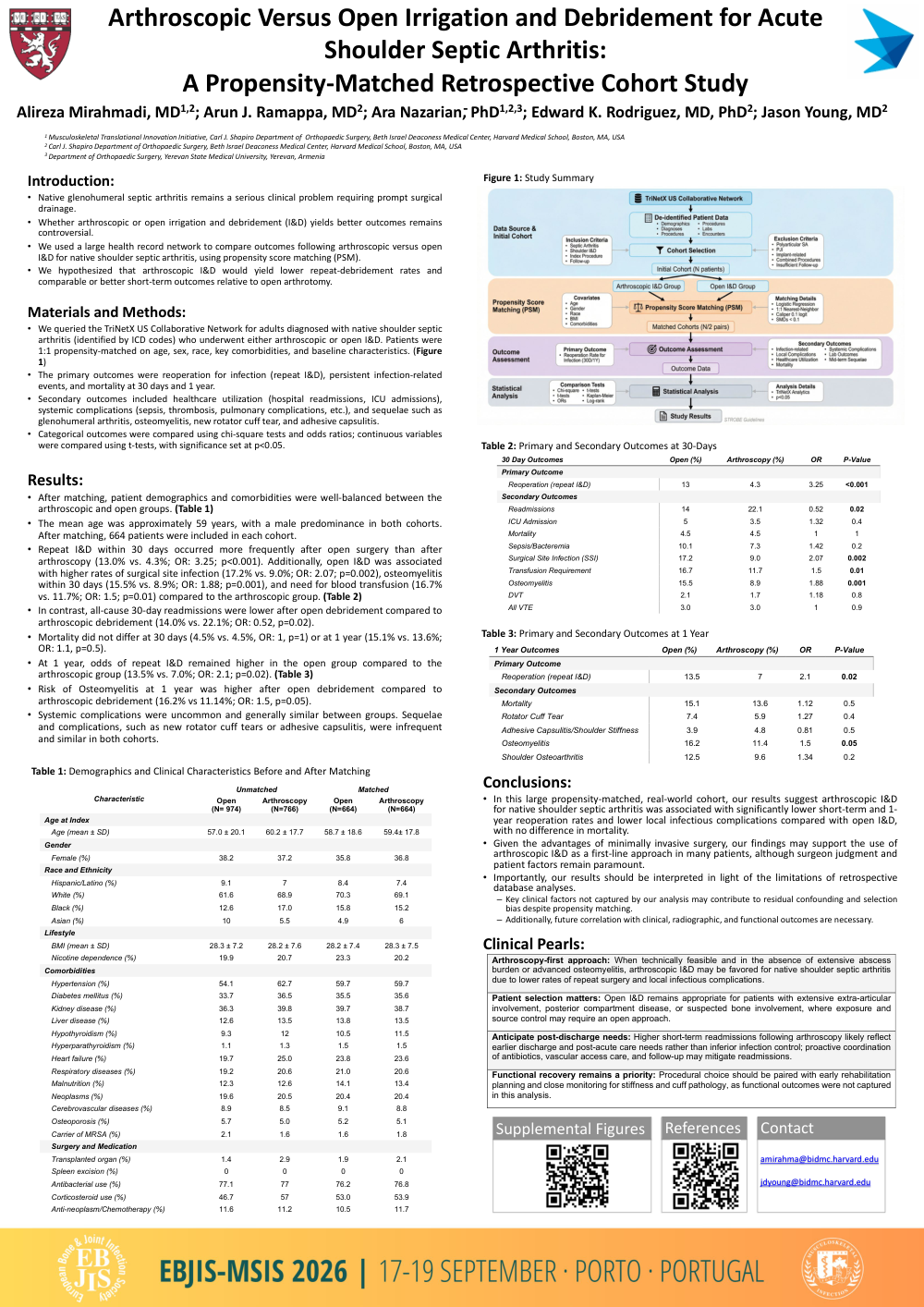
After matching, patient demographics and comorbidities were well-balanced between the arthroscopic and open groups. (Table 1)
The mean age was approximately 59 years, with a male predominance in both cohorts. After matching, 664 patients were included in each cohort.
Repeat I&D within 30 days occurred more frequently after open surgery than after arthroscopy (13.0% vs. 4.3%; OR: 3.25; p<0.001). Additionally, open I&D was associated with higher rates of surgical site infection (17.2% vs. 9.0%; OR: 2.07; p=0.002), osteomyelitis within 30 days (15.5% vs. 8.9%; OR: 1.88; p=0.001), and need for blood transfusion (16.7% vs. 11.7%; OR: 1.5; p=0.01) compared to the arthroscopic group. (Table 2)
In contrast, all-cause 30-day readmissions were lower after open debridement compared to arthroscopic debridement (14.0% vs. 22.1%; OR: 0.52, p=0.02).
Mortality did not differ at 30 days (4.5% vs. 4.5%, OR: 1, p=1) or at 1 year (15.1% vs. 13.6%; OR: 1.1, p=0.5).
At 1 year, odds of repeat I&D remained higher in the open group compared to the arthroscopic group (13.5% vs. 7.0%; OR: 2.1; p=0.02). (Table 3)
Risk of Osteomyelitis at 1 year was higher after open debridement compared to arthroscopic debridement (16.2% vs 11.14%; OR: 1.5, p=0.05).
Systemic complications were uncommon and generally similar between groups. Sequelae and complications, such as new rotator cuff tears or adhesive capsulitis, were infrequent and similar in both cohorts.
Conclusions:
In this large propensity-matched, real-world cohort, our results suggest arthroscopic I&D for native shoulder septic arthritis was associated with significantly lower short-term and 1-year reoperation rates and lower local infectious complications compared with open I&D, with no difference in mortality.
Given the advantages of minimally invasive surgery, our findings may support the use of arthroscopic I&D as a first-line approach in many patients, although surgeon judgment and patient factors remain paramount.
Importantly, our results should be interpreted in light of the limitations of retrospective database analyses.
Key clinical factors not captured by our analysis may contribute to residual confounding and selection bias despite propensity matching.
Additionally, future correlation with clinical, radiographic, and functional outcomes are necessary.