477 posters, 14 topics, 2,065 authors, 1,055 institutions
ePostersLive by SciGen Technologies S.A. All rights reserved.
The Joint EBJIS-MSIS 2026 Conference
17 - 19 September, 2026 | Porto, Portugal

PP26
From Probability to Action: Patient-Specific Thresholds for Diagnosing Chronic Prosthetic Joint Infection
Poster Presenter
Authors
Alvaro Ayala, Daisuke Furukawa, Derek Amanatullah, Natalie Medvedeva, Elizabeth Thottacherry
Affiliations
Division of Infectious Diseases & Geographic Medicine, Stanford University School of Medicine, Stanford, United States, Division of Orthopedic Surgery, Stanford University School of Medicine, Stanford, United States
Part of Topic
Infectious Diseases
From Probability to Action: Patient-Specific Thresholds for Diagnosing Chronic Prosthetic Joint Infection
Authors: Alvaro Ayala1, Daisuke Furukawa1, Derek F. Amanatullah2, Natalie Medvedeva1, Elizabeth Thottacherry1
1Division of Infectious Diseases & Geographic Medicine, Stanford University School of Medicine, Stanford, CA
2Division of Orthopedic Surgery, Stanford University School of Medicine, Stanford, CA
Background
Diagnosing chronic prosthetic joint infection (PJI) relies on diagnostic frameworks that combine inflammatory markers such as serum c-reactive protein (CRP), synovial leukocyte esterase (LE), synovial white blood cell count (sWBC), and percent polymorphonuclear neutrophils (PMN%). Combining similar tests like this can falsely elevate diagnostic confidence. Bayesian inference handles this by discounting redundant tests and carrying uncertainty forward instead of compounding it. When paired with a Pauker-Kassirer decision-threshold model, post-test probability of infection translates to patient tailored action thresholds (“stop testing,” “keep testing,” or “treat”). We applied this approach to the work-up of chronic PJI.
Methods
We built a literature-based Bayesian decision model using sensitivities and specificities for CRP, LE, sWBC, and PMN% from published systematic reviews. A PyMC Bayesian model calculated post-test probabilities while accounting for uncertainty in pretest probability, test accuracy, and lab correlation. Action thresholds were calculated using the Pauker-Kassirer method, which weighs the harms of missing a PJI, additional testing, and treating non infected patient across three patient profiles : 1) a reference healthy patient 2) a frail multimorbid patient, and 3) a patient already undergoing revision or reimplantation surgery.
Results
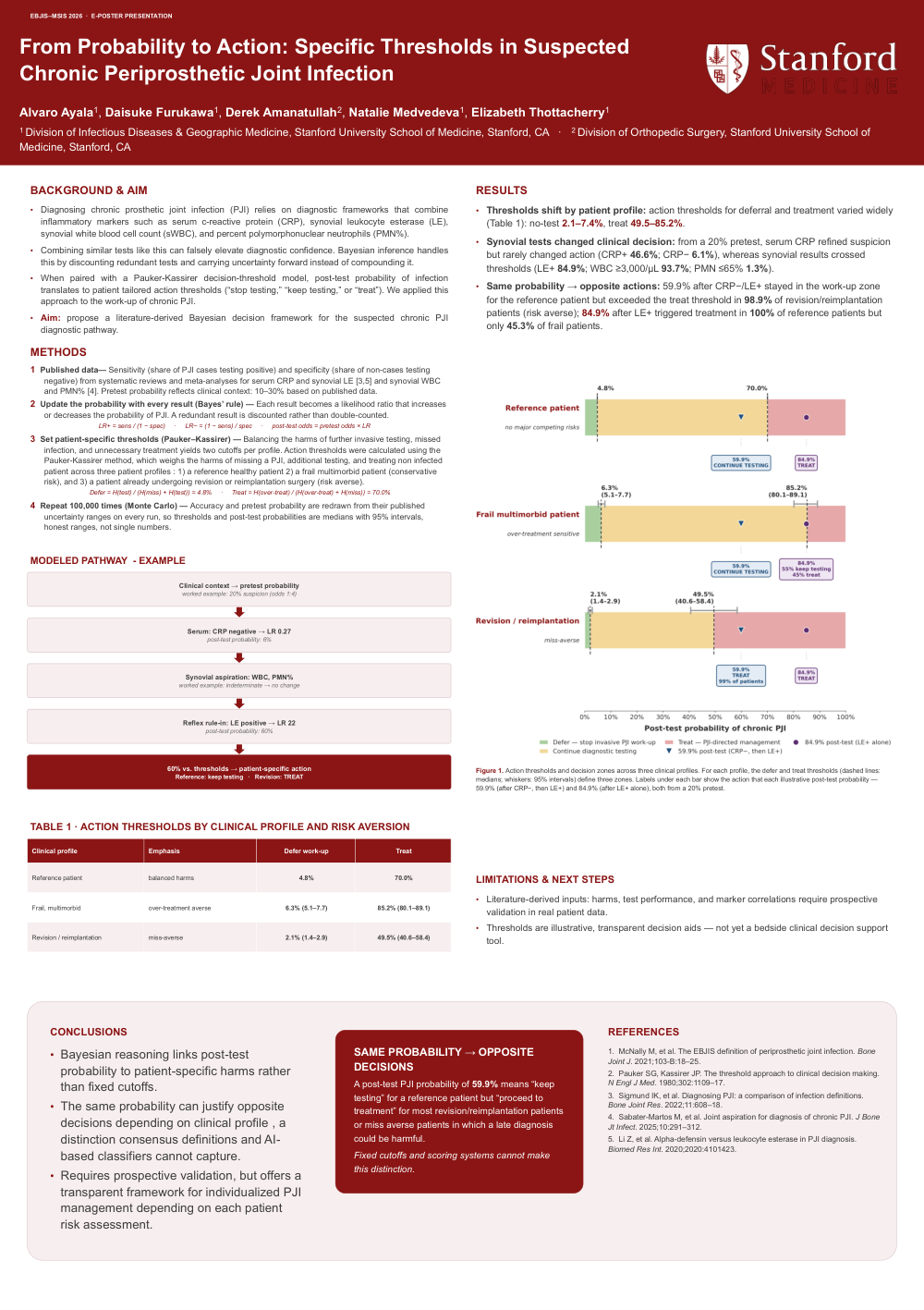
Action thresholds varied between patients with “stop testing” and “treat” thresholds ranging from 2.1-7.4% and 49.5-85.2%, respectively (Figure 1). CRP results by itself (positive or negative) rarely affected the action threshold (post-test probability 46.6% if positive, 6.1% if negative and still in the gray zone ). Synovial fluid results were more decisive as a positive LE raised probability to 84.9% and a sWBC ≥ 3,000/µL raised it to 93.7% while a PMN% ≤ 65% dropped it to 1.3%. Critically, the same post-test probability led to opposite decisions in different patients. A probability of 59.9% after CRP−/LE+ sat in the “keep testing” zone for the reference patient but exceeded the “treat” threshold in 98.9% of revision/reimplantation cases. A probability of 84.9% after LE+ triggered treatment in 100% of reference patients but only 45.3% of frail patients, as harm of treatment influenced the action threshold.
Conclusions
The optimal threshold for PJI intervention depends on patient risk and test characteristics. Unlike fixed criteria, Bayesian reasoning integrates both to justify different clinical actions for the same test result. Our model provides a transparent, surgeon-usable framework for individualized PJI decision-making.
References
1. McNally. Bone Joint J. 2021;103-B:18–25.
2. Pauker. N Engl J Med. 1980;302:1109–1117.
3. Sigmund. Bone Joint Res. 2022;11:608–618.
4. Sabater-Martos. J Bone Jt Infect. 2025;10:291–312.
5. Li. Biomed Res Int. 2020;2020:4101423.