477 posters, 14 topics, 2,065 authors, 1,055 institutions
ePostersLive by SciGen Technologies S.A. All rights reserved.
The Joint EBJIS-MSIS 2026 Conference
17 - 19 September, 2026 | Porto, Portugal

PP03
Potential Utility of Syndrome Specific Antibiograms for Lower Extremity Infections
Poster Presenter
Authors
Eli Wilber, Paulina Rebolledo, Sheetal Kandiah, Yun F Wang, Susan Ray, Marcos Coutinho Schechter
Affiliations
Emory University School Of Medicine, Division of Infectious Diseases, Emory University School Of Medicine, Atlanta, United States; Grady Health System, Atlanta, United States, Division of Infectious Diseases, Emory University School Of Medicine, Atlanta, United States; Grady Health System, Atlanta, United States; Hubert Department of Global Health, Rollins School of Public Health, Emory University, Atlanta, United States, Grady Health System, Atlanta, United States; Department of Pathology and Laboratory Medicine, Emory University School of Medicine, Atlanta, United States
Part of Topic
Antibiotics
Introduction & Aim:
Obtaining high quality cultures from diabetic lower extremity wounds can be clinically challenging and these infections are often treated empirically. Many institutions use antibiogram data to inform empiric antimicrobial selection. The accuracy of using syndromic agnostic antibiogram data to predict the susceptibility of pathogens from diabetic lower extremity infections has not been well studied. We used institutional data to examine the correlation between a lower-extremity specific antibiogram and a generalized non-urine antibiogram for Enterobacterales isolates.
Methods:
A syndrome specific antibiogram was created using the customizable reporting tools available within the Epic electronic health record (EHR). Isolates were included if the specimen sourcecontained “toe” or “foot”.Only one isolate of a species per patient per 90-day period was used. Patients could have multiple isolates of the same species included in the study if they were collected >90 days apart. This analysis includes cultures collected between April 1, 2025 and March 31, 2026. Proportions were compared using the two proportion z-test in RStudio (R version 4.4.1).
Results:
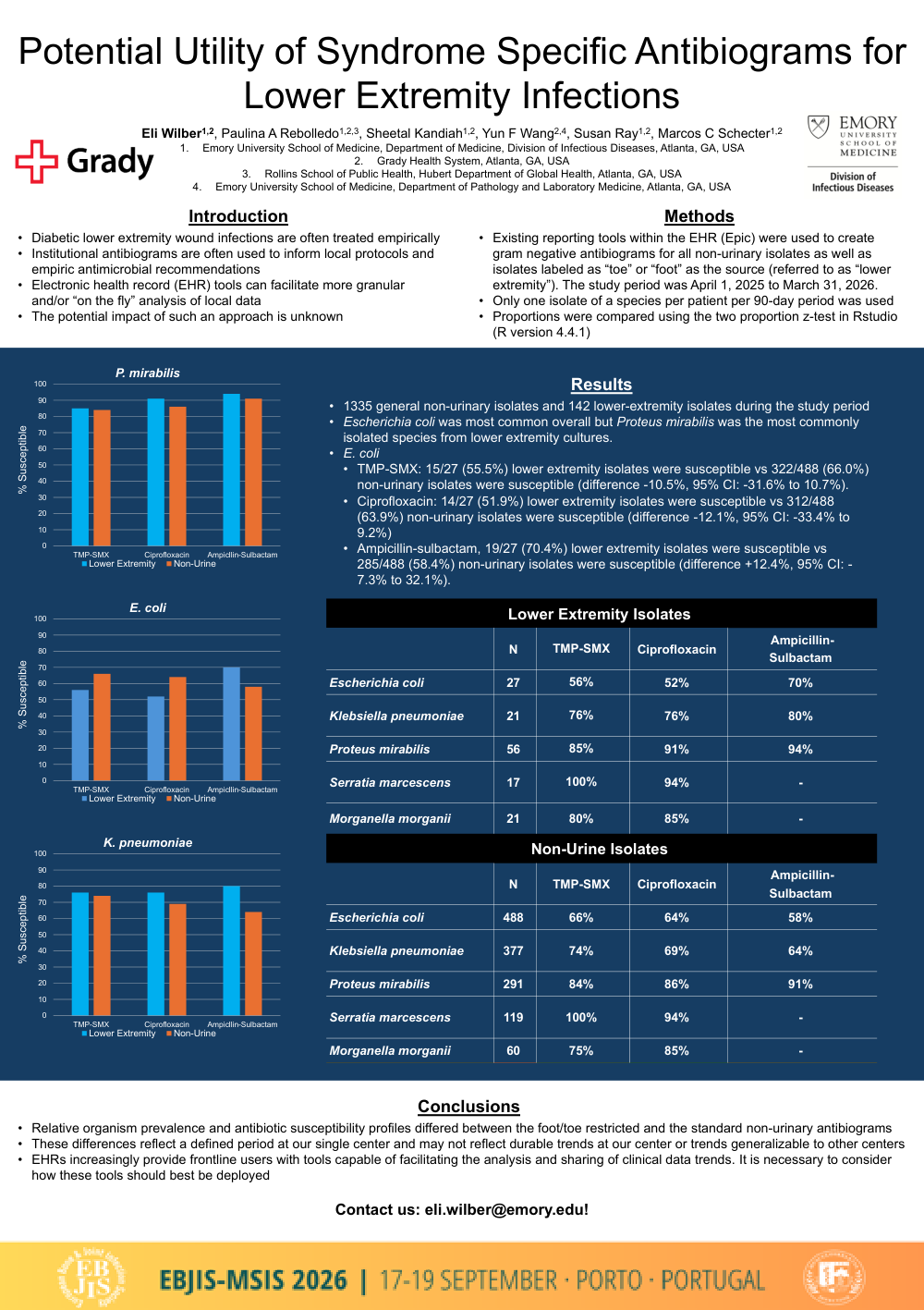
There were 1335 general non-urinary isolates and 142 lower-extremity isolates during the study period; Escherichia coli was most common overall but Proteus mirabilis was most commonly isolated from lower extremity cultures. The majority (~80%) of isolates were from patients with a diagnosis of diabetes.E. coli had notable differences between lower extremity and all non-urine isolates specifically for trimethoprim/sulfamethoxazole (TMP-SMX), ciprofloxacin, and ampicillin-sulbactam. For TMP-SMX, 15/27 (55.5%) lower extremity isolates were susceptible while 322/488 (66.0%) non-urinary isolates were susceptible (difference -10.5%, 95% CI: -31.6% to 10.7%). For ciprofloxacin, 14/27 (51.9%) lower extremity isolates were susceptible while 312/488 (63.9%) non-urinary isolates were susceptible (difference -12.1%, 95% CI: -33.4% to 9.2%). For ampicillin-sulbactam, 19/27 (70.4%) lower extremity isolates were susceptible while 285/488 (58.4%) non-urinary isolates were susceptible (difference +12.4%, 95% CI: -7.3% to 32.1%).
Conclusions:
We observednumerically different susceptibility rates for multiple Enterobacterales species when comparing lower extremity isolates versus a standard non-urinary antibiogram. These discrepancies could be related to small sample sizes and multiple comparisons. However, if confirmed in larger cohorts, these findings could have implications for empiric therapy selection. As EHRs increasingly provide frontline users with customizable tools for clinical data analysis, it will be necessary to determine how these tools can best be deployed.