477 posters, 14 topics, 2,065 authors, 1,055 institutions
ePostersLive by SciGen Technologies S.A. All rights reserved.
The Joint EBJIS-MSIS 2026 Conference
17 - 19 September, 2026 | Porto, Portugal

PP01
Empirical antibiotic therapy in early postoperative orthopedic infections: differences in antimicrobial susceptibility across anatomical sites
Part of Topic
Antibiotics
BACKGROUND
At Sint Maartenskliniek, a tertiary referral center for orthopedic infections with a high volume of revision surgery and DAIR procedures, we observed that the recently introduced Dutch recommendations for empirical treatment of acute PJI (vancomycin plus ceftriaxone) differed substantially from our previous regimen of cefazolin monotherapy. This raised the question of whether broader empirical therapy was justified by our local microbiological profile. We therefore evaluated this in early postoperative orthopedic infections, including prosthetic and non-prosthetic infections.
AIM
To evaluate local microbiological epidemiology and antimicrobial susceptibility in early postoperative orthopaedic infections and to assess the empirical coverage of cefazolin monotherapy vs vancomycin–ceftriaxone vs vancomycin–ciprofloxacin, overall and across anatomical sites.
METHODS
Retrospective, single-centre cohort study at Sint Maartenskliniek, Nijmegen, the Netherlands.
Early postoperative orthopaedic infections (≤90 days) treated between January 2022 and January 2025.
Included implant-related and non-implant-related infections.
Empirical coverage was assessed for cefazolin monotherapy, vancomycin–ceftriaxone, and vancomycin–ciprofloxacin, overall and by anatomical site, using observed antimicrobial susceptibility data.
RESULTS
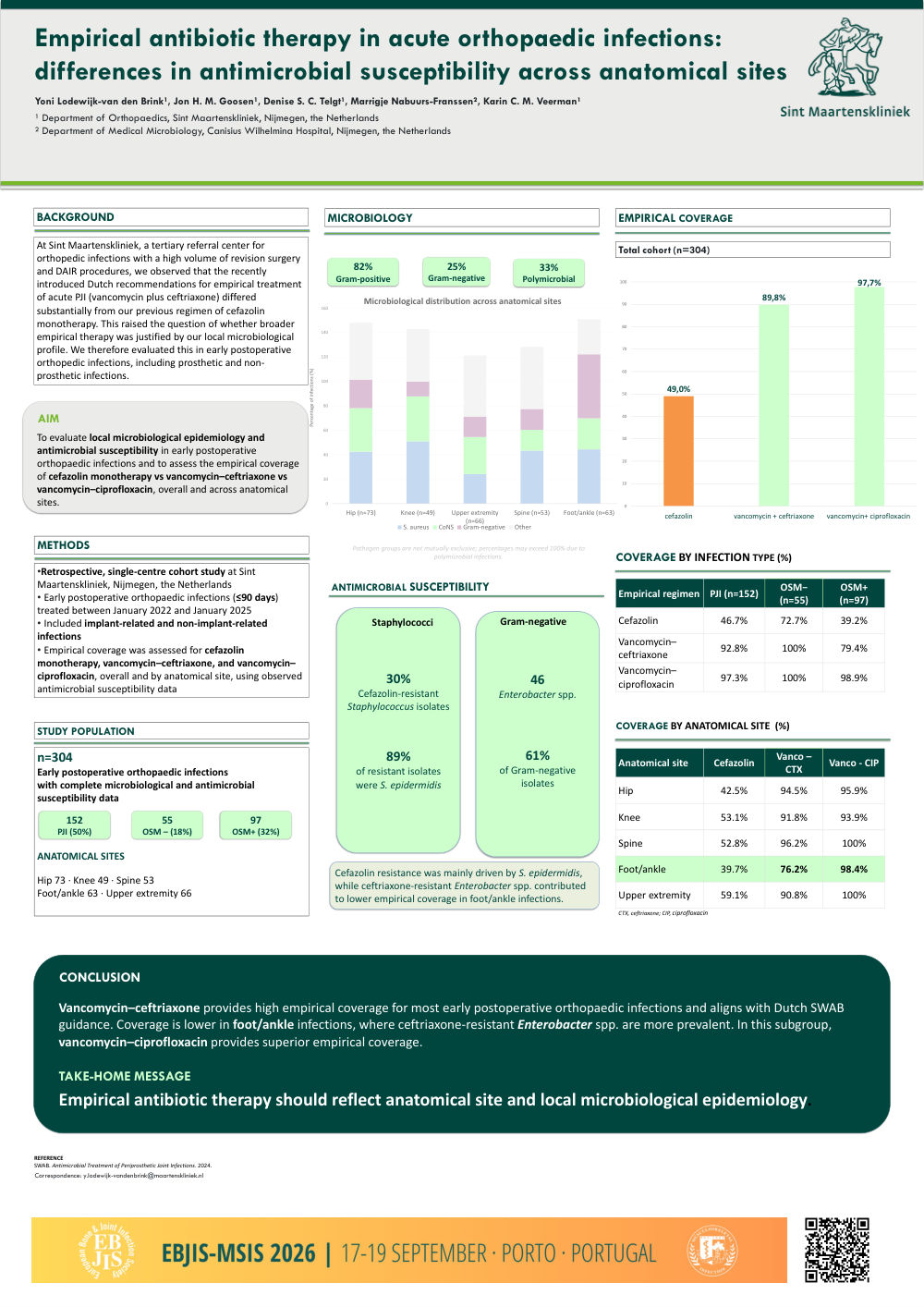
The study included 304 early postoperative orthopaedic infections with complete microbiological and antimicrobial susceptibility data: 152 PJI (50%), 55 OSM− (18%), and 97 OSM+ (32%).
Anatomical sites were hip (n=73), knee (n=49), spine (n=53), foot/ankle (n=63), and upper extremity (n=66).
Overall empirical coverage was 49.0% for cefazolin, 89.8% for vancomycin–ceftriaxone, and 97.7% for vancomycin–ciprofloxacin.
Cefazolin resistance was mainly driven by S. epidermidis, while ceftriaxone-resistant Enterobacter spp. contributed to lower empirical coverage in foot/ankle infections. In foot/ankle infections, empirical coverage was 39.7% for cefazolin, 76.2% for vancomycin–ceftriaxone, and 98.4% for vancomycin–ciprofloxacin.
CONCLUSION
Vancomycin–ceftriaxone provides high empirical coverage for most early postoperative orthopaedic infections and aligns with Dutch SWAB guidance. Coverage is lower in foot/ankle infections, where ceftriaxone-resistant Enterobacter spp. are more prevalent. In this subgroup, vancomycin–ciprofloxacin provides superior empirical coverage.
TAKE-HOME MESSAGE
Empirical antibiotic therapy should reflect anatomical site and local microbiological epidemiology.