477 posters, 14 topics, 2,065 authors, 1,055 institutions
ePostersLive by SciGen Technologies S.A. All rights reserved.
The Joint EBJIS-MSIS 2026 Conference
17 - 19 September, 2026 | Porto, Portugal

EP482
Management and outcome of native spinal infection via COpAT at a UK Teaching Hospital: A retrospective audit against IDSA guidelines
Part of Topic
Spinal Infections
Native spinal infections, including spondylodiscitis and facet joint septic arthritis carry significant mortality and morbidity. Evidence underpinning accepted best practice remains limited.
This study aimed to review management of patients with native spinal infections against IDSA guidelines [1] to highlight areas for service improvement.
We retrospectively reviewed management of adults with native spinal infection under our Complex Outpatient Antibiotic Therapy (COpAT) service with at least one year follow-up between 2022-2025. Metalwork-associated infections were excluded.
Cases were assessed against IDSA guideline standards: baseline investigations, imaging, microbiological sampling, antimicrobial choice and duration.
Outcome at one year (recurrence requiring further antibiotic treatment vs resolution) was also recorded.
Inclusion Criteria:
• Clinical diagnosis of discitis, vertebral osteomyelitis or facet joint septic arthritis
• Managed via the complex outpatient antimicrobial therapy team (COpAT)
• One year follow up/elapsed post diagnosis
Definitions:
Treatment failure: Non-resolution or recurrence
Non-resolution: ongoing infection or antibiotic use for native spinal infection at one year after diagnosis
Recurrence: recurrence of infection after completion of initial treatment, requiring additional, unplanned antibiotic courses
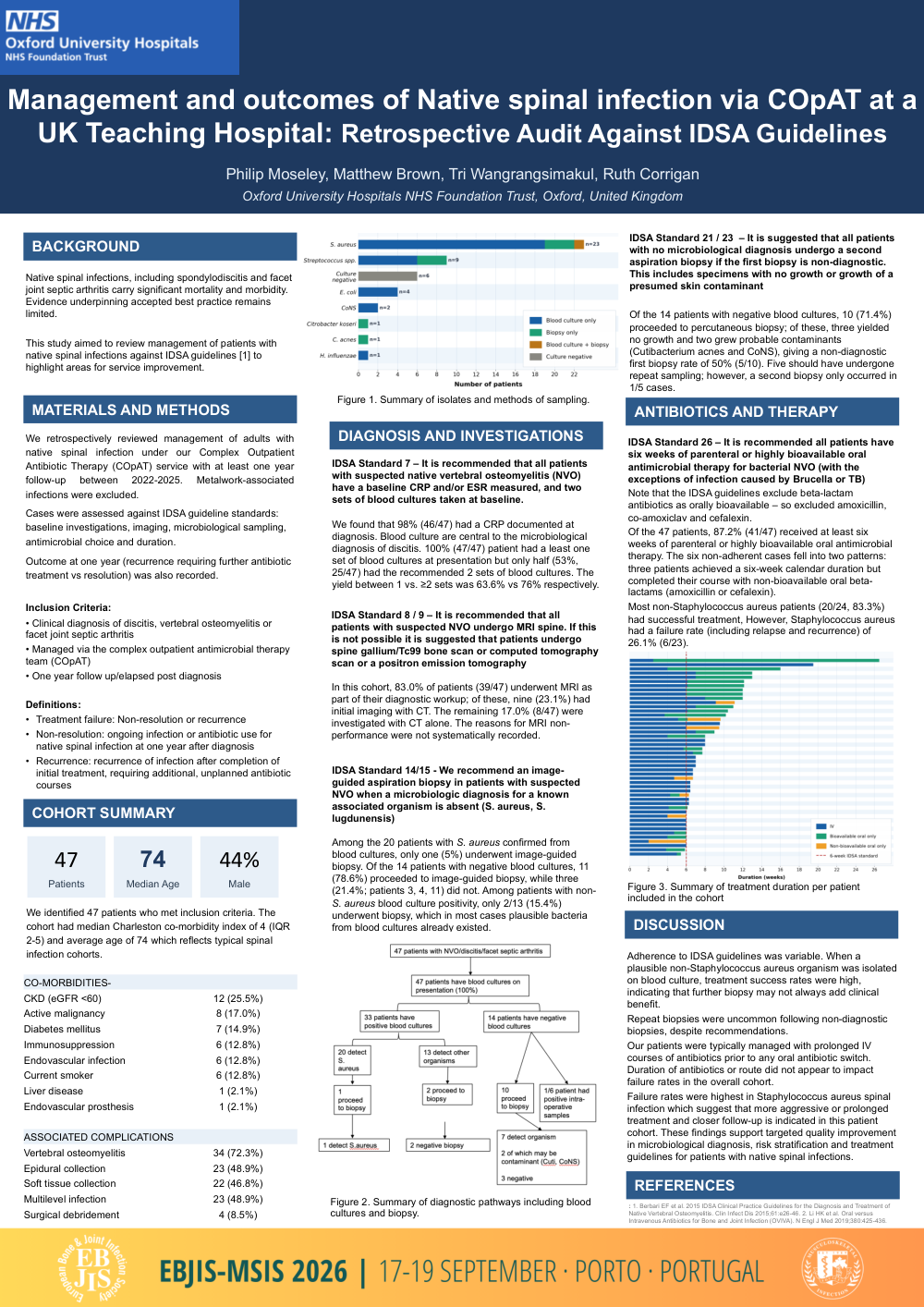
We identified 47 patients who met inclusion criteria. The cohort had median Charleston co-morbidity index of 4 (IQR 2-5) and average age of 74 which reflects typical spinal infection cohorts.
IDSA Standard 7 – It is recommended that all patients with suspected native vertebral osteomyelitis (NVO) have a baseline CRP and/or ESR measured, and two sets of blood cultures taken at baseline.
We found that 98% (46/47) had a CRP documented at diagnosis. Blood culture are central to the microbiological diagnosis of discitis. 100% (47/47) patient had a least one set of blood cultures at presentation but only half (53%, 25/47) had the recommended 2 sets of blood cultures. The yield between 1 vs. ≥2 sets was 63.6% vs 76% respectively.
IDSA Standard 8 / 9 – It is recommended that all patients with suspected NVO undergo MRI spine. If this is not possible it is suggested that patients undergo spine gallium/Tc99 bone scan or computed tomography scan or a positron emission tomography
In this cohort, 83.0% of patients (39/47) underwent MRI as part of their diagnostic workup; of these, nine (23.1%) had initial imaging with CT. The remaining 17.0% (8/47) were investigated with CT alone. The reasons for MRI non-performance were not systematically recorded.
IDSA Standard 14/15 - We recommend an image-guided aspiration biopsy in patients with suspected NVO when a microbiologic diagnosis for a known associated organism is absent (S. aureus, S. lugdunensis)
Among the 20 patients with S. aureus confirmed from blood cultures, only one (5%) underwent image-guided biopsy. Of the 14 patients with negative blood cultures, 11 (78.6%) proceeded to image-guided biopsy, while three (21.4%; patients 3, 4, 11) did not. Among patients with non-S. aureus blood culture positivity, only 2/13 (15.4%) underwent biopsy, which in most cases plausible bacteria from blood cultures already existed.
IDSA Standard 21 / 23 – It is suggested that all patients with no microbiological diagnosis undergo a second aspiration biopsy if the first biopsy is non-diagnostic. This includes specimens with no growth or growth of a presumed skin contaminant
Of the 14 patients with negative blood cultures, 10 (71.4%) proceeded to percutaneous biopsy; of these, three yielded no growth and two grew probable contaminants (Cutibacterium acnes and CoNS), giving a non-diagnostic first biopsy rate of 50% (5/10). Five should have undergone repeat sampling; however, a second biopsy only occurred in 1/5 cases.
IDSA Standard 26 – It is recommended all patients have six weeks of parenteral or highly bioavailable oral antimicrobial therapy for bacterial NVO (with the exceptions of infection caused by Brucella or TB)
Note that the IDSA guidelines exclude beta-lactam antibiotics as orally bioavailable – so excluded amoxicillin, co-amoxiclav and cefalexin.
Of the 47 patients, 87.2% (41/47) received at least six weeks of parenteral or highly bioavailable oral antimicrobial therapy. The six non-adherent cases fell into two patterns: three patients achieved a six-week calendar duration but completed their course with non-bioavailable oral beta-lactams (amoxicillin or cefalexin).
Most non-Staphylococcus aureus patients (20/24, 83.3%) had successful treatment, However, Staphylococcus aureus had a failure rate (including relapse and recurrence) of 26.1% (6/23).
Adherence to IDSA guidelines was variable. When a plausible non-Staphylococcus aureus organism was isolated on blood culture, treatment success rates were high, indicating that further biopsy may not always add clinical benefit.
Repeat biopsies were uncommon following non-diagnostic biopsies, despite recommendations.
Our patients were typically managed with prolonged IV courses of antibiotics prior to any oral antibiotic switch. Duration of antibiotics or route did not appear to impact failure rates in the overall cohort.
Failure rates were highest in Staphylococcus aureus spinal infection which suggest that more aggressive or prolonged treatment and closer follow-up is indicated in this patient cohort. These findings support targeted quality improvement in microbiological diagnosis, risk stratification and treatment guidelines for patients with native spinal infections.