477 posters, 14 topics, 2,065 authors, 1,055 institutions
ePostersLive by SciGen Technologies S.A. All rights reserved.
The Joint EBJIS-MSIS 2026 Conference
17 - 19 September, 2026 | Porto, Portugal

EP476
Improved diagnosis with Sonication Fluid Culture in Postoperative Spinal Infection (PSI)
Poster Presenter
Authors
Anas Zouitni, Erlangga Yusuf, Jakob van Oldenrijk, P. Koen Bos, Peter D. Croughs, Joost P.H.J. Rutges, Ewout S. Veltman
Affiliations
Orthopedic Surgery and Sports Medicine, Erasmus MC, Rotterdam, Netherlands, Medical Microbiology & Infectious Diseases, Erasmus MC, Rotterdam, Netherlands, Erasmus MC
Part of Topic
Spinal Infections
Improved diagnosis with Sonication Fluid Culture in Spinal Implant Infection (SII)
Anas Zouitni1, Erlangga Yusuf2, Jakob van Oldenrijk1, Joost P.H.J. Rutges1, Peter Croughs2, P. Koen Bos1, Ewout S Veltman1
1Department of Orthopaedic Surgery and Sports Medicine, Erasmus Medical Centre,Rotterdam, the Netherlands.
2Department of Medical Microbiology and Infectious Diseases, Erasmus Medical Centre, Rotterdam, the Netherlands
Background
Spinal ImplantInfection (SII) is challenging to diagnose due to often subtle clinical presentation and limitations of conventional methods. Sonication fluid culture (SFC) of spinal implants may be a valuable adjunct tool to diagnose SII. We aimed to assess the added diagnostic value of SFC for SII diagnosis.
Methods
We analyzed patients who underwent spinal implant removal between 2013 and 2021. Patients were classified using consensus criteria as having confirmed SII or probable SII. Cases who did not meet these criteria were classified as aseptic. We differentiated early-onset (symptom onset ≤ 90 days) from late-onset SII (> 90 days). The added diagnostic value of SFC was defined on how frequently SFC altered the diagnostic classification and its possible impact on SII management.
Population
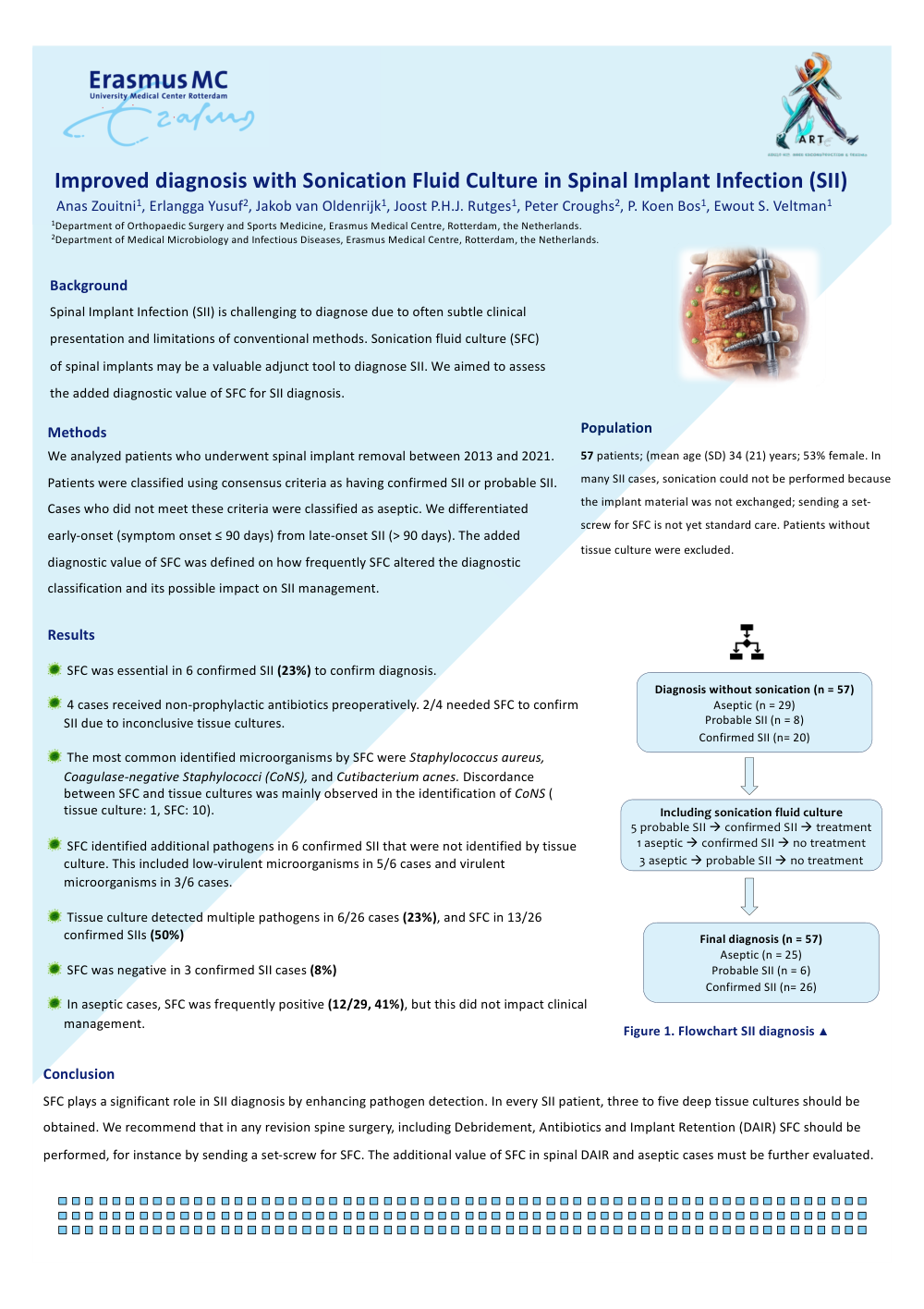
57 patients; (mean age (SD) 34 (21) years; 53% female. In many SII cases, sonication could not be performed because the implant material was not exchanged; sending a set-screw for SFC is not yet standard care. Patients without tissue culture were excluded.
Results
��SFC was essential in 6 confirmed SII (23%) to confirm diagnosis.
��4 cases received non-prophylacticantibiotics preoperatively. 2/4 needed SFC to confirm SII due to inconclusive tissue cultures.
��The most common identified microorganisms by SFC were Staphylococcus aureus, Coagulase-negative Staphylococci (CoNS), andCutibacterium acnes. Discordance between SFC and tissue cultures was mainly observed in the identification of CoNS ( tissue culture: 1, SFC: 10).
��SFC identified additional pathogens in 6 confirmed SII that were not identified by tissue culture. This included low-virulent microorganisms in 5/6 cases and virulent microorganisms in 3/6 cases.
��Tissue culturedetected multiple pathogens in 6/26 cases (23%), and SFC in 13/26 confirmed SIIs (50%)
��SFC was negative in 3 confirmed SII cases (8%)
��In aseptic cases, SFC was frequently positive (12/29, 41%),but this did not impact clinical management.