477 posters, 14 topics, 2,065 authors, 1,055 institutions
ePostersLive by SciGen Technologies S.A. All rights reserved.
The Joint EBJIS-MSIS 2026 Conference
17 - 19 September, 2026 | Porto, Portugal

EP470
Spondylodiscitis in Clinical Practice: A Retrospective Study of Diagnosis, Etiology, and Management
Poster Presenter
Part of Topic
Spinal Infections
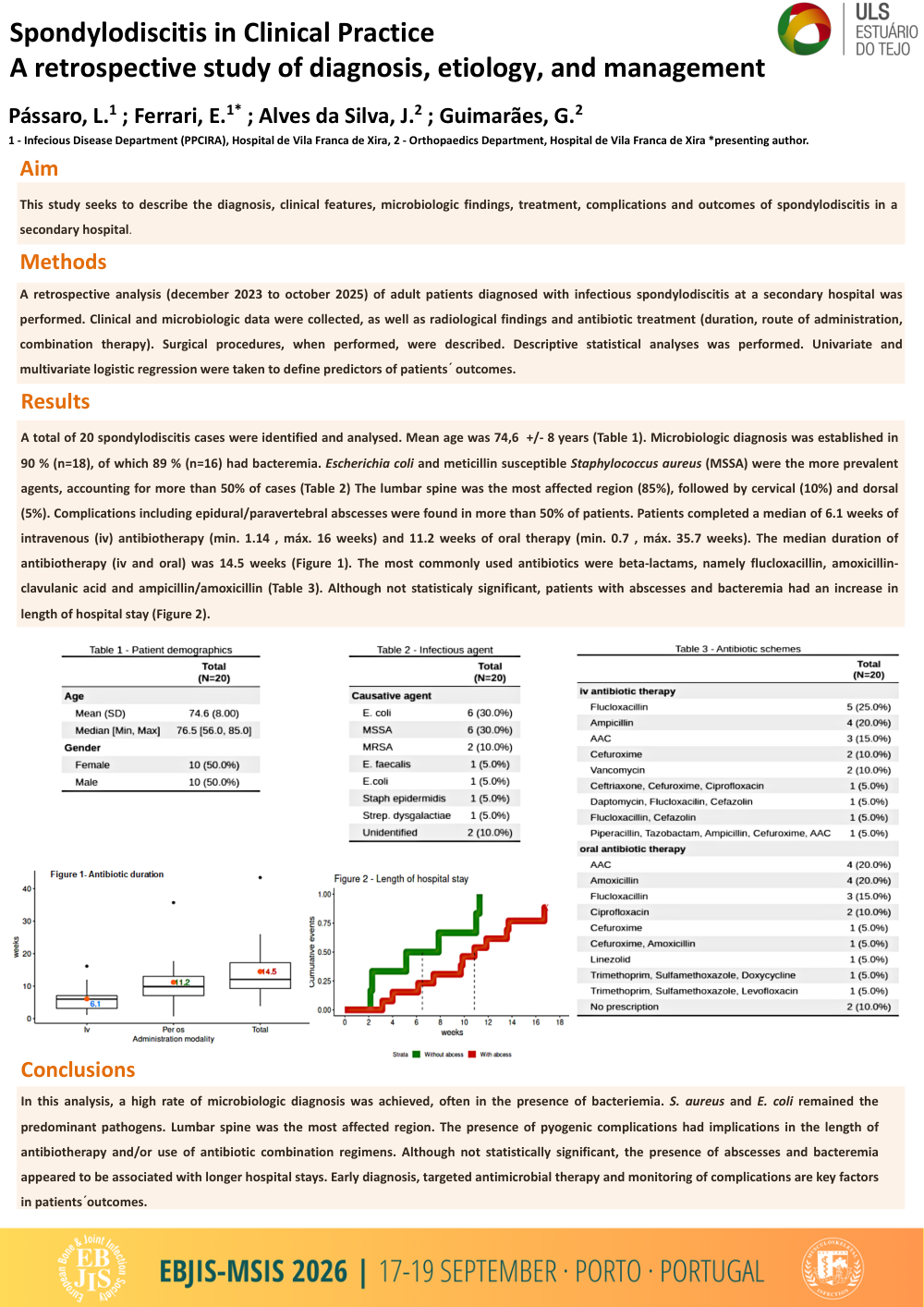
Spondylodiscitis in Clinical Practice A retrospective study of diagnosis, etiology, and management
Pássaro, L.1 ; Ferrari, E.1* ; Alves da Silva, J.2 ; Guimarães, G.2
1 - Infecious Disease Department (PPCIRA), Hospital de Vila Franca de Xira, 2 - Orthopaedics Department, Hospital de Vila Franca de Xira *presenting author.
Aim: To describe the diagnosis, clinical features, microbiologic findings, treatment, complications and outcomes of spondylodiscitis in a secondary hospital.
Methods: A retrospective analysis (december 2023 to october 2025) of adult patients diagnosed with infectious spondylodiscitis at a secondary hospital was performed. Clinical and microbiologic data were collected, as well as radiological findings and antibiotic treatment (duration, route of administration, combination therapy). Surgical procedures, when performed, were described. Descriptive statistical analyses was performed. Univariate and multivariate logistic regression were taken to define predictors of patients´ outcomes.
Methods: A retrospective analysis (december 2023 to october 2025) of adult patients diagnosed with infectious spondylodiscitis at a secondary hospital was performed. Clinical and microbiologic data were collected, as well as radiological findings and antibiotic treatment (duration, route of administration, combination therapy). Surgical procedures, when performed, were described. Descriptive statistical analyses was performed. Univariate and multivariate logistic regression were taken to define predictors of patients´ outcomes.
Results: A total of 20 spondylodiscitis cases were identified and analysed. Microbiologic diagnosis was established in 90 % (n=18), of which 89 % (n=16) had bacteremia. Escherichia coli and meticillin susceptible Staphylococcus aureus (MSSA) were the more prevalente agents, accounting for more than 50% of cases. The lumbar spine was the most affected region (85%), followed by cervical (10%) and dorsal (5%). Patients completed a median of 6 weeks of intravenous (iv) antibiotherapy (min. 1.14 , máx. 16 weeks) and 9 weeks of oral therapy (min. 0.7 , máx. 35.7 weeks). The median duration of antibiotherapy (iv and oral) was 12 weeks (image 1). Complications including epidural/paravertebral abscesses were found in more than 50% of patients. The most commonly used antibiotics were beta-lactams, namely flucloxacillin, amoxicillin-clavulanic acid and ampicillin/amoxicillin. Although not statisticaly significant, patients with abscesses and bacteremia had an increase in length of hospital stay (image 2).
Conclusions: In this analysis, a high rate of microbiologic diagnosis was achieved, often in the presence of bacteriemia. S. aureus and E. coli remained the predominant pathogens. Lumbar spine was the most affected region. The presence of pyogenic complications had implications in the length of antibiotherapy and/or use of antibiotic combination regimens. Although not statistically significant, the presence of abscesses and bacteremia appeared to be associated with longer hospital stays. Early diagnosis, targeted antimicrobial therapy and monitoring of complications are key factors in patients´outcomes.