477 posters, 14 topics, 2,065 authors, 1,055 institutions
ePostersLive by SciGen Technologies S.A. All rights reserved.
The Joint EBJIS-MSIS 2026 Conference
17 - 19 September, 2026 | Porto, Portugal

EP467
Microbiological Profile, Antimicrobial Susceptibility Test Results, and Inflammatory Profiles in Surgically Managed Spondylodiscitis: Results from A Retrospective Single-Center Cohort Study
Poster Presenter
Authors
Diana-Elena Vulpe, Rares-Mircea Birlutiu, Bogdan Neamtu, Dana-Georgiana Nedelea, Serban Dragosloveanu, Cristian Scheau, Victoria Birlutiu
Affiliations
Foisor Clinical Hospital Of Orthopedics, Traumatology, And Osteoarticular Tb Bucharest, Foisor Clinical Hospital of Orthopedics, Traumatology, and Osteoarticular TB, Bucharest, Romania; Faculty of Medicine, �Carol Davila� University of Medicine and Pharmacy, Bucharest, Romania, Faculty of Medicine, Lucian Blaga University of Sibiu, Sibiu, Romania; Pediatric Research Department, Pediatric Clinical Hospital Sibiu, Sibiu, Romania, Foisor Clinical Hospital of Orthopedics, Traumatology, and Osteoarticular TB, Bucharest, Romania, Faculty of Medicine, Lucian Blaga University of Sibiu, Sibiu, Romania; County Clinical Emergency Hospita, Sibiu, Romania
Part of Topic
Spinal Infections
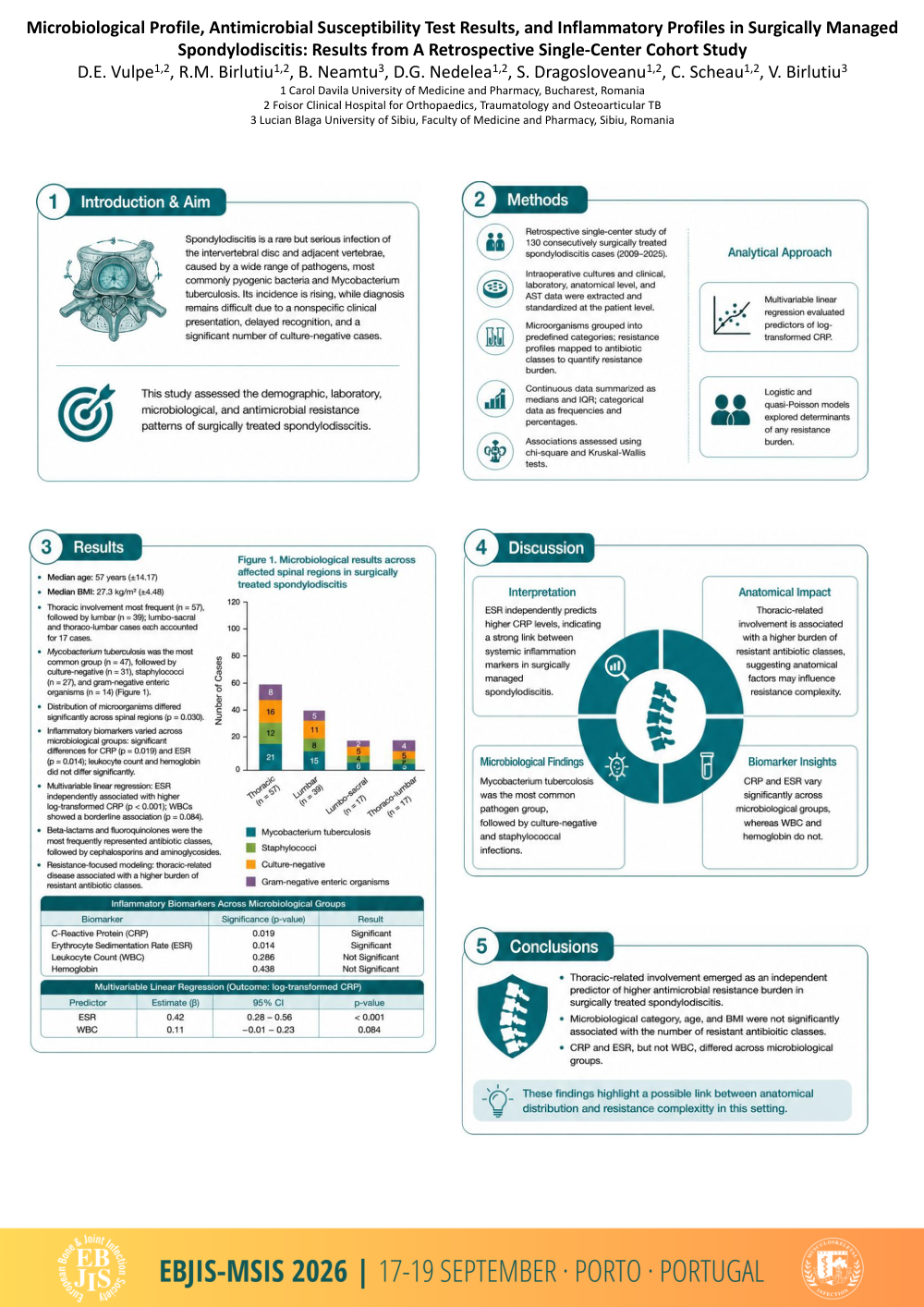
Introduction & Aim: Spondylodiscitis is a rare but serious infection of the intervertebral disc and adjacent vertebrae, caused by a wide range of pathogens, most commonly pyogenic bacteria and Mycobacterium tuberculosis. Its incidence is rising, while diagnosis remains difficult due to a nonspecific clinical presentation, delayed recognition, and a significant number of culture-negative cases. This study assessed the demographic, laboratory, microbiological, and antimicrobial resistance patterns of surgically treated spondylodiscitis.
Methods: We performed a retrospective single-center study on 130 consecutively surgically treated spondylodiscitis cases in a single orthopedic center, with intraoperative cultures harvested between 2009 and 2025. Clinical, laboratory, microbiological, anatomical level, and AST data were extracted and standardized at the patient level. Microorganisms were grouped into predefined categories, and resistance profiles were mapped to antibiotic classes to quantify resistance burden. Continuous data were summarized as medians and IQR, and categorical data as frequencies and percentages. Associations were assessed using chi-square and Kruskal-Wallis tests. Multivariable linear regression evaluated predictors of log-transformed CRP, while logistic and quasi-Poisson models explored determinants of any resistance burden.
Results: Median age of the enrolled cases was 57 years (±14.17), and median BMI was 27.3 kg/m² (±4.48). Thoracic involvement was the most frequent anatomical location (n= 57), followed by lumbar (n= 39), while lumbo-sacral and thoraco-lumbar cases each accounted for 17 cases. Microbiologically, Mycobacterium tuberculosis was the most common group (n= 47), followed by culture-negative cases (n= 31) and staphylococci (n= 27). Gram-negative enteric organisms accounted for 14 cases (Figure 1). The distribution of microorganisms differed significantly according to the affected spinal region (p = 0.030). Inflammatory biomarkers also varied across microbiological groups, with significant differences for CRP (p = 0.019) and ESR (p = 0.014), whereas leukocyte count and hemoglobin did not differ significantly. In the performed multivariable linear regression, ESR was independently associated with higher log-transformed CRP values (p < 0.001), while WBCs showed a borderline association (p = 0.084). Among resistance patterns, beta-lactams and fluoroquinolones were the most frequently represented antibiotic classes, followed by cephalosporins and aminoglycosides. In resistance-focused modeling, thoracic-related disease was associated with a higher burden of resistant antibiotic classes.
Conclusions: Thoracic-related involvement emerged as an independent predictor of higher antimicrobial resistance burden in surgically treated spondylodiscitis, whereas microbiological category, age, and BMI were not significantly associated with the number of resistant antibiotic classes. At the same time, CRP and ESR, but not WBC, differed across microbiological groups. This finding highlights a possible link between anatomical distribution and resistance complexity in this setting.