477 posters, 14 topics, 2,052 authors, 1,056 institutions
ePostersLive by SciGen Technologies S.A. All rights reserved.
The Joint EBJIS-MSIS 2026 Conference
17 - 19 September, 2026 | Porto, Portugal

EP417
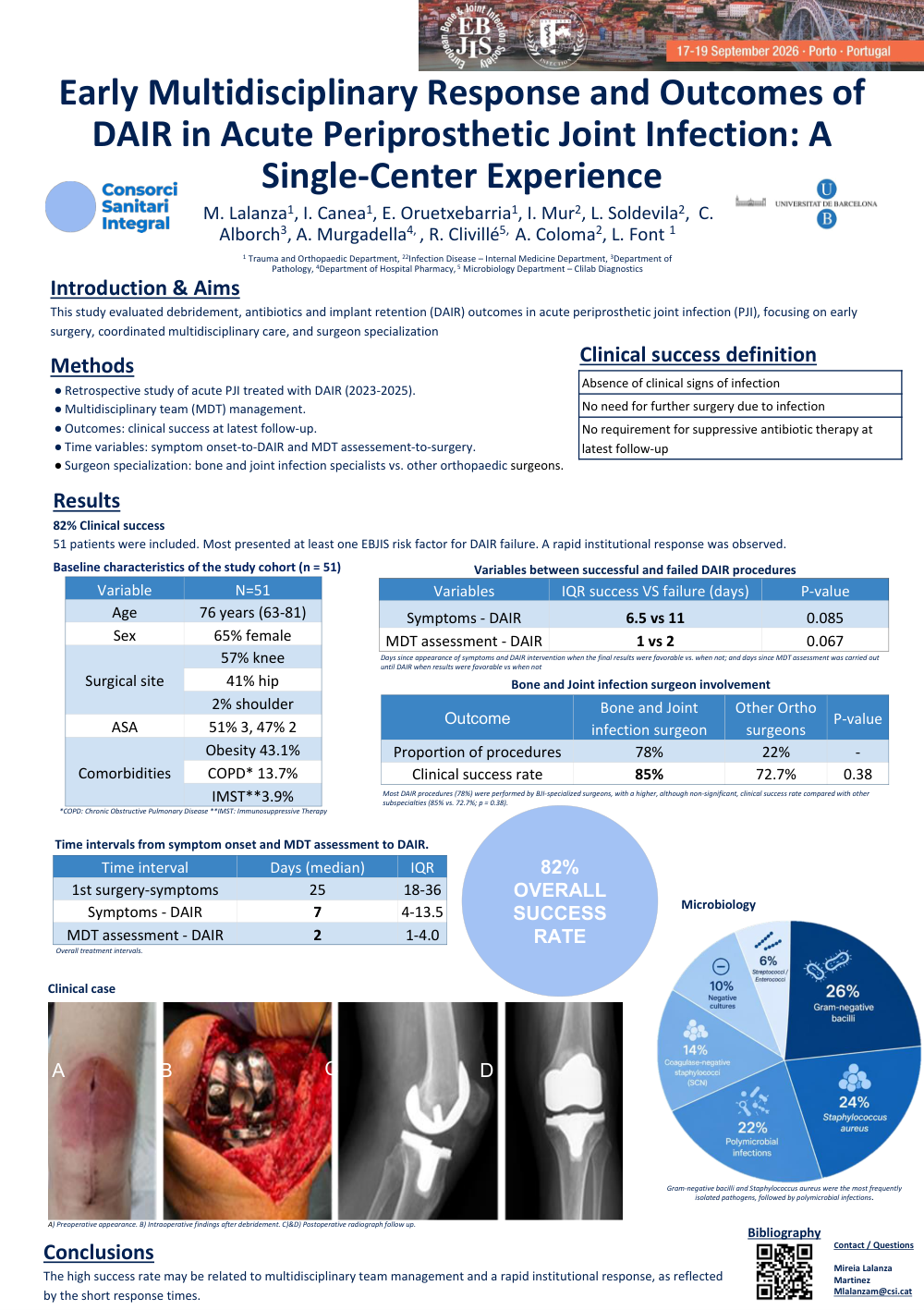
Early Multidisciplinary Response and Outcomes of DAIR in Acute Periprosthetic Joint Infection: A Single-Center Experience
Poster Presenter
Authors
Mireia Lalanza Martinez, Inge Iohana Canea Novacescu, Estíbaliz Oruetxebarria Garcia, Isabel Mur Arizon, Laura Soldevila Boixader, Carmen Alborch Gil, Anna Murgadella Sancho, Raquel Clivillé Abad, Ana Guadalupe Coloma Conde, Lluís Font Vizcarra
Affiliations
Consorci Sanitari Integral- Hospital Mois?s Broggi, Spain, Consorci Sanitari Integral- Hospital Mois?s Broggi, CLILAB Diagn?stics, Spain
Part of Topic
Prosthetic Joint Infections
Early Multidisciplinary Response and Outcomes of DAIR in Acute Periprosthetic Joint Infection: A Single-Center Experience
M. Lalanza1, I. Canea1, E. Oruetxebarria1, I. Mur2, L. Soldevila2, C. Alborch3, A. Murgadella4, , R. Clivillé5, A. Coloma2, L. Font 1
1Trauma and Orthopaedic Department; 2Infection Disease –Internal Medicine Department ; 3Department of Pathology; 4Department of Hospital Pharmacy,5Microbiology Department –Clilab Diagnostics
Introduction & Aims
This study evaluated debridement, antibiotics and implant retention (DAIR) outcomes in acute periprosthetic joint infection (PJI), focusing on early surgery, coordinated multidisciplinary care, and surgeon specialization
Methods
Retrospective study of acute PJI treated with DAIR (2023-2025).
Multidisciplinary team (MDT) management.
Outcomes: clinical success at latest follow-up.
Time variables: symptom onset-to-DAIR and MDT assessement-to-surgery.
Surgeon specialization: bone and joint infection specialists vs. other orthopaedic surgeons.
Clinicalsuccessdefinition:
- Absence of clinical signs of infection
- No need for further surgery due to infection
- No requirementfor suppressiveantibiotictherapyat latestfollow
Results
82% Clinical success
51 patients were included. Most presented at least one EBJIS risk factor for DAIR failure. A rapid institutional response wasobserved
Conclusions
The high successrate may be related to multidisciplinary team management and a rapid institutional response, as reflected by the short response times.