477 posters, 14 topics, 2,052 authors, 1,056 institutions
ePostersLive by SciGen Technologies S.A. All rights reserved.
The Joint EBJIS-MSIS 2026 Conference
17 - 19 September, 2026 | Porto, Portugal
EP356
How Does Aspirin Compare to Other Anticoagulants in Patients Undergoing Hip Prosthesis Explantation with Spacer Insertion?
Part of Topic
Prosthetic Joint Infections
How Does Aspirin Compare to Other Anticoagulants in Patients Undergoing Hip Prosthesis Explantation with Spacer Insertion?
Tarek Haj Shehadeh MD1; Jesus M. Villa MD1; Elie Ghanem MD2; Carlos A. Higuera MD1,3
1.Cleveland Clinic Florida, Levitetz Department of Orthopaedic Surgery
2.Missouri Orthopaedic Institute, University of Missouri-Columbia
3.Case Western Reserve University
Introduction: Venous thromboembolism (VTE) remains an important complication following total hip revision arthroplasty (rTHA)
•rTHA for periprosthetic joint infection (PJI) is associated with increased risk of VTE.
•Previous studies reported Aspirin to be safe and effective in prevention of VTE after rTHA without separating septic from aseptic indications [1, 2].
•However, there is limited literature on optimal VTE prevention drug after hip explantation with spacer insertion for PJI.
Objective: We conducted a propensity-score matched analysis to:
Compare the safety and effectiveness of Aspirin monotherapy with non-Aspirin monotherapy and dual therapy following hip explantation with spacer insertion in preventing VTE
Results: •We conducted a retrospective analysis using the Research Network on the TriNetX healthcare database (2005 – 2025)
•We identified adult patients undergoing their first hip explantation with spacer insertion for PJI using ICD-10 and CPT codes.
•Patients were required to have a preoperative PJI diagnosis and a concomitant spacer insertion code on the same day of surgery.
•Patients with spacer removal/exchange and/or arthrotomy codes on same day of surgery were excluded.
•Stratified based on the postoperative VTE drug prescribed (defined as prescription within 2 weeks after surgery [3]) into 3 cohorts:
1.Aspirin
2.Non-Aspirin (Rivaroxaban, Apixaban or Enoxaparin)
3.Dual therapy (Aspirin and a non-Aspirin)
•Ensured no overlapping prescriptions in monotherapy cohorts.
•1:1 propensity score matched for relevant comorbidities, including age at surgery, sex, history of VTE, stroke, cancer, coagulopathy, body mass index, tranexamic acid use, glycemic control and smoking among other variables.
•Outcomes of interest included 90-day risk of:
-VTE, transfusion and wound disruption
•TriNetX built-in tool for statistical analysis.
•Used chi-square test for categorical variables and student t-test for continuous variables
•Significance threshold was set at p<0.05.
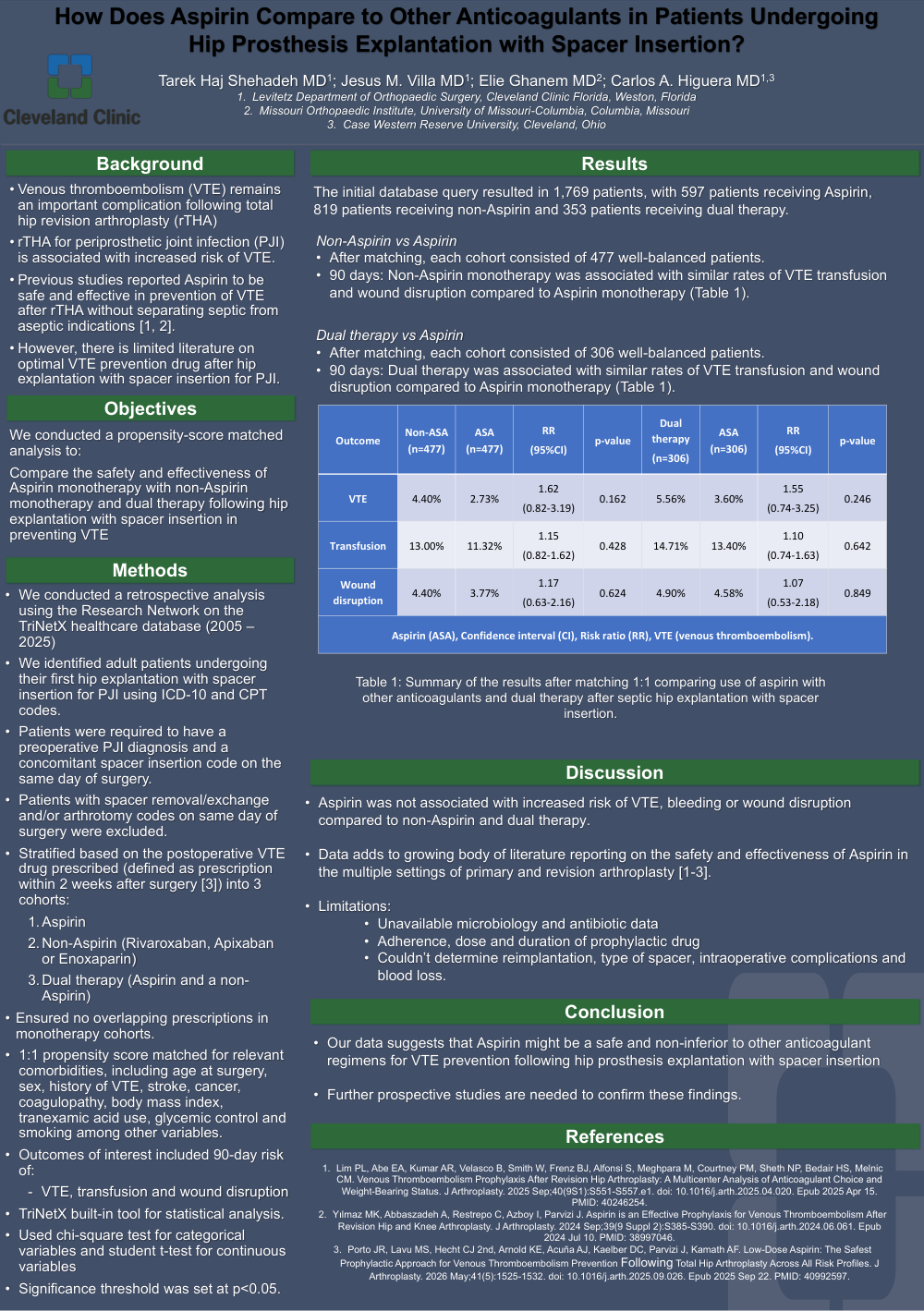
Results: The initial database query resulted in 1,769 patients, with 597 patients receiving Aspirin, 819 patients receiving non-Aspirin and 353 patients receiving dual therapy.
Non-Aspirin vs Aspirin
•After matching, each cohort consisted of 477 well-balanced patients.
•90 days: Non-Aspirin monotherapy was associated with similar rates of VTE transfusion and wound disruption compared to Aspirin monotherapy (Table 1).
Conclusion
•Our data suggests that Aspirin might be a safe and non-inferior to other anticoagulant regimens for VTE prevention following hip prosthesis explantation with spacer insertion
•Further prospective studies are needed to confirm these findings.
Dual therapy vs Aspirin
•After matching, each cohort consisted of 306 well-balanced patients.
•90 days: Dual therapy was associated with similar rates of VTE transfusion and wound disruption compared to Aspirin monotherapy
Discussion: •Aspirin was not associated with increased risk of VTE, bleeding or wound disruption compared to non-Aspirin and dual therapy.
•Data adds to growing body of literature reporting on the safety and effectiveness of Aspirin in the multiple settings of primary and revision arthroplasty [1-3].
•Limitations:
•Unavailable microbiology and antibiotic data
•Adherence, dose and duration of prophylactic drug
•Couldn’t determine reimplantation, type of spacer, intraoperative complications and blood loss.
Conclusion: •Our data suggests that Aspirin might be a safe and non-inferior to other anticoagulant regimens for VTE prevention following hip prosthesis explantation with spacer insertion
•Further prospective studies are needed to confirm these findings.