477 posters, 14 topics, 2,065 authors, 1,055 institutions
ePostersLive by SciGen Technologies S.A. All rights reserved.
The Joint EBJIS-MSIS 2026 Conference
17 - 19 September, 2026 | Porto, Portugal

EP010
Frequency and Causes of Rifampin Non-Prescription and Discontinuation After DAIR for Staphylococcal THA/TKA PJI
Poster Presenter
Part of Topic
Antibiotics
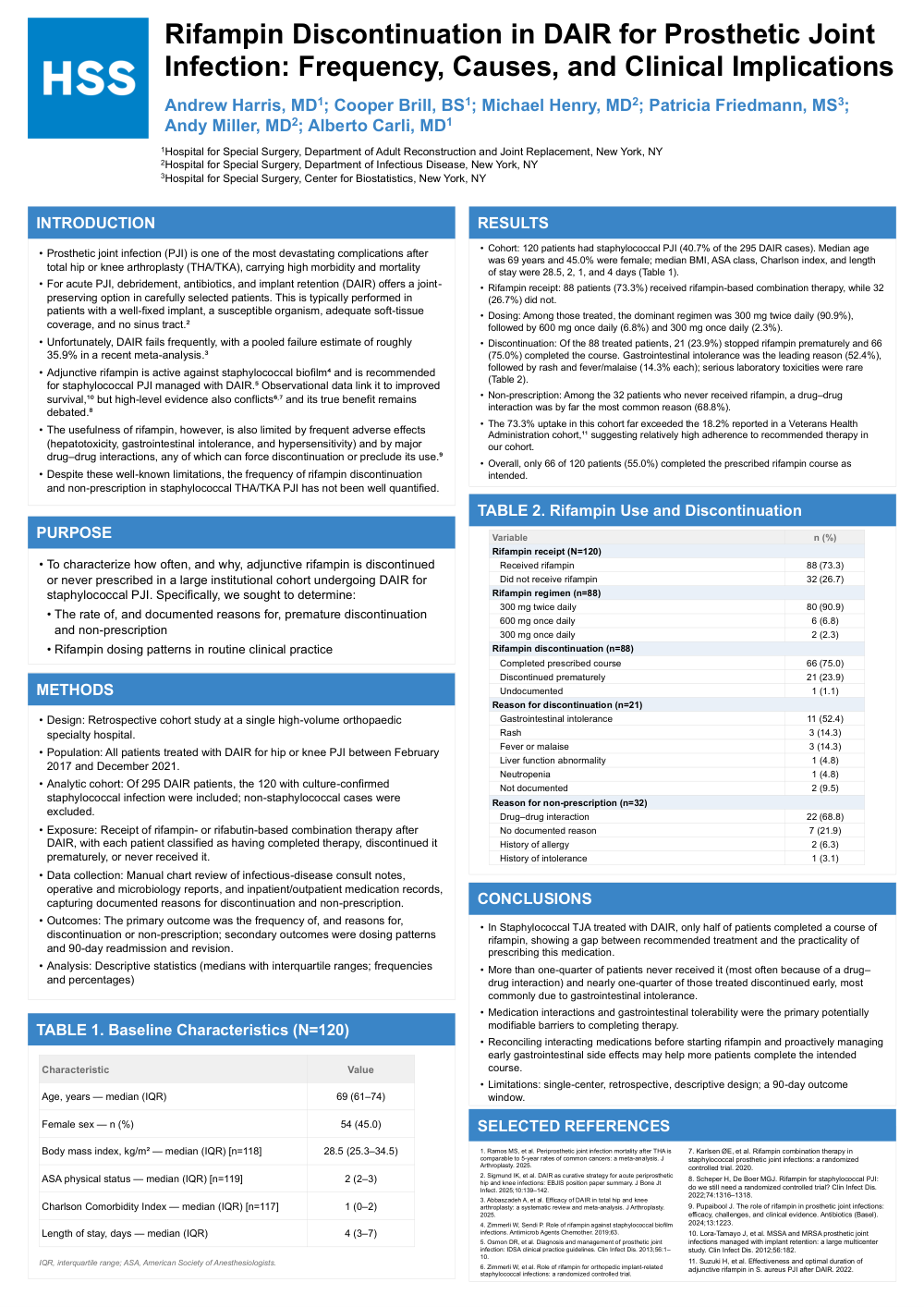
Rifampin Discontinuation in DAIR for Prosthetic Joint Infection: Frequency, Causes, and Clinical Implications
Andrew Harris, MD1; Cooper Brill, BS1; Michael Henry, MD2; Patricia Friedmann, MS3; Andy Miller, MD2; Alberto Carli, MD1
1Hospital for Special Surgery, Department of Adult Reconstruction and Joint Replacement, New York, NY
2Hospital for Special Surgery, Department of Infectious Disease, New York, NY
3Hospital for Special Surgery, Center for Biostatistics, New York, NY
INTRODUCTION
Prosthetic joint infection (PJI) is one of the most devastating complications after total hip or knee arthroplasty (THA/TKA), carrying high morbidity and mortality
For acute PJI, debridement, antibiotics, and implant retention (DAIR) offers a joint-preserving option in carefully selected patients. This is typically performed in patients with a well-fixed implant, a susceptible organism, adequate soft-tissue coverage, and no sinus tract.²
Unfortunately, DAIR fails frequently, with a pooled failure estimate of roughly 35.9% in a recent meta-analysis.³
Adjunctive rifampin is active against staphylococcal biofilm⁴ and is recommended for staphylococcal PJI managed with DAIR.⁵ Observational data link it to improved survival,¹⁰ but high-level evidence also conflicts⁶,⁷ and its true benefit remains debated.⁸
The usefulness of rifampin, however, is also limited by frequent adverse effects (hepatotoxicity, gastrointestinal intolerance, and hypersensitivity) and by major drug–drug interactions, any of which can force discontinuation or preclude its use.⁹
Despite these well-known limitations, the frequency of rifampin discontinuation and non-prescription in staphylococcal THA/TKA PJI has not been well quantified.
PURPOSE
To characterize how often, and why, adjunctive rifampin is discontinued or never prescribed in a large institutional cohort undergoing DAIR for staphylococcal PJI. Specifically, we sought to determine:
The rate of, and documented reasons for, premature discontinuation and non-prescription
Rifampin dosing patterns in routine clinical practice
METHODS
Design: Retrospective cohort study at a single high-volume orthopaedic specialty hospital.
Population: All patients treated with DAIR for hip or knee PJI between February 2017 and December 2021.
Analytic cohort: Of 295 DAIR patients, the 120 with culture-confirmed staphylococcal infection were included; non-staphylococcal cases were excluded.
Exposure: Receipt of rifampin- or rifabutin-based combination therapy after DAIR, with each patient classified as having completed therapy, discontinued it prematurely, or never received it.
Data collection: Manual chart review of infectious-disease consult notes, operative and microbiology reports, and inpatient/outpatient medication records, capturing documented reasons for discontinuation and non-prescription.
Outcomes: The primary outcome was the frequency of, and reasons for, discontinuation or non-prescription; secondary outcomes were dosing patterns and 90-day readmission and revision.
Analysis: Descriptive statistics (medians with interquartile ranges; frequencies and percentages)
TABLE 1. Baseline Characteristics (N=120)
Characteristic | Value
Age, years — median (IQR) | 69 (61–74)
Female sex — n (%) | 54 (45.0)
Body mass index, kg/m² — median (IQR) [n=118] | 28.5 (25.3–34.5)
ASA physical status — median (IQR) [n=119] | 2 (2–3)
Charlson Comorbidity Index — median (IQR) [n=117] | 1 (0–2)
Length of stay, days — median (IQR) | 4 (3–7)
IQR, interquartile range; ASA, American Society of Anesthesiologists.
RESULTS
Cohort: 120 patients had staphylococcal PJI (40.7% of the 295 DAIR cases). Median age was 69 years and 45.0% were female; median BMI, ASA class, Charlson index, and length of stay were 28.5, 2, 1, and 4 days (Table 1).
Rifampin receipt: 88 patients (73.3%) received rifampin-based combination therapy, while 32 (26.7%) did not.
Dosing: Among those treated, the dominant regimen was 300 mg twice daily (90.9%), followed by 600 mg once daily (6.8%) and 300 mg once daily (2.3%).
Discontinuation: Of the 88 treated patients, 21 (23.9%) stopped rifampin prematurely and 66 (75.0%) completed the course. Gastrointestinal intolerance was the leading reason (52.4%), followed by rash and fever/malaise (14.3% each); serious laboratory toxicities were rare (Table 2).
Non-prescription: Among the 32 patients who never received rifampin, a drug–drug interaction was by far the most common reason (68.8%).
The 73.3% uptake in this cohort far exceeded the 18.2% reported in a Veterans Health Administration cohort,¹¹ suggesting relatively high adherence to recommended therapy in our cohort.
Overall, only 66 of 120 patients (55.0%) completed the prescribed rifampin course as intended.
TABLE 2. Rifampin Use and Discontinuation
Variable | n (%)
Rifampin receipt (N=120)
Received rifampin | 88 (73.3)
Did not receive rifampin | 32 (26.7)
Rifampin regimen (n=88)
300 mg twice daily | 80 (90.9)
600 mg once daily | 6 (6.8)
300 mg once daily | 2 (2.3)
Rifampin discontinuation (n=88)
Completed prescribed course | 66 (75.0)
Discontinued prematurely | 21 (23.9)
Undocumented | 1 (1.1)
Reason for discontinuation (n=21)
Gastrointestinal intolerance | 11 (52.4)
Rash | 3 (14.3)
Fever or malaise | 3 (14.3)
Liver function abnormality | 1 (4.8)
Neutropenia | 1 (4.8)
Not documented | 2 (9.5)
Reason for non-prescription (n=32)
Drug–drug interaction | 22 (68.8)
No documented reason | 7 (21.9)
History of allergy | 2 (6.3)
History of intolerance | 1 (3.1)
CONCLUSIONS
In Staphylococcal TJA treated with DAIR, only half of patients completed a course of rifampin, showing a gap between recommended treatment and the practicality of prescribing this medication.
More than one-quarter of patients never received it (most often because of a drug–drug interaction) and nearly one-quarter of those treated discontinued early, most commonly due to gastrointestinal intolerance.
Medication interactions and gastrointestinal tolerability were the primary potentially modifiable barriers to completing therapy.
Reconciling interacting medications before starting rifampin and proactively managing early gastrointestinal side effects may help more patients complete the intended course.
Limitations: single-center, retrospective, descriptive design; a 90-day outcome window.
SELECTED REFERENCES
1. Ramos MS, et al. Periprosthetic joint infection mortality after THA is comparable to 5-year rates of common cancers: a meta-analysis. J Arthroplasty. 2025.
2. Sigmund IK, et al. DAIR as curative strategy for acute periprosthetic hip and knee infections: EBJIS position paper summary. J Bone Jt Infect. 2025;10:139–142.
3. Abbaszadeh A, et al. Efficacy of DAIR in total hip and knee arthroplasty: a systematic review and meta-analysis. J Arthroplasty. 2025.
4. Zimmerli W, Sendi P. Role of rifampin against staphylococcal biofilm infections. Antimicrob Agents Chemother. 2019;63.
5. Osmon DR, et al. Diagnosis and management of prosthetic joint infection: IDSA clinical practice guidelines. Clin Infect Dis. 2013;56:1–10.
6. Zimmerli W, et al. Role of rifampin for orthopedic implant-related staphylococcal infections: a randomized controlled trial.
7. Karlsen ØE, et al. Rifampin combination therapy in staphylococcal prosthetic joint infections: a randomized controlled trial. 2020.
8. Scheper H, De Boer MGJ. Rifampin for staphylococcal PJI: do we still need a randomized controlled trial? Clin Infect Dis. 2022;74:1316–1318.
9. Pupaibool J. The role of rifampin in prosthetic joint infections: efficacy, challenges, and clinical evidence. Antibiotics (Basel). 2024;13:1223.
10. Lora-Tamayo J, et al. MSSA and MRSA prosthetic joint infections managed with implant retention: a large multicenter study. Clin Infect Dis. 2012;56:182.
11. Suzuki H, et al. Effectiveness and optimal duration of adjunctive rifampin in S. aureus PJI after DAIR. 2022.