477 posters, 14 topics, 2,065 authors, 1,055 institutions
ePostersLive by SciGen Technologies S.A. All rights reserved.
The Joint EBJIS-MSIS 2026 Conference
17 - 19 September, 2026 | Porto, Portugal

EP009
Safety and Outcomes of Prolonged Linezolid Use for Chronic Suppressive Therapy in Orthopedic Infections: A Single-Center Case Series
Poster Presenter
Authors
Affiliations
Part of Topic
Antibiotics
Aim:
Orthopedic infections often require prolonged antimicrobial therapy, and chronic suppressive antibiotic therapy is used when definitive surgical management is not feasible. Linezolid is an attractive oral agent due to its activity against resistant gram-positive organisms and excellent bioavailability, but its long-term use is limited by toxicity. We aimed to describe the clinical characteristics, safety, and outcomes of patients receiving chronic linezolid suppressive therapy for orthopedic infections.
Methods:
We conducted a retrospective case series of adult patients with orthopedic infections receiving linezolid for chronic suppressive therapy at a single center from 1/2024 to 2/2026. Data collected included demographics, infection characteristics, microbiology, surgical management, adverse events, and clinical outcomes. Descriptive statistics were used.
Results:
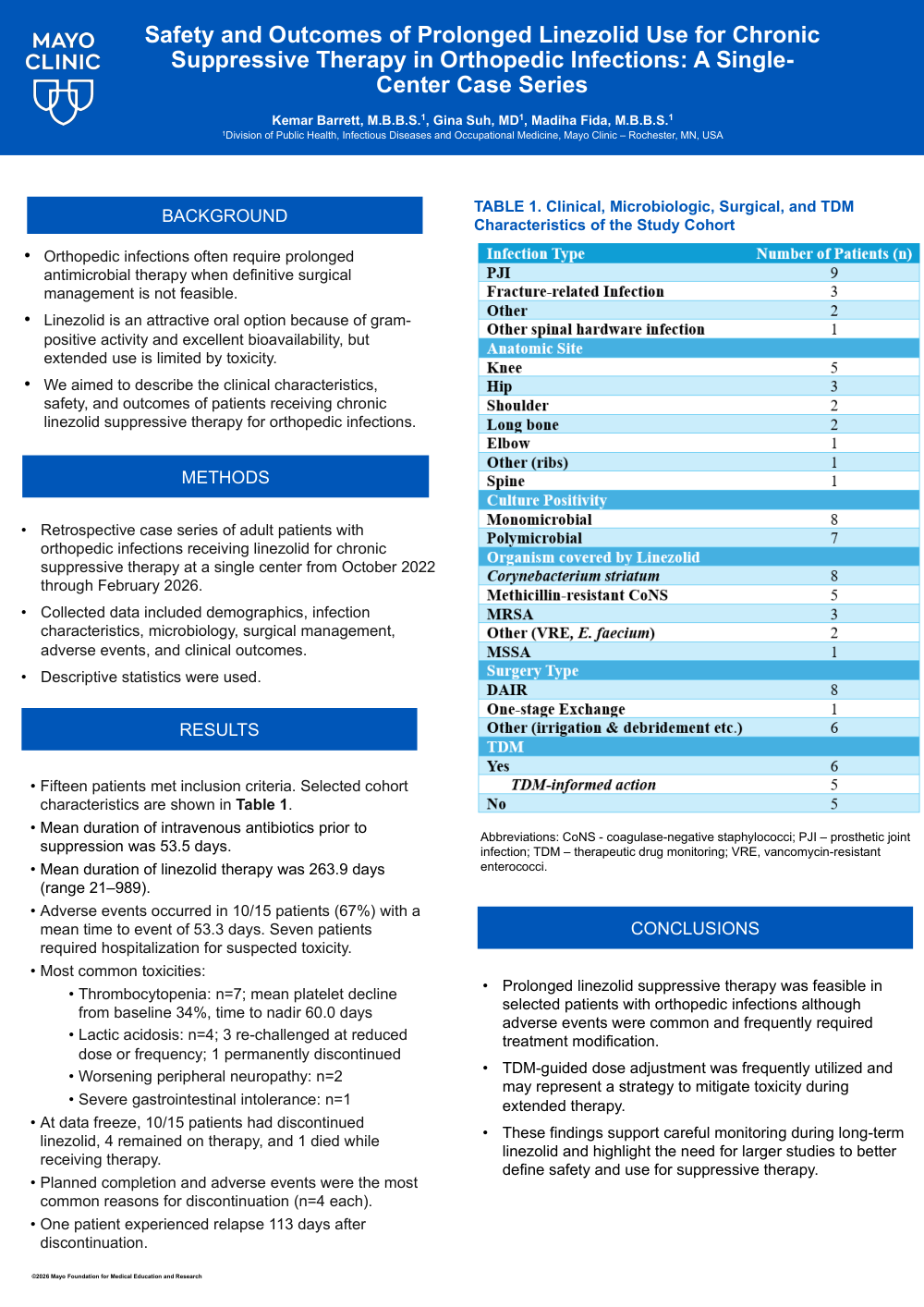
Fifteen patients met inclusion criteria. The most common infection type was prosthetic joint infection (n=9), followed by fracture-related infection (n=3). Debridement with implant retention was the most common surgical strategy (n=8). The most frequently identified organism was Corynebacterium striatum (n=8), followed by methicillin-resistant coagulase-negative staphylococci (n=5), and methicillin-resistant Staphylococcus aureus (n=3).
Mean duration of intravenous antibiotics prior to suppression was 53.5 days. Mean duration of linezolid therapy was 263.9 days (range 21–989). Therapeutic drug monitoring (TDM) was performed in 6/12 patients, with TDM-informed adjustments in 5, most commonly resulting in reduced dosing frequency.
Adverse events occurred in 10/15 (67%) patients, with a mean time to event of 53.3 days. Seven patients required hospitalization for suspected toxicity. The most common adverse event was thrombocytopenia (n=7), with a mean platelet decline of 34% and time to nadir of 60.0 days. Four patients developed lactic acidosis; three were re-challenged at reduced dose or frequency, while one required permanent discontinuation. Two patients developed worsening peripheral neuropathy and one severe gastrointestinal intolerance, both leading to discontinuation. No cases of optic neuropathy or serotonin syndrome were observed.
At data freeze, 10/15 patients had discontinued linezolid, 4 remained on therapy and 1 died while receiving therapy. Among those who discontinued, 4 completed the intended suppressive course, 4 discontinued due to adverse events, 1 died from unrelated causes, 1 self-discontinued, and 1 transitioned to an alternative agent. One patient experienced relapse 113 days after discontinuation.
Conclusion:
Prolonged linezolid suppressive therapy was feasible in selected patients with orthopedic infections although adverse events were common and frequently required treatment modification. TDM-guided dose adjustment was frequently utilized and may represent a strategy to mitigate toxicity during extended therapy. These findings support careful monitoring during long-term linezolid and highlight the need for larger studies to better define safety and use for suppressive therapy.