477 posters, 14 topics, 2,052 authors, 1,056 institutions
ePostersLive by SciGen Technologies S.A. All rights reserved.
The Joint EBJIS-MSIS 2026 Conference
17 - 19 September, 2026 | Porto, Portugal

EP266
Preoperative Exposure to Oral First-Generation Cephalosporins and Periprosthetic Joint Infection: A Cautionary Association
Poster Presenter
Part of Topic
Prosthetic Joint Infections
Background
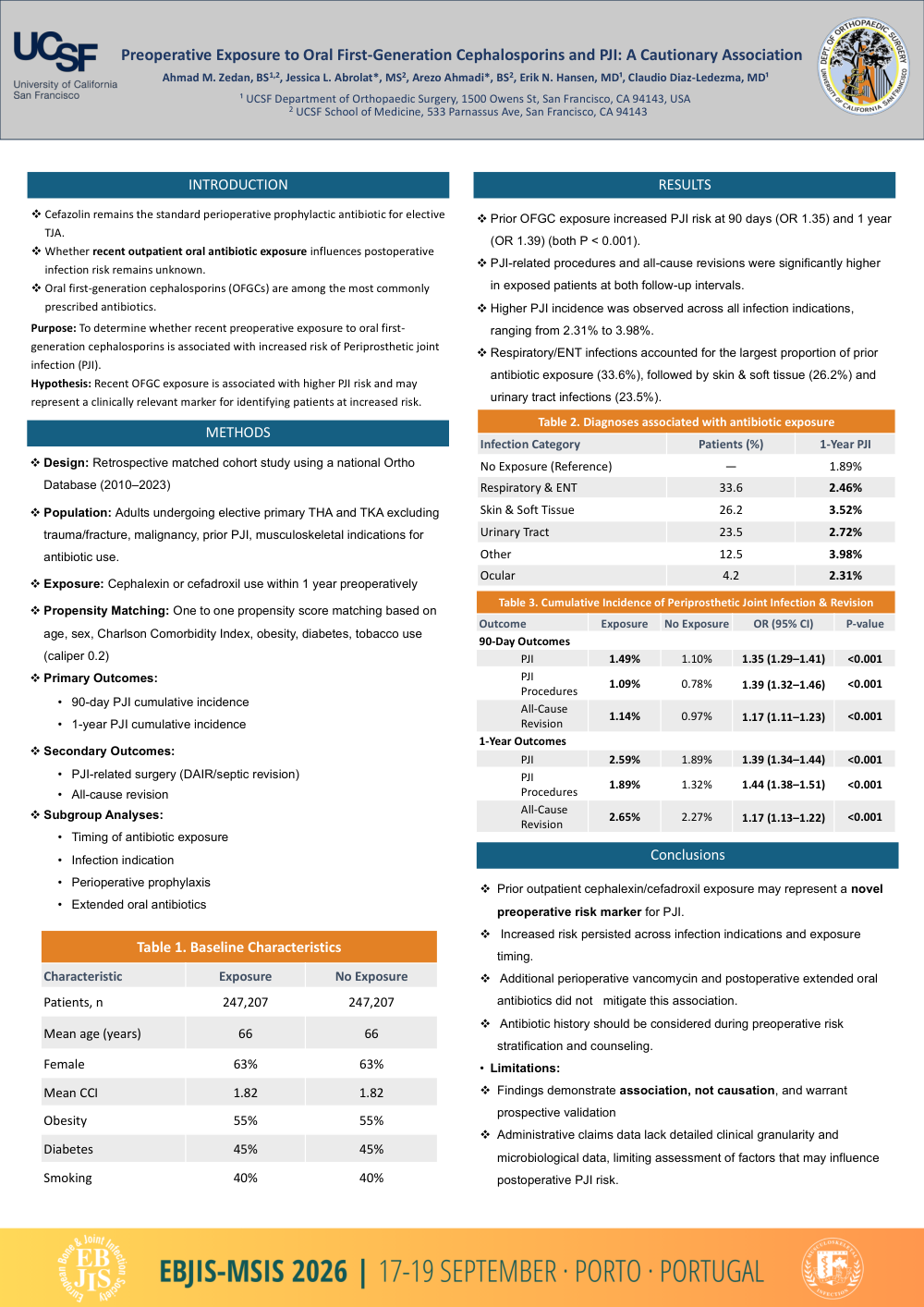
While patient-specific risk factors for periprosthetic joint infection (PJI) are well-defined, the impact of recent antibiotic exposure as a marker of infection vulnerability remains poorly understood. This study evaluated whether recent preoperative exposure to oral first-generation cephalosporins (OFGCs) is associated with an increased risk of PJI following elective TJA.
Methods
We performed a retrospective study using a national administrative database (2010–2023). Exposure was defined as receiving OFGCs for non-musculoskeletal indications within one year preoperatively. Exposed adults undergoing elective primary TJA were propensity-matched 1:1 to unexposed patients (N=247,207) by age, sex, Charlson Comorbidity Index, obesity, diabetes, and smoking. Main outcomes were surgical procedures for PJI and all-cause revision at 90 days and 1 year.
Results
OFGC exposure was associated with higher PJI incidence at 90 days (1.49% vs 1.10%, OR 1.35, 95% CI 1.29–1.41, P<.0001) and 1 year (2.59% vs 1.89%, OR 1.39, 95% CI 1.34–1.44, P<.0001). Similarly, OFGC-exposed patients had higher rates of PJI-related surgical procedures at 90 days (1.09% vs 0.78%, OR 1.39, 95% CI 1.32–1.46, P<.0001) and 1 year (1.89% vs 1.32%, OR 1.44, 95% CI 1.38–1.51, P<.0001). Across all infection indications, PJI rates remained significantly higher than those of the no-exposure cohort. Neither addition of vancomycin to cefazolin prophylaxis nor postoperative EOA mitigated this association.
Conclusions
Recent OFGC exposure was associated with an increased risk of PJI following elective primary TJA, regardless of the clinical indication for the antibiotic. Future studies are needed to determine whether prior OFGC exposure not only identifies higher-risk patients but also influences the microbiological and clinical course of PJI.