477 posters, 14 topics, 2,052 authors, 1,056 institutions
ePostersLive by SciGen Technologies S.A. All rights reserved.
The Joint EBJIS-MSIS 2026 Conference
17 - 19 September, 2026 | Porto, Portugal

EP250
Distress Trajectories Following Septic and Aseptic Revision Total Joint Arthroplasty
Poster Presenter
Authors
Jacob Oeding, Allison Lastinger, Matthew Lokant, Nathan Pearson, Nathan Lerfald, Matthew Dietz
Affiliations
Department of Orthopaedics, West Virginia University School Of Medicine, Morgantown, United States, Department of Medicine, West Virginia University School Of Medicine, Morgantown, United States, Department of Behavioral Medicine and Psychiatry, West Virginia University School Of Medicine, Morgantown, United States, West Virginia University School Of Medicine
Part of Topic
Prosthetic Joint Infections
Distress Trajectories Following Septic and Aseptic Revision Total Joint Arthroplasty
Aim:
To compare psychological distress between patients undergoing septic and aseptic revision total joint arthroplasty and to evaluate distress trajectories, surgical subtype differences, and predictors of clinically significant distress over time.
Methods:
This prospective observational study included revision arthroplasty episodes categorized as septic or aseptic. Distress was measured using the Distress Thermometer (DT; scale 0–10), with clinically significant distress defined as DT ≥ 4. Assessments were performed at enrollment (preoperative) and postoperatively at 2 weeks, 6 weeks, 12 weeks, 6 months, and 1 year. Distress outcomes were summarized by revision type and surgical subtype. Group comparisons were conducted using t-tests and chi-square tests. Multivariable logistic regression models evaluated predictors of DT ≥ 4 at 2 and 6 weeks, including revision type, age, and sex; additional septic-only models examined surgical subtype and duration of intravenous antibiotics. Longitudinal trends were assessed using generalized estimating equations.
Results:
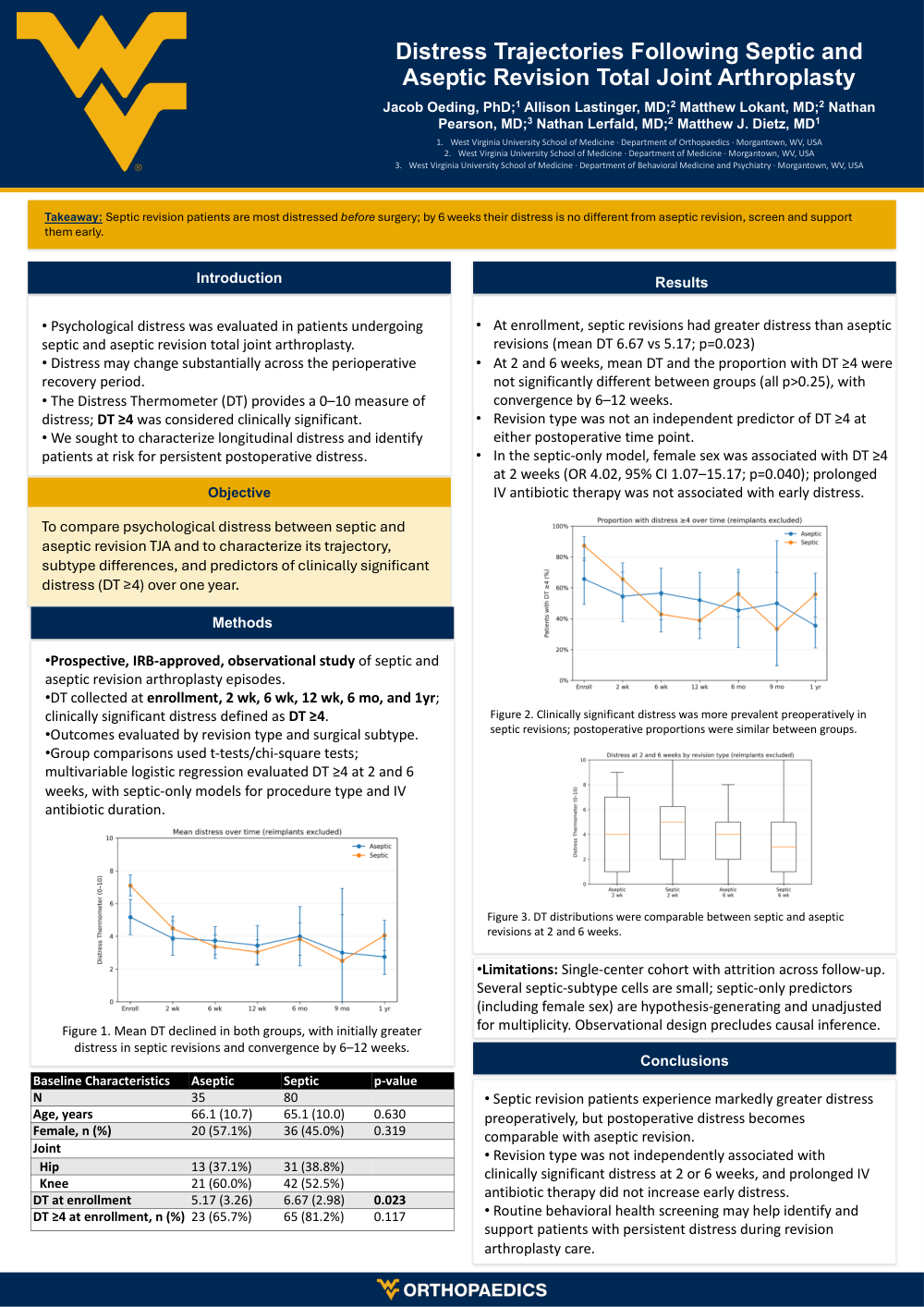
At enrollment, septic episodes demonstrated significantly higher distress than aseptic episodes (6.67 vs 5.17; p=0.023). At 2 and 6 weeks postoperatively, mean DT scores and proportions with DT ≥ 4 did not differ significantly between septic and aseptic revisions (all p > 0.25). Distress declined over time in both groups, with convergence by 6–12 weeks. Two-stage septic revisions and complete aseptic revisions showed higher distress at 2 weeks, whereas DAIR procedures and aseptic single-component revisions showed lower distress. In multivariable analyses, revision type was not independently associated with DT ≥ 4 at 2 or 6 weeks. Female sex was a significant predictor of DT ≥ 4 within septic episodes at both 2 and 6 weeks. Longer intravenous antibiotic duration (>6 weeks) was not associated with higher distress at early postoperative time points.
Conclusions:
Patients undergoing septic revision arthroplasty experience significantly higher distress preoperatively; however, postoperative distress levels are comparable to aseptic revisions and generally decline over time. Early postoperative distress varies by surgical subtype, with more extensive procedures associated with higher distress. Female sex is a key predictor of persistent distress following septic revision. These findings highlight the importance of integrating behavioral health screening into existing PJI care pathways, with particular attention to early identification and intervention for high-risk subgroups.