477 posters, 14 topics, 2,065 authors, 1,055 institutions
ePostersLive by SciGen Technologies S.A. All rights reserved.
The Joint EBJIS-MSIS 2026 Conference
17 - 19 September, 2026 | Porto, Portugal

EP191
Clinical and Patient-Reported Outcomes of Revision Total Knee Arthroplasty Using Rotating-Hinge Implants
Poster Presenter
Part of Topic
Miscellaneous
Title: Clinical and Patient-Reported Outcomes of Revision Total Knee Arthroplasty Using Rotating-Hinge Implants
Authors: Braden Terner BS, Farouk Khury MD, Anzar Sarfraz MD, Dante Petruzziello BS, Ran Schwarzkopf MD MSc, Joshua C. Rozell MD, Vinay K. Aggarwal MD
Affiliation: Department of Orthopedic Surgery, NYU Langone Health, New York, NY
Background: Revision total knee arthroplasty (rTKA) remains technically demanding, with higher complication rates and worse functional outcomes than primary TKA. Rotating-hinge implants are reserved for severe bone loss, ligamentous deficiency, or recurrent instability. Reported survivorship and complication rates vary widely across the literature, and patient-reported outcomes in this population remain poorly characterized.
Objectives: To determine re-revision rates and implant survivorship after rTKA using rotating-hinge implants at an urban, academic center, and to characterize changes in patient-reported outcome measures (PROMs) through 2 years postoperatively.
Methods: We performed a retrospective review of 87 patients who underwent rTKA with a rotating-hinge design between 2015 and 2025 at a single academic institution. KOOS, JR; PROMIS Pain Intensity; and PROMIS Pain Interference were collected preoperatively and at 6 weeks, 3 months, 1 year, and 2 years. Implant survivorship free from all-cause and aseptic revision was estimated by Kaplan-Meier analysis.
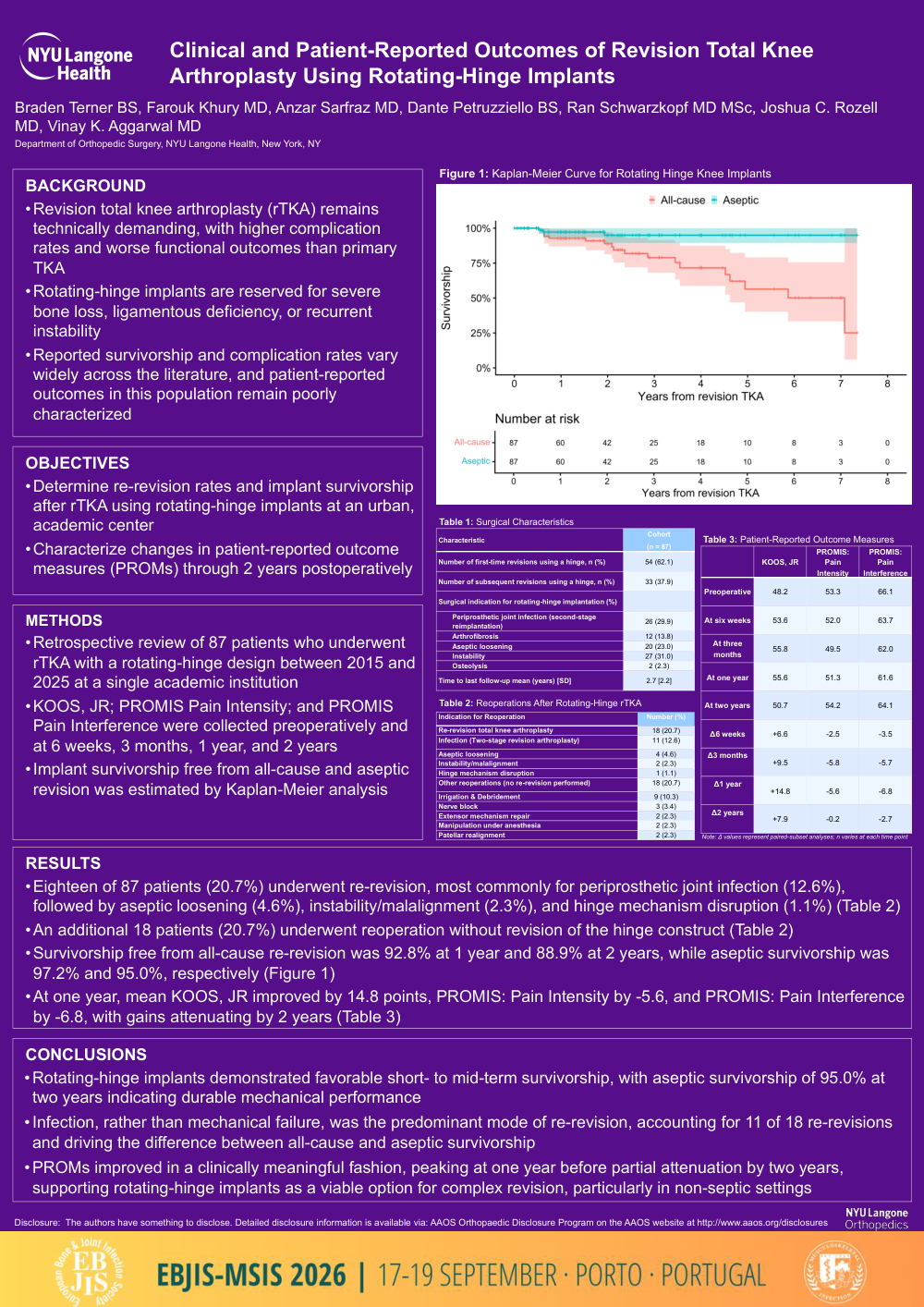
Results: Eighteen of 87 patients (20.7%) underwent re-revision, most commonly for periprosthetic joint infection (12.6%), followed by aseptic loosening (4.6%), instability/malalignment (2.3%), and hinge mechanism disruption (1.1%) (Table 2). An additional 18 patients (20.7%) underwent reoperation without revision of the hinge construct (Table 2). Survivorship free from all-cause re-revision was 92.8% at 1 year and 88.9% at 2 years, while aseptic survivorship was 97.2% and 95.0%, respectively (Figure 1). At one year, mean KOOS, JR improved by 14.8 points, PROMIS Pain Intensity by -5.6, and PROMIS Pain Interference by -6.8, with gains attenuating by 2 years (Table 3).
Conclusions: Rotating-hinge implants demonstrated favorable short- to mid-term survivorship, with aseptic survivorship of 95.0% at two years indicating durable mechanical performance. Infection, rather than mechanical failure, was the predominant mode of re-revision, accounting for 11 of 18 re-revisions and driving the difference between all-cause and aseptic survivorship. PROMs improved in a clinically meaningful fashion, peaking at one year before partial attenuation by two years, supporting rotating-hinge implants as a viable option for complex revision, particularly in non-septic settings.