477 posters, 14 topics, 2,065 authors, 1,055 institutions
ePostersLive by SciGen Technologies S.A. All rights reserved.
The Joint EBJIS-MSIS 2026 Conference
17 - 19 September, 2026 | Porto, Portugal

EP170
Low CRP, Delayed Diagnosis: How Tuberculous Arthritis Differs from Pyogenic Infection
Poster Presenter
Part of Topic
Infectious Diseases
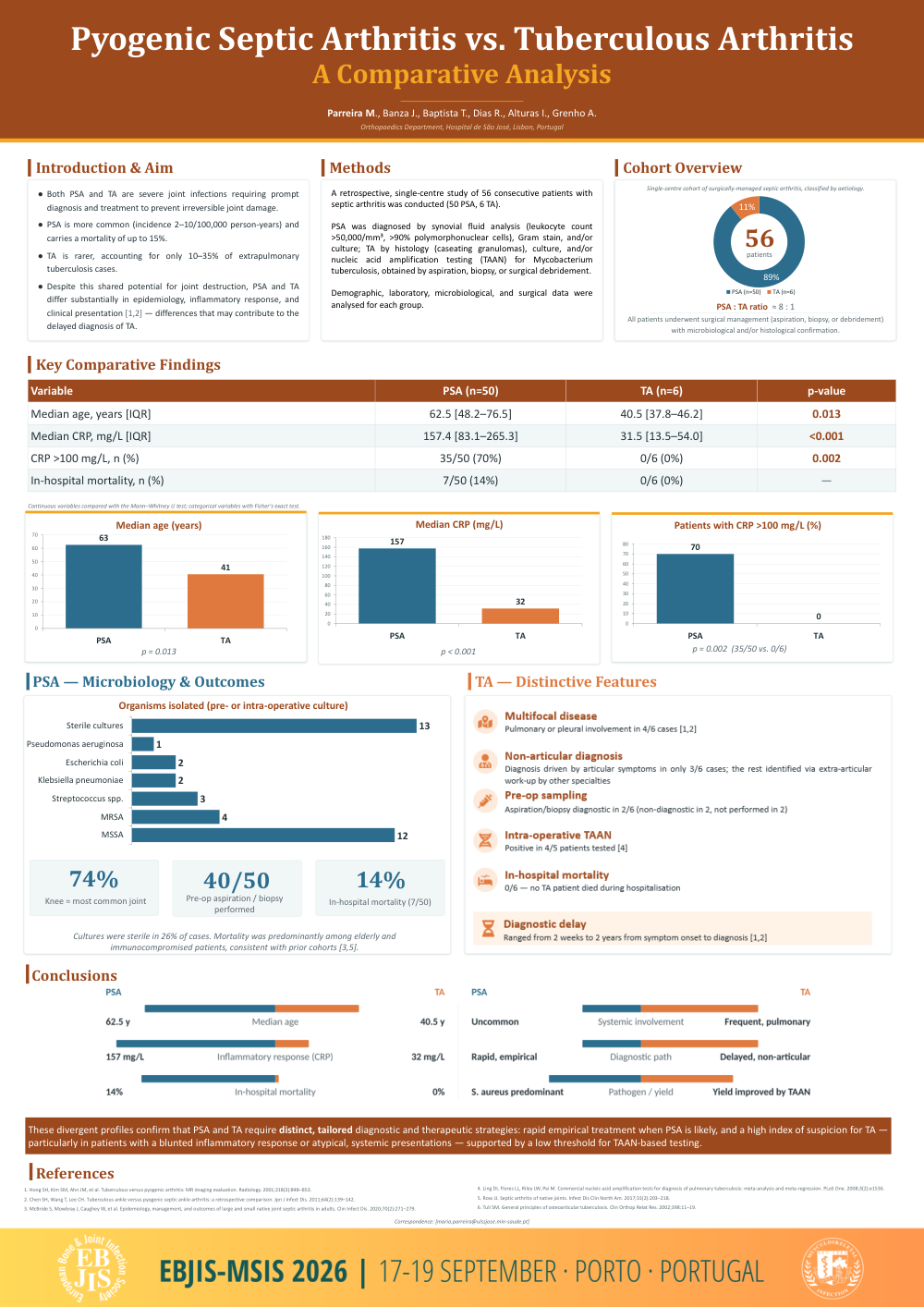
Pyogenic Septic Arthritis vs. Tuberculous Arthritis: A Comparative Analysis
Introduction & Aim:
Pyogenic septic arthritis (PSA) and tuberculous arthritis (TA) are severe joint infections that require prompt diagnosis and treatment. However, they differ substantially in epidemiology, inflammatory response, and clinical presentation, which may contribute to the delayed diagnosis of TA. This study aims to compare PSA and TA across clinical, laboratory, microbiological, and diagnostic characteristics.
Methods:
A retrospective single-centre study of 56 consecutive patients with septic arthritis was conducted (50 PSA and 6 TA). Demographic, laboratory, microbiological, and surgical data were analysed. Continuous variables are presented as medians with interquartile ranges (IQR) and compared using the Mann–Whitney U test. Categorical variables were analysed using Fisher's exact test.
Results:
TA patients were significantly younger than PSA patients (median 40.5 [IQR 37.8–46.2] years vs. 62.5 [IQR 48.2–76.5]; p=0.013) and more likely to be foreign-born. Inflammatory markers were markedly lower in TA (median CRP 31.5 [13.5–54.0] vs. 157.4 [83.1–265.3] mg/L; p<0.001). No TA patient had CRP >100 mg/L, compared with 35/50 (70%) PSA patients (p=0.002).
TA frequently presented with multifocal disease, with pulmonary or pleural involvement in 4/6 cases. Diagnosis was driven by articular symptoms in only 3 cases; in the remaining cases, TA was identified following investigation of extra-articular manifestations by other specialties. Diagnostic delay ranged from 2 weeks to 2 years.
Pre-operative aspiration or biopsy was diagnostic in 2/6 TA cases (non-diagnostic in 2, not performed in 2). Intraoperative TAAN was positive in 4/5 patients tested.
No TA patients died during their hospitalisation.
In PSA, pre-operative aspiration or biopsy was performed in 40/50 patients. The most frequently isolated organism was methicillin-susceptible Staphylococcus aureus (n=12), followed by MRSA (n=4), Streptococcus spp. (n=3), Klebsiella pneumoniae (n=2), Escherichia coli (n=2), and Pseudomonas aeruginosa (n=1). Cultures were sterile in 26% of cases. The knee was the most commonly affected joint (74%). In-hospital mortality was 14% (7/50), predominantly among elderly and immunocompromised patients.
Conclusions:
PSA and TA are distinct clinical entities. TA is characterised by younger age, a lower inflammatory response, frequent systemic involvement, and delayed diagnosis, often driven by non-articular symptoms. A high index of suspicion is essential, particularly in patients with low CRP and atypical presentations. Intraoperative molecular testing may improve diagnostic yield. PSA remains associated with significant mortality, with Staphylococcus aureus as the predominant pathogen.