477 posters, 14 topics, 2,065 authors, 1,055 institutions
ePostersLive by SciGen Technologies S.A. All rights reserved.
The Joint EBJIS-MSIS 2026 Conference
17 - 19 September, 2026 | Porto, Portugal

EP169
Rethinking Infection after Achilles Tendon Repair: a more judicious approach
Poster Presenter
Authors
Arthur Meuris, Laura Bessems, Timothy Peperstraete, Jolien Onsea, Harm Hoekstra, Willem -Jan Metsemakers
Affiliations
Faculty of Medicine, KU Leuven, Leuven, Belgium; Department of Trauma Surgery, University Hospitals Leuven, Leuven, Belgium, Department of Trauma Surgery, University Hospitals Leuven, Leuven, Belgium, Kuleuven
Part of Topic
Infectious Diseases
RETHINKING INFECTION AFTER ACHILLES TENDON REPAIR: A MORE JUDICIOUS APPROACH
Arthur Meuris, Laura Bessems, Timothy Peperstraete, Jolien Onsea, Harm Hoekstra, Willem-Jan Metsemakers
Faculty of Medicine, KU Leuven, Leuven, Belgium • Department of Trauma Surgery, University Hospitals Leuven, Leuven, Belgium
---
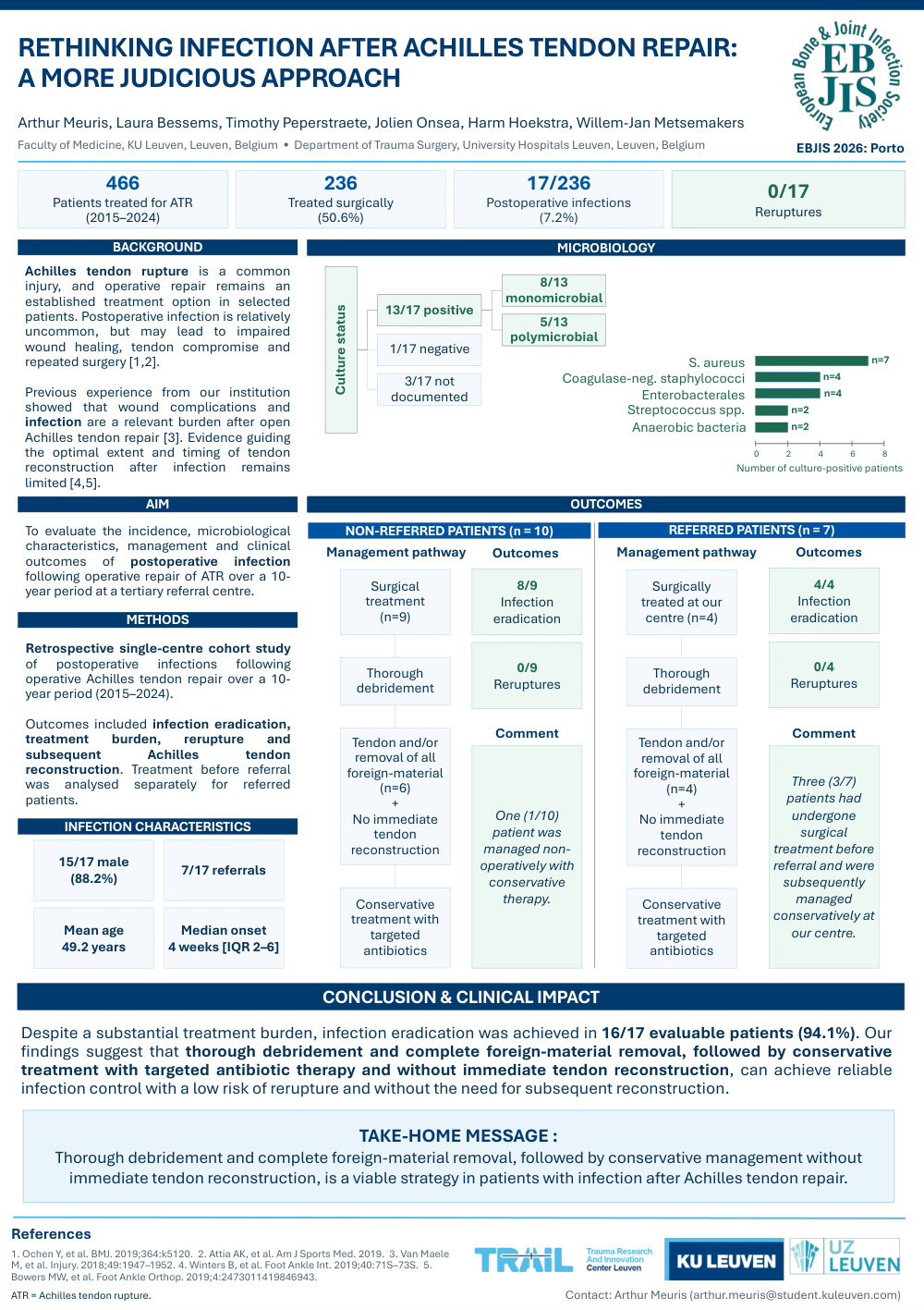
466 Patients treated for ATR (2015–2024)
236 Treated surgically (50.6%)
17/236 Postoperative infections (7.2%)
0/17 Reruptures
BACKGROUND
Achilles tendon rupture is a common injury, and operative repair remains an established treatment option in selected patients. Postoperative infection is relatively uncommon, but may lead to impaired wound healing, tendon compromise and repeated surgery [1,2].
Previous experience from our institution showed that wound complications and infection are a relevant burden after open Achilles tendon repair [3]. Evidence guiding the optimal extent and timing of tendon reconstruction after infection remains limited [4,5].
AIM
To evaluate the incidence, microbiological characteristics, management and clinical outcomes of postoperative infection following operative repair of ATR over a 10-year period at a tertiary referral centre.
METHODS
Retrospective single-centre cohort study of postoperative infections following operative Achilles tendon repair over a 10-year period (2015–2024).
Outcomes included infection eradication, treatment burden, rerupture and subsequent Achilles tendon reconstruction. Treatment before referral was analysed separately for referred patients.
INFECTION CHARACTERISTICS
15/17 male (88.2%)
7/17 referrals
Mean age: 49.2 years
Median onset: 4 weeks [IQR 2–6]
MICROBIOLOGY
Culture status:
13/17 positive
8/13 monomicrobial
5/13 polymicrobial
1/17 negative
3/17 not documented
S. aureus: n=7
Coagulase-negative staphylococci: n=4
Enterobacterales: n=4
Streptococcus spp.: n=2
Anaerobic bacteria: n=2
NON-REFERRED PATIENTS (n=10)
Management pathway:
Surgical treatment (n=9)
Thorough debridement
Tendon and/or removal of all foreign-material + No immediate tendon reconstruction (n=6)
Conservative treatment with targeted antibiotics
Outcomes:
9/10 Infection eradication
0/10 Reruptures
One (1/10) patient was managed non-operatively with conservative therapy.
REFERRED PATIENTS (n=7)
Management pathway:
Surgically treated at our centre (n=4)
Thorough debridement
Tendon and/or removal of all foreign-material + No immediate tendon reconstruction (n=4)
Conservative treatment with targeted antibiotics
Outcomes:
4/4 Infection eradication
0/4 Reruptures
Three (3/7) patients had undergone surgical treatment before referral and were subsequently managed conservatively at our centre.
---
CONCLUSION & CLINICAL IMPACT
Despite a substantial treatment burden, infection eradication was achieved in 13/14 evaluable patients (92.9%). Our findings suggest that thorough debridement and complete foreign-material removal, followed by conservative treatment with targeted antibiotic therapy and without immediate tendon reconstruction, can achieve reliable infection control with a low risk of rerupture and without the need for subsequent reconstruction.
TAKE-HOME MESSAGE
Thorough debridement and complete foreign-material removal, followed by conservative management without immediate tendon reconstruction, is a viable strategy in patients with infection after Achilles tendon repair.
---
REFERENCES
- Ochen Y, et al. BMJ. 2019;364:k5120.
- Attia AK, et al. Am J Sports Med. 2019.
- Van Maele M, et al. Injury. 2018;49:1947–1952.
- Winters B, et al. Foot Ankle Int. 2019;40:71S–73S.
- Bowers MW, et al. Foot Ankle Orthop. 2019;4:2473011419846943.
ATR = Achilles tendon rupture.
Contact: Arthur Meuris (arthur.meuris@student.kuleuven.com)