477 posters, 14 topics, 2,065 authors, 1,055 institutions
ePostersLive by SciGen Technologies S.A. All rights reserved.
The Joint EBJIS-MSIS 2026 Conference
17 - 19 September, 2026 | Porto, Portugal

EP161
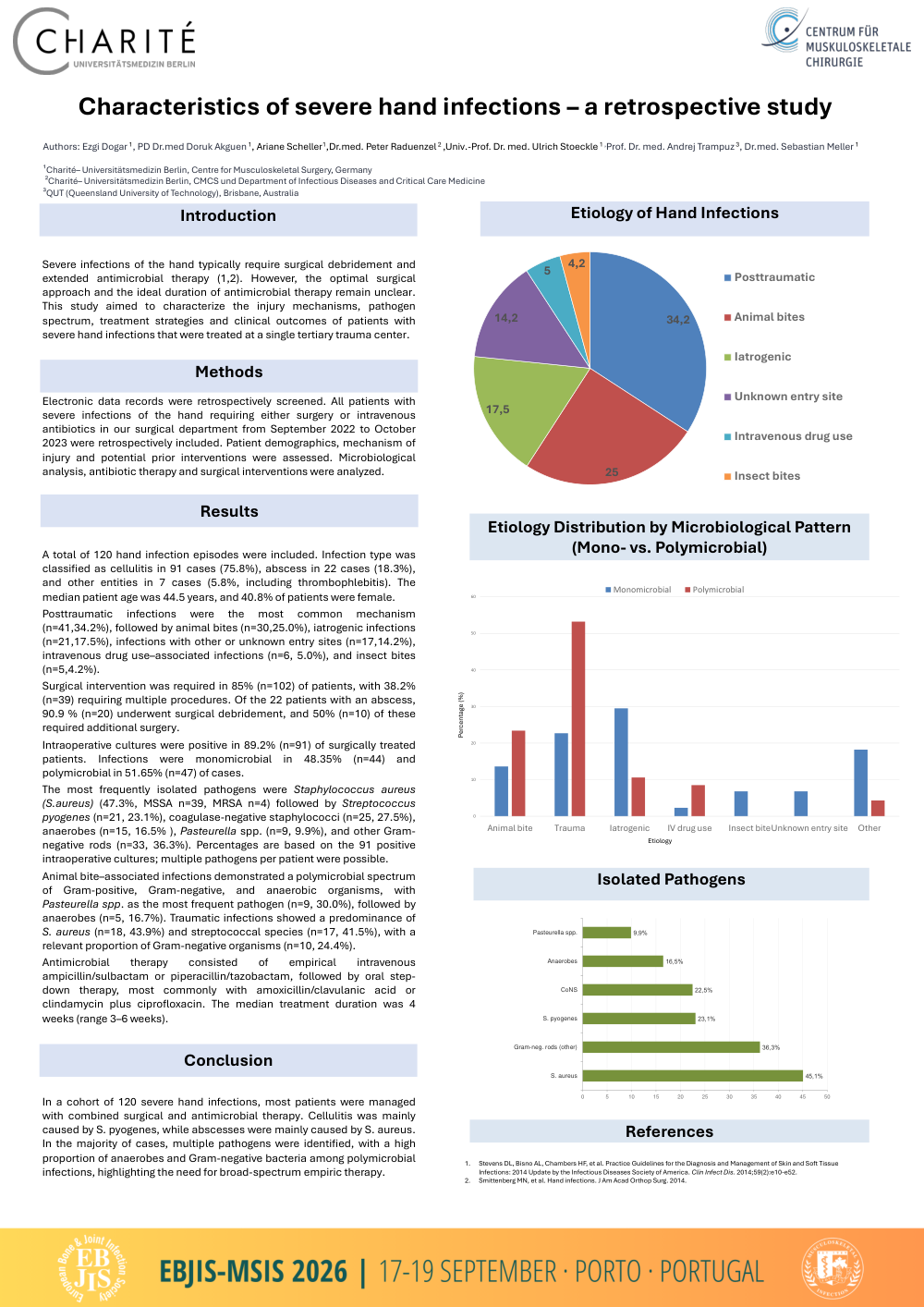
Characteristics of severe hand infections after bites and traumatic injuries a retrospective study
Poster Presenter
Part of Topic
Infectious Diseases
Introduction
Severe infections of the hand typically require surgical debridement and
extended antimicrobial therapy (1,2). However, the optimal surgical
approach and the ideal duration of antimicrobial therapy remain unclear.
This study aimed to characterize the injury mechanisms, pathogen
spectrum, treatment strategies and clinical outcomes of patients with
severe hand infections that were treated at a single tertiary trauma center.
Methods
Electronic data records were retrospectively screened. All patients with
severe infections of the hand requiring either surgery or intravenous
antibiotics in our surgical department from September 2022 to October
2023 were retrospectively included. Patient demographics, mechanism of
injury and potential prior interventions were assessed. Microbiological
analysis, antibiotic therapy and surgical interventions were analyzed.
Results
A total of 120 hand infection episodes were included. Infection type was
classified as cellulitis in 91 cases (75.8%), abscess in 22 cases (18.3%),
and other entities in 7 cases (5.8%, including thrombophlebitis). The
median patient age was 44.5 years, and 40.8% of patients were female.
Posttraumatic infections were the most common mechanism
(n=41,34.2%), followed by animal bites (n=30,25.0%,), iatrogenic infections
(n=21,17.5%), infections with other or unknown entry sites (n=17,14.2%),
intravenous drug use–associated infections (n=6, 5.0%), and insect bites
(n=5,4.2%).
Surgical intervention was required in 85% (n=102) of patients, with 38.2%
(n=39) requiring multiple procedures. Of the 22 patients with an abscess,
90.9 % (n=20) underwent surgical debridement, and 50% (n=10) of these
required additional surgery.
Intraoperative cultures were positive in 89.2% (n=91) of surgically treated
patients. Infections were monomicrobial in 48.35% (n=44) and
polymicrobial in 51.65% (n=47) of cases.
The most frequently isolated pathogens were Staphylococcus aureus
(S.aureus) (47.3%, MSSA n=39, MRSA n=4) followed by Streptococcus
pyogenes (n=21, 23.1%), coagulase-negative staphylococci (n=25, 27.5%),
anaerobes (n=15, 16.5% ), Pasteurella spp. (n=9, 9.9%), and other Gramnegative
rods (n=33, 36.3%). Percentages are based on the 91 positive
intraoperative cultures; multiple pathogens per patient were possible.
Animal bite–associated infections demonstrated a polymicrobial spectrum
of Gram-positive, Gram-negative, and anaerobic organisms, with
Pasteurella spp. as the most frequent pathogen (n=9, 30.0%), followed by
anaerobes (n=5, 16.7%). Traumatic infections showed a predominance of
S. aureus (n=18, 43.9%) and streptococcal species (n=17, 41.5%), with a
relevant proportion of Gram-negative organisms (n=10, 24.4%).
Antimicrobial therapy consisted of empirical intravenous
ampicillin/sulbactam or piperacillin/tazobactam, followed by oral stepdown
therapy, most commonly with amoxicillin/clavulanic acid or
clindamycin plus ciprofloxacin. The median treatment duration was 4
weeks (range 3–6 weeks).
Conclusion
In a cohort of 120 severe hand infections, most patients were managed
with combined surgical and antimicrobial therapy. Cellulitis was mainly
caused by S. pyogenes, while abscesses were mainly caused by S. aureus.
In the majority of cases, multiple pathogens were identified, with a high
proportion of anaerobes and Gram-negative bacteria among polymicrobial
infections, highlighting the need for broad-spectrum empiric therapy.