477 posters, 14 topics, 2,065 authors, 1,055 institutions
ePostersLive by SciGen Technologies S.A. All rights reserved.
The Joint EBJIS-MSIS 2026 Conference
17 - 19 September, 2026 | Porto, Portugal

EP149
Gentamicin-loaded injectable synthetic bone void filler* as a bone graft substitute in the management of tibial plateau fractures
Poster Presenter
Part of Topic
Fracture-Related Infections
Gentamicin-loaded injectable synthetic bone void filler* as a bone graft substitute in the management of tibial plateau fractures
A Retrospective Case Series
Raquel Pinto1, Nuno Oliveira2, Raquel Costa2, Rodrigo Lopes3, Luís Barbosa2
1ULS São José, Lisbon, Portugal 2 Hospital Beatriz Ângelo, Loures, Portugal 3 Hospital Ortopédico de Sant’Ana, Parede, Portugal
Introduction
Tibial plateau fractures are complex articular injuries frequently associated with bone defects, with fracture-related infection among the main complications after osteosynthesis.
Bone substitutes have gained relevance by reducing donor-site morbidity associated with autologous bone grafting, while additionally enabling local antibiotic delivery.
The substitute used is an injectable calcium phosphate–based bioceramic combined with gentamicin, associating osteoconductive properties with local antibiotic release.
Objective
To evaluate the clinical and radiological outcomes of this gentamicin-eluting bone substitute in the surgical treatment of tibial plateau fractures.
Material, methods and results
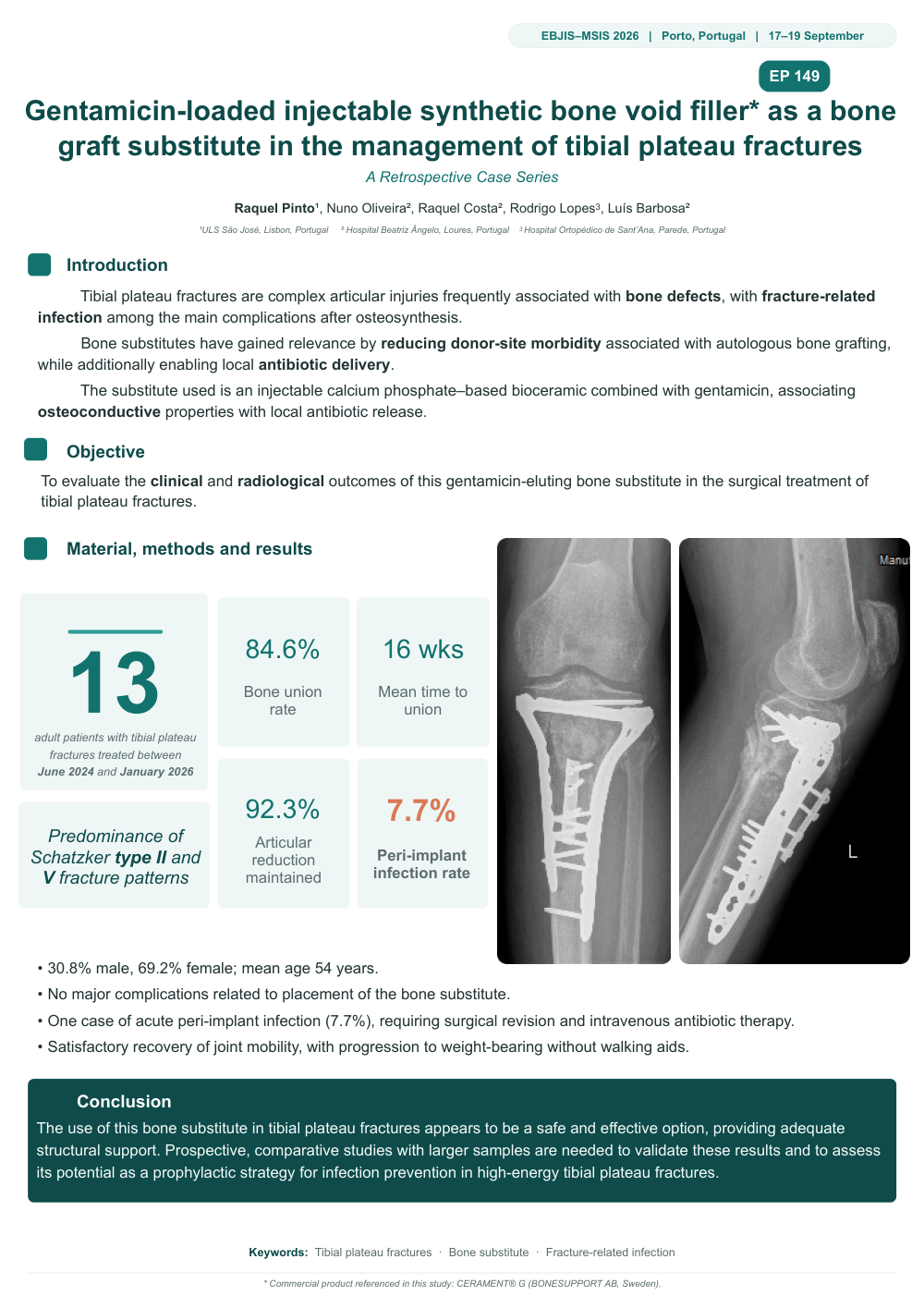
13 adult patients with tibial plateau fractures treated between June 2024 and January 2026
Predominance of Schatzker type II and V fracture pattern
84.6% Bone union rate
16 wks Mean time to union
92.3%Articular reduction maintained
7.7% Peri-implant infection rate
30.8% male, 69.2% female; mean age 54 years.
No major complications related to placement of the bone substitute.
One case of acute peri-implant infection (7.7%), requiring surgical revision and intravenous antibiotic therapy.
Satisfactory recovery of joint mobility, with progression to weight-bearing without walking aids
Conclusion
The use of this bone substitute in tibial plateau fractures appears to be a safe and effective option, providing adequate structural support. Prospective, comparative studies with larger samples are needed to validate these results and to assess its potential as a prophylactic strategy for infection prevention in high-energy tibial plateau fractures.
Keywords: Tibial plateau fractures · Bone substitute · Fracture-related infection * Commercial product referenced in this study: CERAMENT® G (BONESUPPORT AB, Sweden).