477 posters, 14 topics, 2,065 authors, 1,055 institutions
ePostersLive by SciGen Technologies S.A. All rights reserved.
The Joint EBJIS-MSIS 2026 Conference
17 - 19 September, 2026 | Porto, Portugal

EP148
Cumulative Metabolic-Risk Score Predicts Fracture-Related Infection Following Operative Fixation of Proximal Humerus Fractures
Poster Presenter
Part of Topic
Fracture-Related Infections
Title
Cumulative Metabolic-Risk Score Predicts Fracture-Related Infection Following Operative Fixation of Proximal Humerus Fractures
Authors:
Rohan Chandrashekhar, Vinay Chandrasekaran, Patrick Fernicola, Matt Tucker, Kyle Cichos
Aim
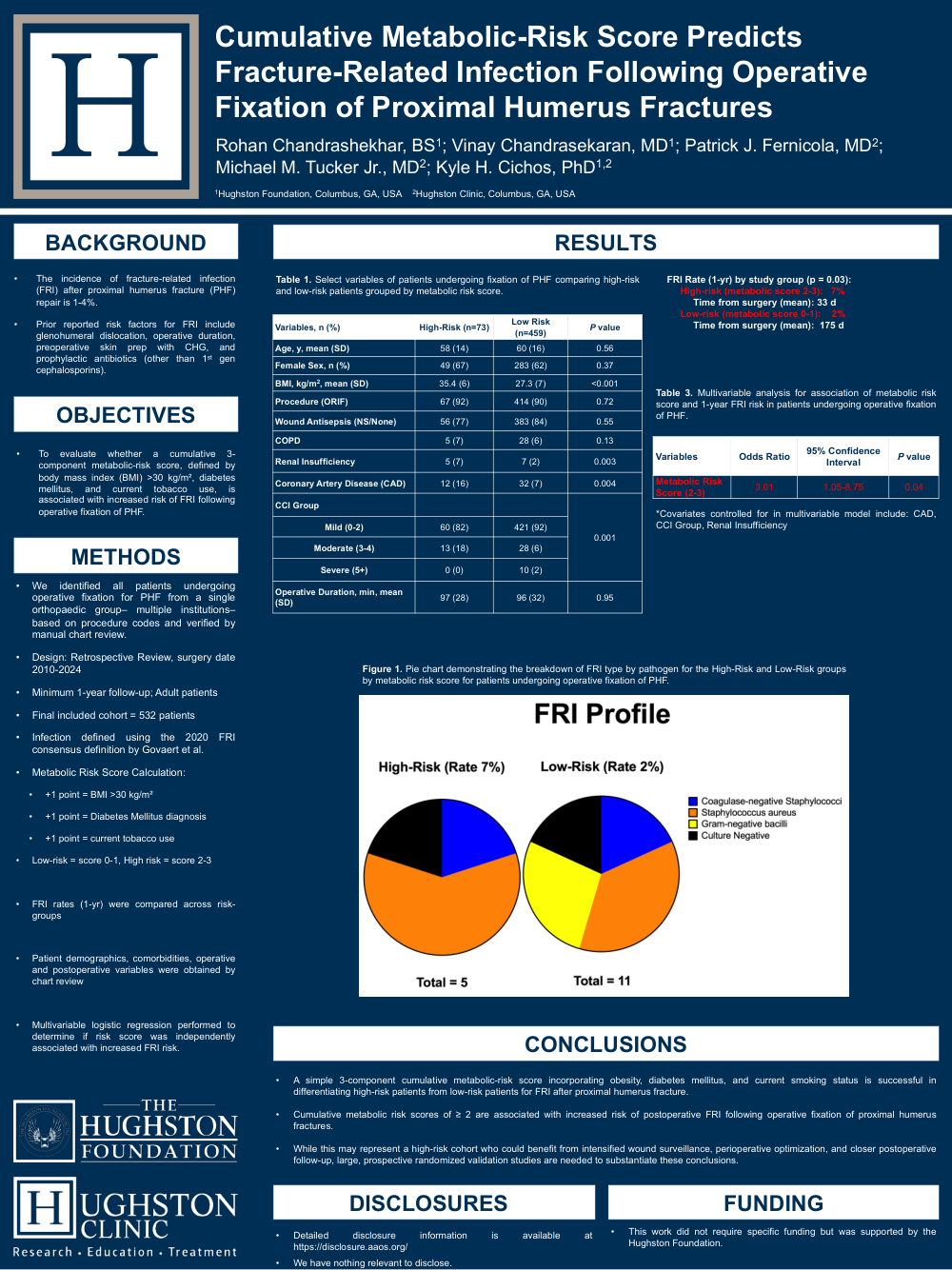
The purpose of the present study was to evaluate whether a cumulative 3-component metabolic-risk score, defined by body mass index (BMI) >30 kg/m², diabetes mellitus, and current tobacco use, is associated with increased risk of fracture-related infection (FRI) following operative fixation of proximal humerus fractures (PHF).
Methods
A retrospective review of patients undergoing operative fixation for PHF was conducted at a single orthopaedic group between 2010-2021. The final cohort included 532 patients meeting inclusion criteria of adult patients with minimum 12-month follow-up, of which 16 (3%) were diagnosed with FRI according to current consensus criteria (Govaert et al., 2020). Patients received one point each for BMI >30 kg/m², diabetes mellitus, and current tobacco use, yielding a cumulative metabolic-risk score ranging from 0 to 3 of which they were classified into low-risk (score 0-1) and high-risk (score 2-3). Infection rates were compared across score groups, and multivariable logistic regression was performed to determine whether increasing score independently predicted postoperative infection after controlling for significant demographic and operative variables.
Results
The cohort included 459 (86%) low-risk patients with cumulative metabolic-risk score 0-1 and 73 (14%) high-risk patients with score 2-3. The rate of FRI was increased in the high-risk group (7%, n=5) compared to the low-risk group (2%, n=11) (p=0.03). Multivariable analysis supported the independent predictive value of cumulative metabolic risk score grouping as the high-risk group resulted in 3 times increased risk of FRI compared to low-risk group (OR 3.01, 95% CI 1.05-8.75, p=0.04).
Conclusion
A simple 3-component cumulative metabolic-risk score incorporating obesity, diabetes mellitus, and current smoking status is successful in differentiating high-risk patients from low-risk patients for FRI after proximal humerus fracture. Cumulative metabolic risk scores of ≥ 2 are associated with increased risk of postoperative FRI following operative fixation of proximal humerus fractures. This may represent a high-risk cohort who could benefit from intensified wound surveillance, perioperative optimization, and closer postoperative follow-up. That said, large, prospective randomized validation studies are needed to substantiate these conclusions.