477 posters, 14 topics, 2,065 authors, 1,055 institutions
ePostersLive by SciGen Technologies S.A. All rights reserved.
The Joint EBJIS-MSIS 2026 Conference
17 - 19 September, 2026 | Porto, Portugal

EP146
Does Temporary External Fixation Influence The Infection Rate and Clinical Outcomes in Ankle Fractures?
Poster Presenter
Authors
Jo?o De Sousa Seixas, M?rio Rui Silva, Bianca Barros, Afonso Faria, Francisco Serra, Ant?nio Gon?alo Silva, Ricardo Sousa, Andre Dias Carvalho
Affiliations
Orthopaedics Department, Unidade Local de Sa?de de Santo Ant?nio, Porto, Portugal, Porto Bone and Joint Infection Group (GRIP), Porto, Portugal; Hospital Lus?adas Porto, Porto, Portugal, Orthopaedics Department, Unidade Local de Sa?de de Santo Ant?nio, Porto, Portugal; Porto Bone and Joint Infection Group (GRIP), Porto, Portugal, Uls Santo Ant?nio
Part of Topic
Fracture-Related Infections
Ankle fracture-dislocations are unstable injuries requiring urgent reduction to preserve soft tissues. While temporary external fixation (ExFix) provides enhanced stability over splinting, concerns remain regarding increased surgical waiting times and its necessity relative to conservative management.
This study aims to compare surgical waiting times, postoperative complications, and functional outcomes between patients treated with temporary EF versus direct definitive surgery.
Retrospective case-control study
Included ankle fractures or fracture-dislocations who underwent definitive surgical fixation. The study group, consisting of patients initially managed with temporary external fixation Control group: patients managed without ExFix in a 1:2 ratio Demographic data, fracture patterns, and the time interval to definitive surgery were matched and recorded.
Primary outcomes: Postoperative complication rates Functional status, assessed using a categorical satisfaction scale (“unsatisfied,” “moderately satisfied,” and “highly satisfied”).
69 patients included Median age 60 years old 57% female 23 (33,3%) treated initially with ExFix Trimalleolar fractures and fracture-dislocations were the most prevalent injury patterns (78%). The median waiting time for definitive surgery was significantly longer in the external fixation group (14 vs. 5 days).
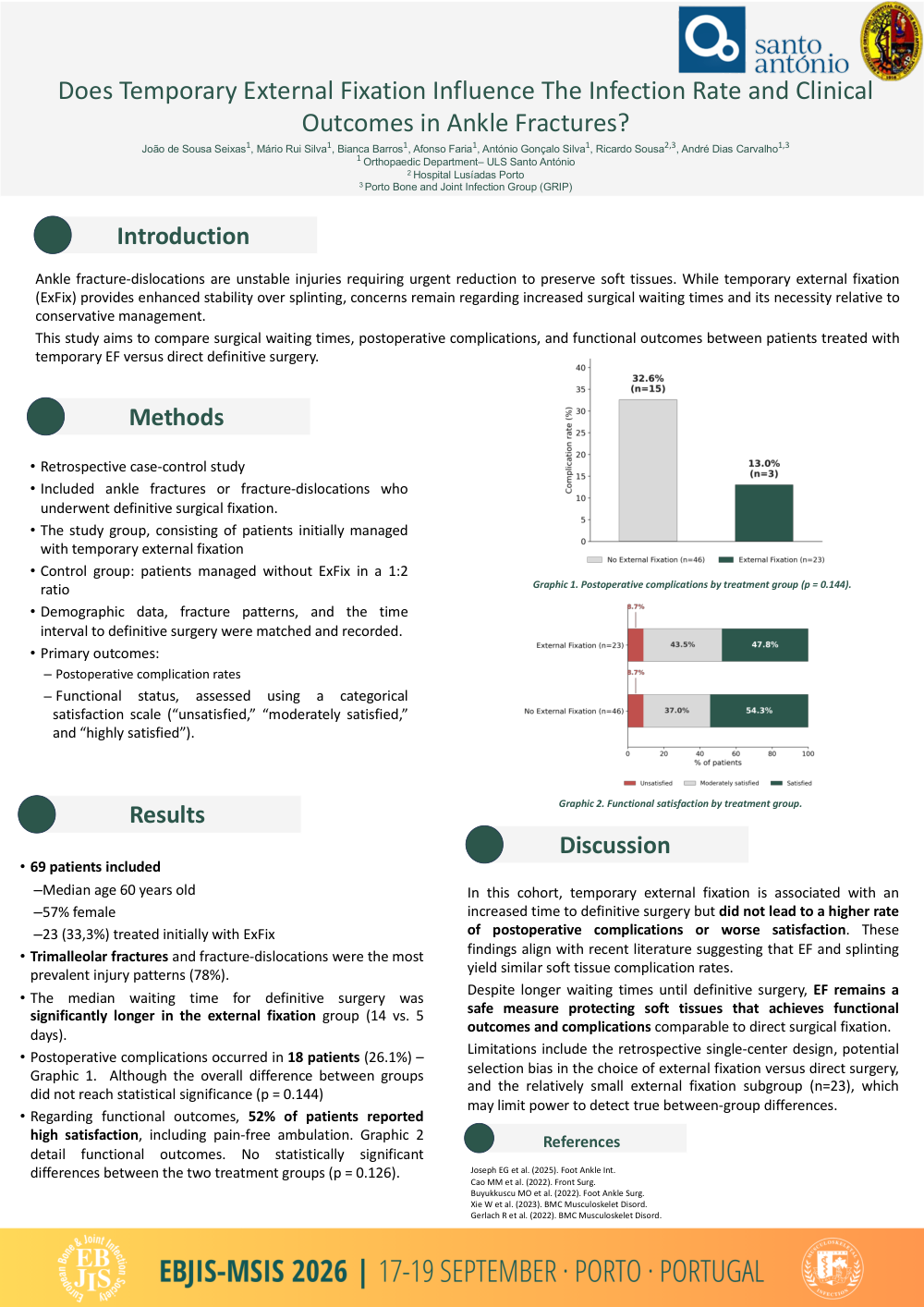
Postoperative complications occurred in 18 patients (26.1%) – Graphic 1. Although the overall difference between groups did not reach statistical significance (p = 0.144) Regarding functional outcomes, 52% of patients reported high satisfaction, including pain-free ambulation. Graphic 2 detail functional outcomes. No statistically significant differences between the two treatment groups (p = 0.126).
In this cohort, temporary external fixation is associated with an increased time to definitive surgery but did not lead to a higher rate of postoperative complications or worse satisfaction. These findings align with recent literature suggesting that EF and splinting yield similar soft tissue complication rates. Despite longer waiting times until definitive surgery, EF remains a safe measure protecting soft tissues that achieves functional outcomes and complications comparable to direct surgical fixation. Limitations include the retrospective single-center design, potential selection bias in the choice of external fixation versus direct surgery, and the relatively small external fixation subgroup (n=23), which may limit power to detect true between-group differences.