477 posters, 14 topics, 2,065 authors, 1,055 institutions
ePostersLive by SciGen Technologies S.A. All rights reserved.
The Joint EBJIS-MSIS 2026 Conference
17 - 19 September, 2026 | Porto, Portugal

EP140
Resorbable Mesh Cages for Segmental Bone Defect Reconstruction Following Long Bone Infection
Poster Presenter
Authors
Jakob Lischka, Cornelius Grimme, Geert Fieten, Michaela Haas
Affiliations
Part of Topic
Fracture-Related Infections
Resorbable Mesh Cages for Segmental Bone Defect Reconstruction Following Long Bone Infection
Introduction & Aims:
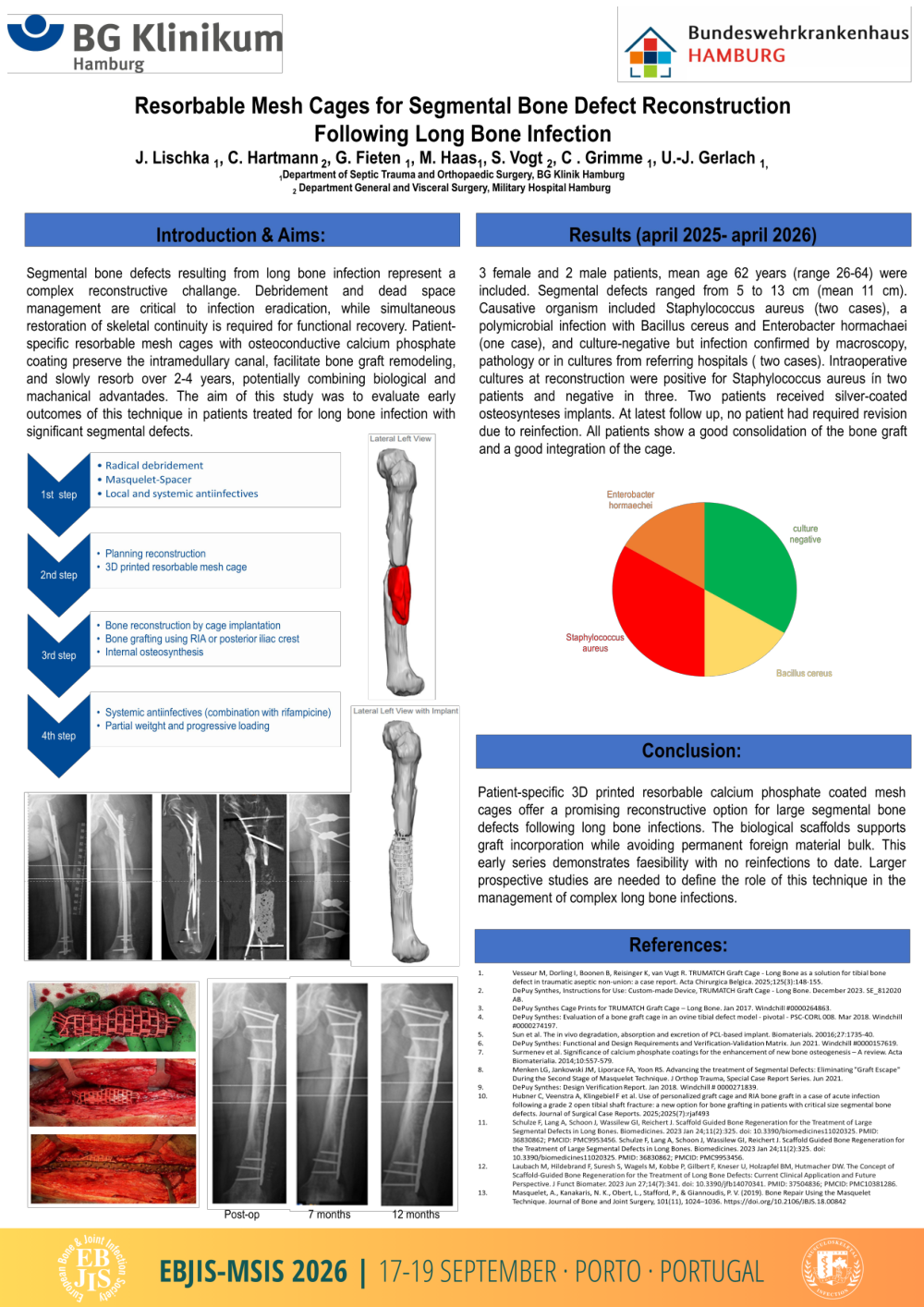
Segmental bone defects resulting from long bone infection represent a complex reconstructive challange. Debridement and dead space management are critical to infection eradication, while simultaneous restoration of skeletal continuity is required for functional recovery. Patient-specific resorbable mesh cages with osteoconductive calcium phosphate coating preserve the intramedullary canal, facilitate bone graft remodeling, and slowly resorb over 2-4 years, potentially combining biological and machanical advantades. The aim of this study was to evaluate early outcomes of this technique in patients treated for long bone infection with significant segmental defects.
Results (april 2025- april 2026):
3 female and 2 male patients, mean age 62 years (range 26-64) were included. Segmental defects ranged from 5 to 13 cm (mean 11 cm). Causative organism included Staphylococcus aureus (two cases), a polymicrobial infection with Bacillus cereus and Enterobacter hormachaei (one case), and culture-negative but infection confirmed by macroscopy, pathology or in cultures from referring hospitals ( two cases). Intraoperative cultures at reconstruction were positive for Staphylococcus aureus ín two patients and negative in three. Two patients received silver-coated osteosynteses implants. At latest follow up, no patient had required revision due to reinfection. All patients show a good consolidation of the bone graft and a good integration of the cage.
Conclusion:
Patient-specific 3D printed resorbable calcium phosphate coated mesh cages offer a promising reconstructive option for large segmental bone defects following long bone infections. The biological scaffolds supports graft incorporation while avoiding permanent foreign material bulk. This early series demonstrates faesibility with no reinfections to date. Larger prospective studies are needed to define the role of this technique in the management of complex long bone infections.