477 posters, 14 topics, 2,065 authors, 1,055 institutions
ePostersLive by SciGen Technologies S.A. All rights reserved.
The Joint EBJIS-MSIS 2026 Conference
17 - 19 September, 2026 | Porto, Portugal

EP139
Definitive External Fixation and Early Soft Tissue Closure Enable One-Stage Orthoplastic Management of Mine-Blast Open Fractures Instead of Staged Revision
Poster Presenter
Part of Topic
Fracture-Related Infections
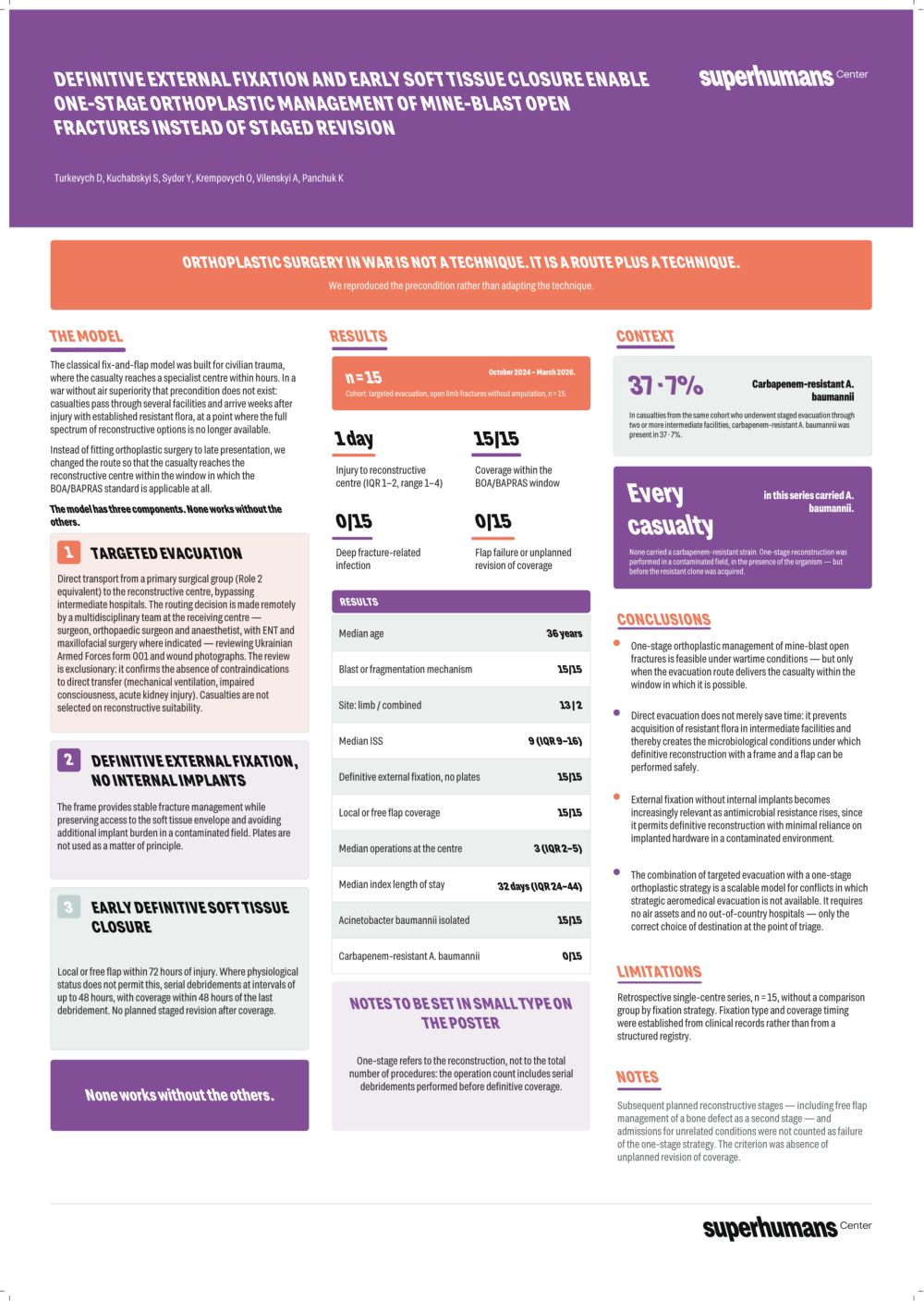
DEFINITIVE EXTERNAL FIXATION AND EARLY SOFT TISSUE CLOSURE ENABLE ONE-STAGE ORTHOPLASTIC MANAGEMENT OF MINE-BLAST OPEN FRACTURES INSTEAD OF STAGED REVISION
Turkevych D, Kuchabskyi S, Sydor Y, Krempovych O, Vilenskyi A, Panchuk K
ORTHOPLASTIC SURGERY IN WAR IS NOT A TECHNIQUE. IT IS A ROUTE PLUS A TECHNIQUE. We reproduced the precondition rather than adapting the technique.
THE MODEL
The classical fix-and-flap model was built for civilian trauma, where the casualty reaches a specialist centre within hours. In a war without air superiority that precondition does not exist: casualties pass through several facilities and arrive weeks after injury with established resistant flora, at a point where the full spectrum of reconstructive options is no longer available.
Instead of fitting orthoplastic surgery to late presentation, we changed the route so that the casualty reaches the reconstructive centre within the window in which the BOA/BAPRAS standard is applicable at all.
The model has three components. None works without the others.
1 — TARGETED EVACUATION Direct transport from a primary surgical group (Role 2 equivalent) to the reconstructive centre, bypassing intermediate hospitals. The routing decision is made remotely by a multidisciplinary team at the receiving centre — surgeon, orthopaedic surgeon and anaesthetist, with ENT and maxillofacial surgery where indicated — reviewing Ukrainian Armed Forces form 001 and wound photographs. The review is exclusionary: it confirms the absence of contraindications to direct transfer (mechanical ventilation, impaired consciousness, acute kidney injury). Casualties are not selected on reconstructive suitability.
2 — DEFINITIVE EXTERNAL FIXATION, NO INTERNAL IMPLANTS The frame provides stable fracture management while preserving access to the soft tissue envelope and avoiding additional implant burden in a contaminated field. Plates are not used as a matter of principle.
3 — EARLY DEFINITIVE SOFT TISSUE CLOSURE Local or free flap within 72 hours of injury. Where physiological status does not permit this, serial debridements at intervals of up to 48 hours, with coverage within 48 hours of the last debridement. No planned staged revision after coverage.
None works without the others.
RESULTS
n = 15 · October 2024 – March 2026 Cohort: targeted evacuation, open limb fractures without amputation, n = 15.
- 1 day — Injury to reconstructive centre (IQR 1–2, range 1–4)
- 15/15 — Coverage within the BOA/BAPRAS window
- 0/15 — Deep fracture-related infection
- 0/15 — Flap failure or unplanned revision of coverage
| Median age | 36 years |
| Blast or fragmentation mechanism | 15/15 |
| Site: limb / combined | 13 | 2 |
| Median ISS | 9 (IQR 9–16) |
| Definitive external fixation, no plates | 15/15 |
| Local or free flap coverage | 15/15 |
| Median operations at the centre | 3 (IQR 2–5) |
| Median index length of stay | 32 days (IQR 24–44) |
| Acinetobacter baumannii isolated | 15/15 |
| Carbapenem-resistant A. baumannii | 0/15 |
NOTE ON THE OPERATION COUNT One-stage refers to the reconstruction, not to the total number of procedures: the operation count includes serial debridements performed before definitive coverage.
CONTEXT
37·7% — Carbapenem-resistant A. baumannii In casualties from the same cohort who underwent staged evacuation through two or more intermediate facilities, carbapenem-resistant A. baumannii was present in 37·7%.
Every casualty in this series carried A. baumannii. None carried a carbapenem-resistant strain. One-stage reconstruction was performed in a contaminated field, in the presence of the organism — but before the resistant clone was acquired.
CONCLUSIONS
- One-stage orthoplastic management of mine-blast open fractures is feasible under wartime conditions — but only when the evacuation route delivers the casualty within the window in which it is possible.
- Direct evacuation does not merely save time: it prevents acquisition of resistant flora in intermediate facilities and thereby creates the microbiological conditions under which definitive reconstruction with a frame and a flap can be performed safely.
- External fixation without internal implants becomes increasingly relevant as antimicrobial resistance rises, since it permits definitive reconstruction with minimal reliance on implanted hardware in a contaminated environment.
- The combination of targeted evacuation with a one-stage orthoplastic strategy is a scalable model for conflicts in which strategic aeromedical evacuation is not available. It requires no air assets and no out-of-country hospitals — only the correct choice of destination at the point of triage.
LIMITATIONS
Retrospective single-centre series, n = 15, without a comparison group by fixation strategy. Fixation type and coverage timing were established from clinical records rather than from a structured registry.
NOTES
Subsequent planned reconstructive stages — including free flap management of a bone defect as a second stage — and admissions for unrelated conditions were not counted as failure of the one-stage strategy. The criterion was absence of unplanned revision of coverage.