477 posters, 14 topics, 2,065 authors, 1,055 institutions
ePostersLive by SciGen Technologies S.A. All rights reserved.
The Joint EBJIS-MSIS 2026 Conference
17 - 19 September, 2026 | Porto, Portugal

EP136
Infection After Hip Periprosthetic Fracture Fixation: A Two-Centre Study of Risk Factors, Treatment, and Mortality
Part of Topic
Fracture-Related Infections
Background:
The global rise in periprosthetic femoral fractures is an unintended consequence of advances in healthcare, including increased life expectancy, expanding indications for total hip arthroplasty, and the growing feasibility of performing arthroplasty in older and more medically complexpatients1. Surgical fixation represents a major physiological insult in this already frail population. Post-operative infection is difficult to recognise early because expected clinical and biochemical inflammatory changes may mimic infection, while progression to involve the prosthetic joint can result in substantial morbidity, repeated surgery, and increased mortality. Sparse previous literature has identified operative duration, blood loss, and dialysis dependence as potential risk factors for infection2. This study evaluates outcomes following operative treatment of hip periprosthetic fracture fixation (PPFF) at two centres, with a focus on factors associated with post-operative infection.
Methods:
A three-year retrospective cohort study spanning 2023-2026 was completed reviewing patients undergoing PPFF.
Any Vancouver subtype, cemented or uncemented, ± revision
Excluded pre-existing joint infection, pathological fracture and immunocompromise.
Data were collected from two hospitals, in New Zealand and in the United Kingdom. Cases were identified by cross-referencing the local theatre operation registry and prosthetic infection databases.
The primary outcome was surgical site infection within three months.
Results:
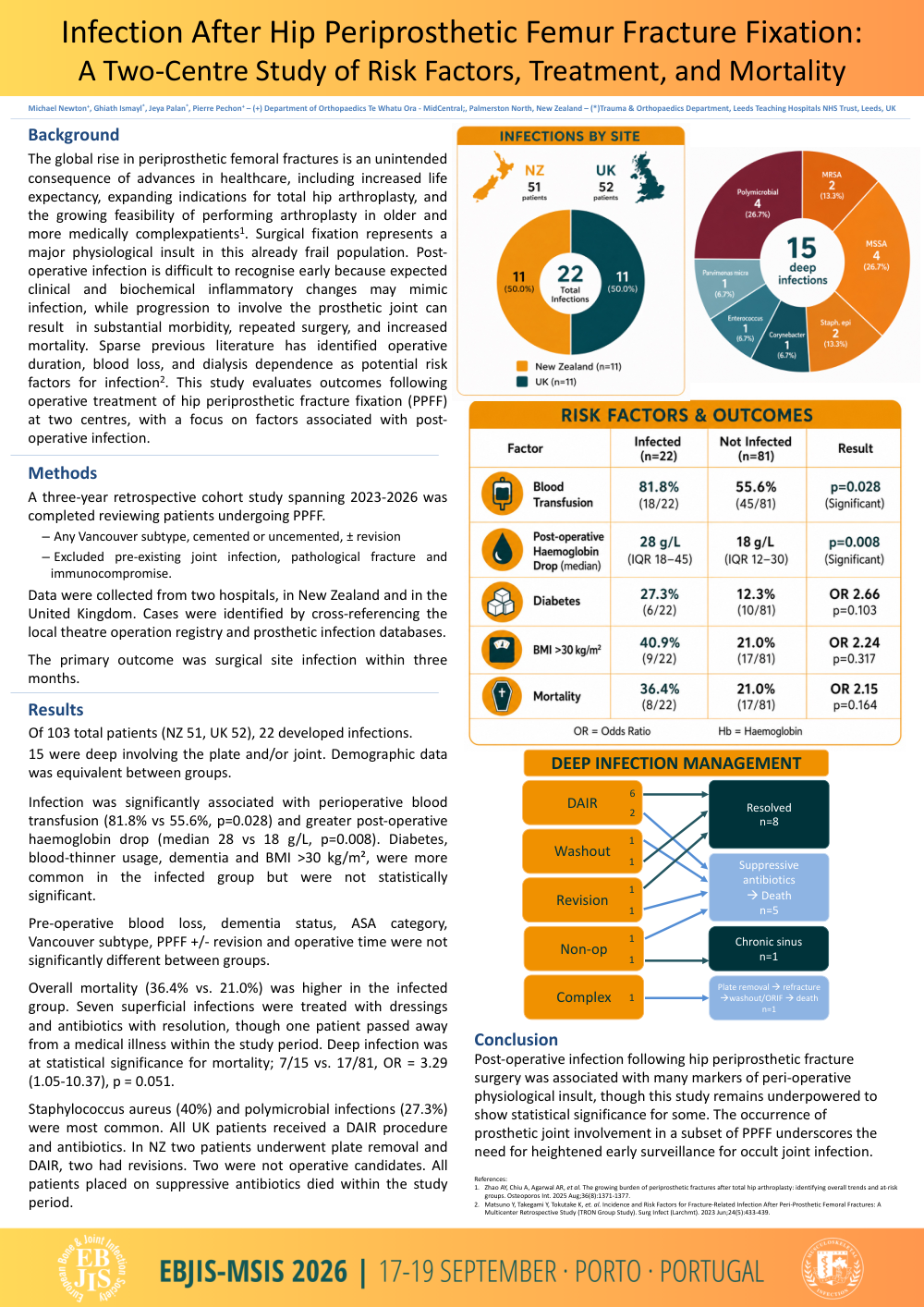
Of 103 total patients (NZ 51, UK 52), 22 developed infections.
15 were deep involving the plate and/or joint. Demographic data was equivalent between groups.
Infection was significantly associated with perioperative blood transfusion (81.8% vs 55.6%, p=0.028) and greater post-operative haemoglobin drop (median 28 vs 18 g/L, p=0.008). Diabetes, blood-thinner usage, dementia and BMI >30 kg/m², were more common in the infected group but were not statistically significant.
Pre-operative blood loss, dementia status, ASA category, Vancouver subtype, PPFF +/- revision and operative time were not significantly different between groups.
Overall mortality (36.4% vs. 21.0%) was higher in the infected group. Seven superficial infections were treated with dressings and antibiotics with resolution, though one patient passed away from a medical illness within the study period. Deep infection was at statistical significance for mortality; 7/15 vs. 17/81, OR = 3.29 (1.05-10.37), p = 0.051.
Staphylococcus aureus (40%) and polymicrobial infections (27.3%) were most common. All UK patients received a DAIR procedure and antibiotics. In NZ two patients underwent plate removal and DAIR, two had revisions. Two were not operative candidates. All patients placed on suppressive antibiotics died within the study period.
Conclusion:
Post-operative infection following hip periprosthetic fracture surgery was associated with many markers of peri-operative physiological insult, though this study remains underpowered to show statistical significance for some. The occurrence of prosthetic joint involvement in a subset of PPFF underscores the need for heightened early surveillance for occult joint infection.