477 posters, 14 topics, 2,065 authors, 1,055 institutions
ePostersLive by SciGen Technologies S.A. All rights reserved.
The Joint EBJIS-MSIS 2026 Conference
17 - 19 September, 2026 | Porto, Portugal

EP135
Management of Bone Infection in the Upper Limb
Poster Presenter
Authors
Andrew Hotchen, Mathew Baldwin, Thomas Stevenson, Alistair Reed, Vicky Pullinger, Alex Ramsden, David Stubbs, Jamie Ferguson, Martin McNally
Affiliations
University Of Oxford, Oxford University Hospitals, Oxford, United Kingdom; University of Oxford, Oxford, United Kingdom, Oxford University Hospitals, Oxford, United Kingdom
Part of Topic
Fracture-Related Infections
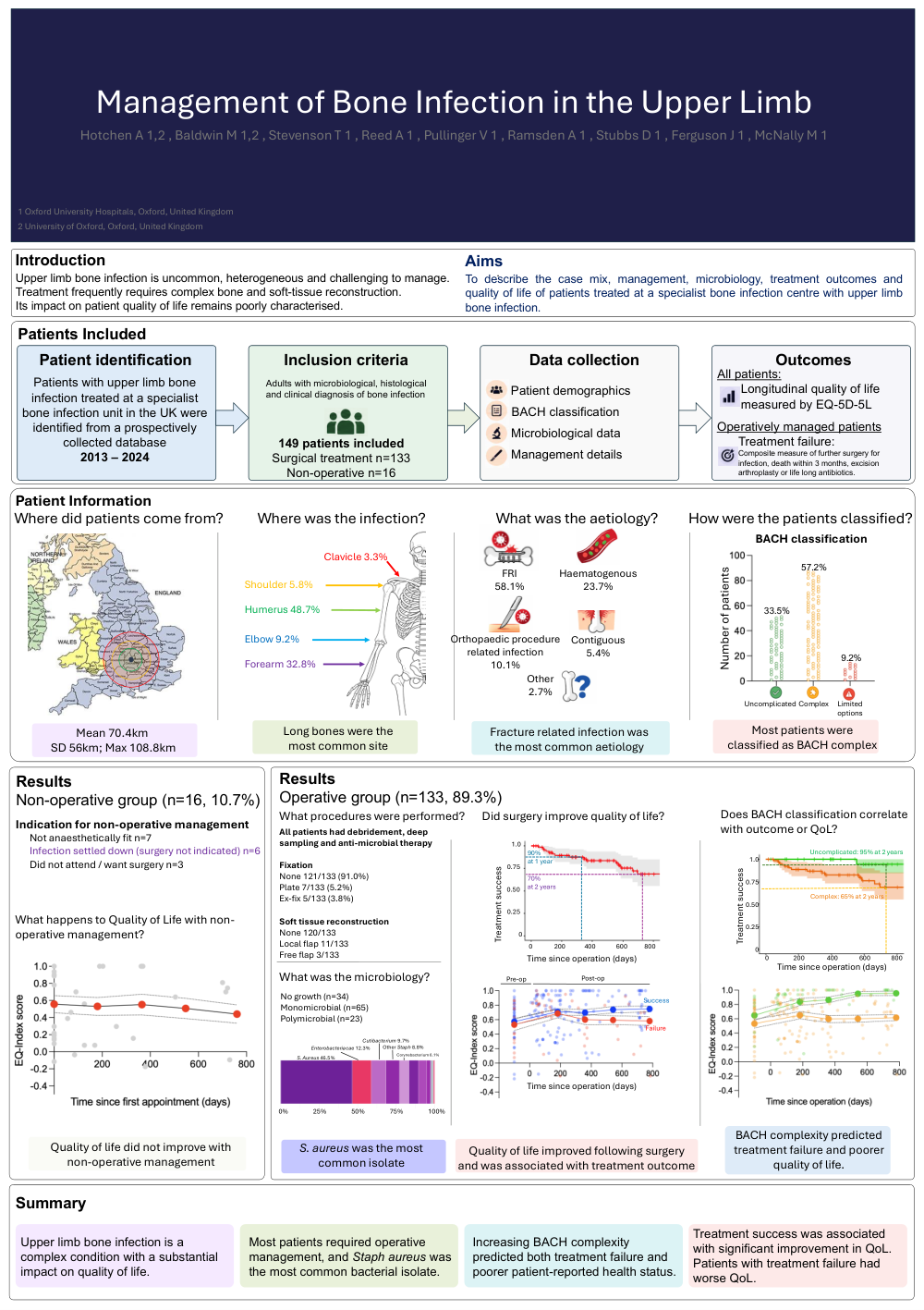
Aim: To describe the clinical characteristics, management strategies, microbiology, and outcomes of patients treated for upper limb bone infection at a tertiary referral centre, including longitudinal patient-reported health status.
Methods: A cohort study of patients treated for upper limb bone infection identified between 2013 and 2024 in a single specialist bone infection centre. Bones included were clavicle, humerus, radius, and ulnar. Demographic, clinical, microbiological, and surgical data were collected, including infection aetiology, BACH classification, treatment strategy, and follow-up. The primary outcome was treatment failure. Secondary outcomes included EQ-5D-5L utility score. Longitudinal EQ-5D-5L scores were summarised using normalised trapezoidal area under the curve (AUC).
Results: A total of 148 patients met the inclusion criteria for infection (mean age 50.4years SD 17.6 years). Infection followed fracture in 88 patients (59.5%), haematogenous osteomyelitis in 35 (23.6%), following orthopaedic procedures in 15 (10.1%), and 12 were contiguous focus (8.1%). Patients were referred from a mean distance of 78.5km (SD 50.5km) from their home. Forty-eight cases (32.4%) were classified as BACH-uncomplicated, 84 (56.8%) BACH-complex, and 16 (10.8%) BACH-limited options.
Overall, 133 patients underwent surgery, with a standardized protocol of pre-operative optimization, deep tissue sampling, debridement, stabilization and skin closure, usually in a single stage procedure. Patients had initial empiric antibiotics after sampling with definitive therapy decided after culture and usually within 7 days of surgery. Baseline EQ-5D-5L utility was similar in operative and non-operative groups (0.649, IQR 0.35-0.778 vs 0.548, IQR 0.157-0.9). In surgical cases, 122 (91.7%) received local antibiotics, and 15 (11.3%) required flap coverage. Staphylococcus aureus was the commonest isolate (39.8%); 23 (17.3%) infections were polymicrobial and Cutibacterium acnes was isolated in only 11 (8.3%) patients, despite prolonged culture in an automated blood culture system (BD BACTEC™).
In 16/133 (12.0%) patients, surgical treatment failed at a median follow-up of 1.6 years (IQR 0.93-2.6) Treatment failure was more frequent in BACH-complex than BACH-uncomplicated cases (17.9% vs 2.1%, p<0.001). Patients with treatment failure had worse longitudinal normalised EQ-5D-5L scores than those without failure (0.554 vs 0.774, p=0.036), and BACH-complex cases had worse scores than BACH-uncomplicated cases (0.691 vs 0.930, p<0.001).
Conclusion: Upper limb bone infection is a complex condition associated with substantial treatment burden and a 12% treatment failure rate. The BACH classification accurately predicted clinical failure and patient-reported health status. Successful treatment produced substantial improvement in quality of life, close to age-matched population norms.