477 posters, 14 topics, 2,065 authors, 1,055 institutions
ePostersLive by SciGen Technologies S.A. All rights reserved.
The Joint EBJIS-MSIS 2026 Conference
17 - 19 September, 2026 | Porto, Portugal

EP134
Multidisciplinary Treatment Algorithm for Fracture-Related Infection: Integrating Reconstructive Plastic Surgery as a Decision-Making Driver
Poster Presenter
Part of Topic
Fracture-Related Infections
Introduction:
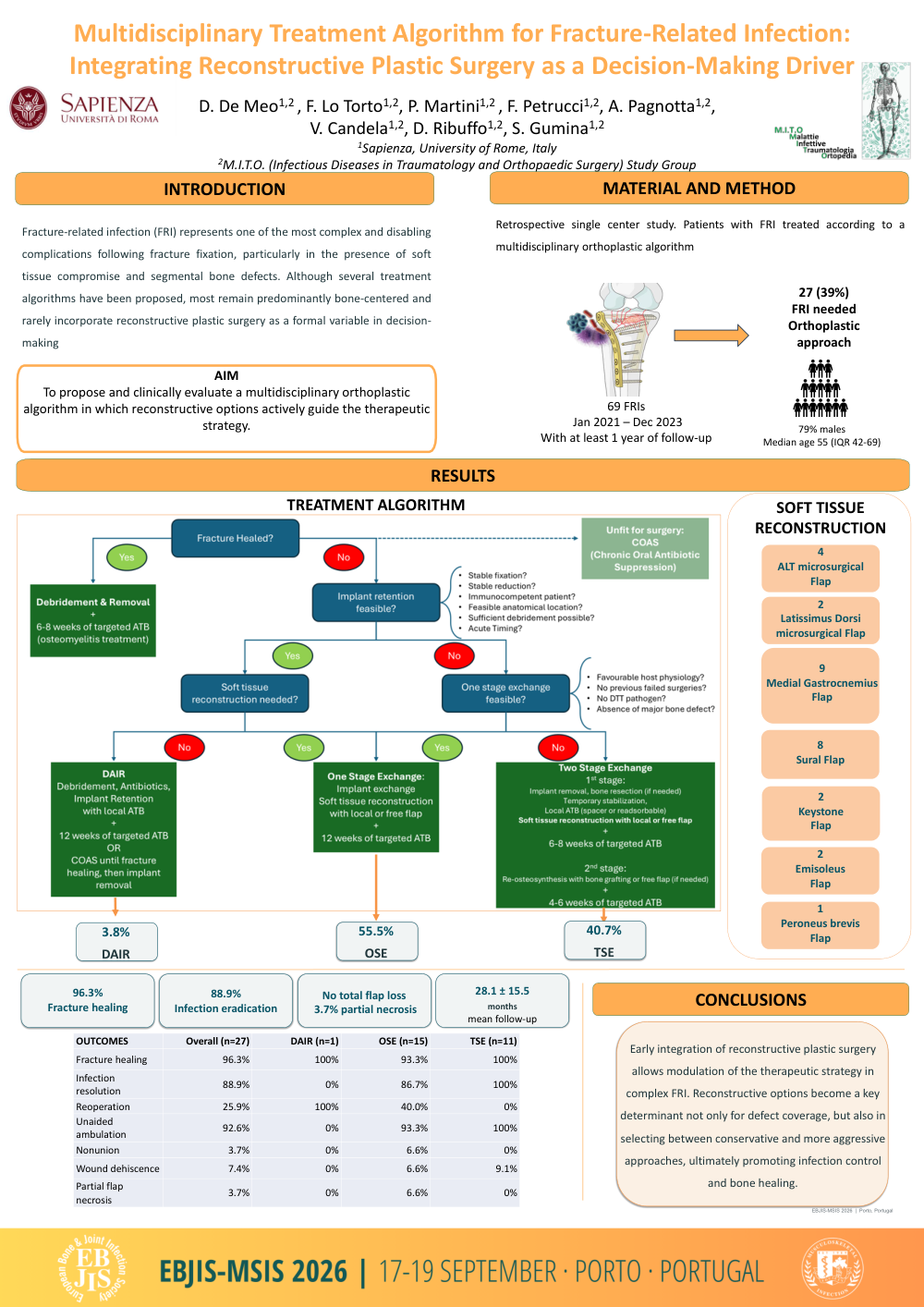
Fracture-related infection (FRI) represents one of the most complex and disabling complications following fracture fixation, particularly in the presence of soft tissue compromise and segmental bone defects. Although several treatment algorithms have been proposed, most remain predominantly bone-centered and rarely incorporate reconstructive plastic surgery as a formal variable in the decision-making process. The aim of this study is to propose and clinically evaluate a novel multidisciplinary orthoplastic algorithm in which reconstructive options actively guide the therapeutic strategy.
Materials and Methods:
This is a retrospective single-center observational study including patients with FRI treated according to a multidisciplinary orthoplastic algorithm between January 2017 and June 2023. Treatment strategies were defined through structured multidisciplinary discussions following a dedicated algorithm, considering fracture healing status, implant stability, timing of infection, soft tissue conditions, and reconstructive options.
Results:
A total of 27 patients were included (mean follow-up 28.1 ± 15.5 months). Single-stage implant exchange was performed in 55.5% of cases, while a two-stage exchange was carried out in 37%. Implant retention was applied in one case. No total flap loss occurred; one case of partial necrosis (3.7%) was observed. Pedicled flaps were used in 81.5% of patients, while free tissue transfer, including vascularized fibular flap, was required in 33.3%. Fracture healing was achieved in 96.3% of cases and infection eradication in 88.9%. At final follow-up, 92.6% of patients regained independent ambulation.
Discussion and Conclusions:
The results suggest that early integration of reconstructive plastic surgery allows modulation of the therapeutic strategy in complex cases. Reconstructive options become a key determinant not only for defect coverage but also in selecting between conservative and more aggressive approaches, ultimately promoting infection control and bone healing. The high success rates and low incidence of major complications support the validity of a shared orthoplastic decision-making model. This approach, by formally integrating reconstructive considerations into treatment algorithms, may contribute to the standardization of multidisciplinary FRI management in centers with dedicated orthoplastic expertise.