477 posters, 14 topics, 2,065 authors, 1,055 institutions
ePostersLive by SciGen Technologies S.A. All rights reserved.
The Joint EBJIS-MSIS 2026 Conference
17 - 19 September, 2026 | Porto, Portugal

EP132
Different faces of fracture related infections 6 cases series presentation
Part of Topic
Fracture-Related Infections
The definition of fracture-related or infection (FRI) was proposed when the AO Trauma Division undertook a systematic literature review in late 2016, which revealed that mostly randomized controlled trials of fracture treatment did not use a standardized FRI definition. In response, an international consensus process was initiated to formulate a core FRI definition, with the definition documents being distributed to all registered AO Trauma users. Approximately 90% of the more than 2000 surgeons who responded said that a FRI definition was needed.
The final step was a meeting of the authors of the consensus document with an expert group in 2017. The result of this process was the publication of the international consensus FRI definition document in 2018:
Fracture-related infection: consensus on a definition by an international expert group. W. J. Metsemakers et al. / Injury, Int. J. Care Injured 49 (2018) 505–510
The document defined two levels of certainty for diagnostic features. Criteria can be confirmatory (infection is definitely present) or suggestive.
Four confirmatory criteria were defined:
1) fistula, draining sinus, or wound discharge; 2) purulent discharge from the wound or presence of pus during surgery; 3) phenotypically confirmed indistinguishable pathogens, based on bacterial culture from two separate deep tissue/implant samples; 4) presence of microorganisms in deep tissue taken during surgery, as confirmed by histopathological examination.
The aforementioned document is also reflected in the PRO-Implant 2017 Pocket Guide to the Diagnosis and Treatment of Fracture-Related Infections:
Thus, the previously presented guidelines were decided to look at clinical situations where proven diagnostical and treatment guidelines are used or when it is decided to disregard recognized recommendations and apply guideline recommendations unfoundedly.
Aim
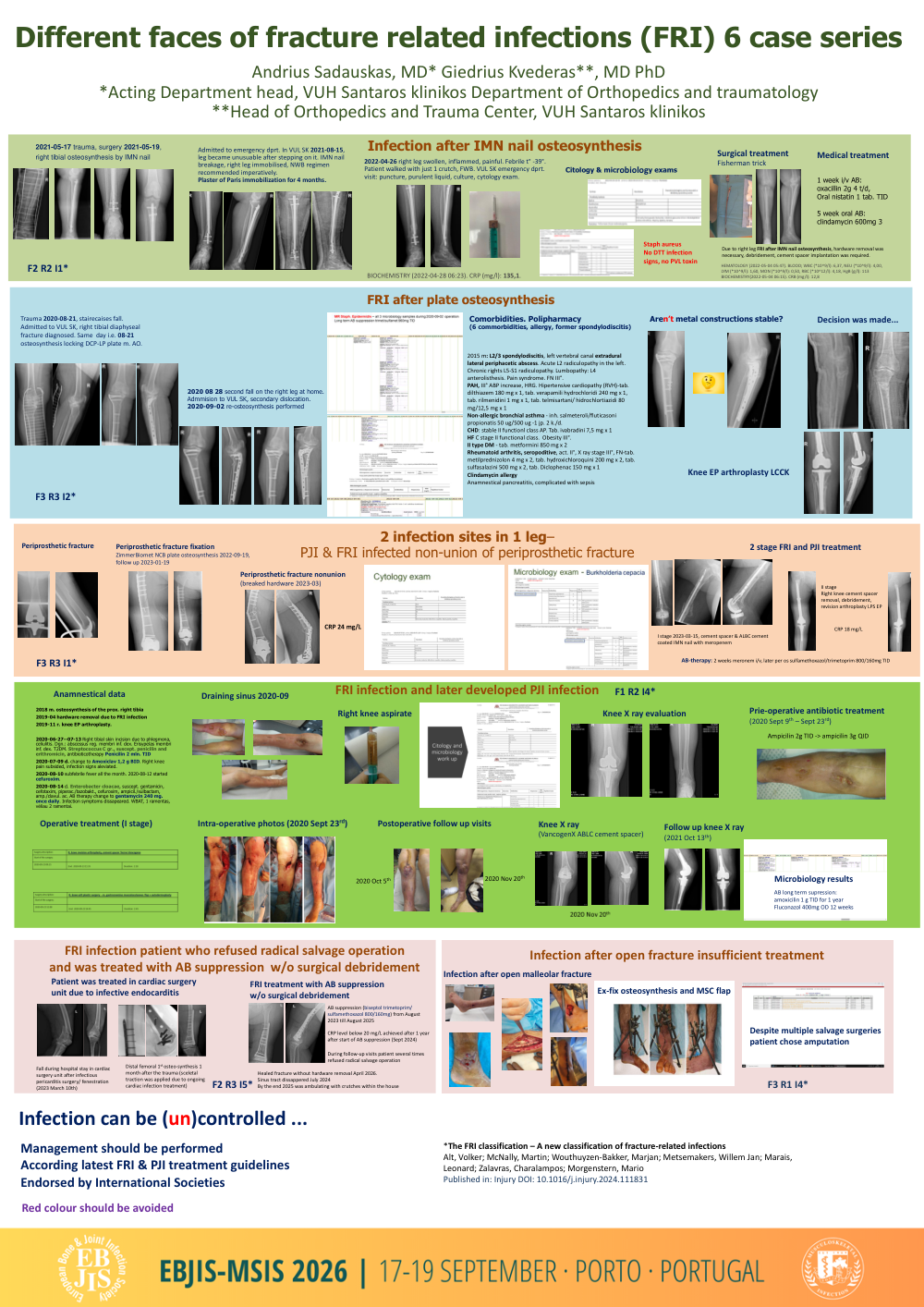
To present examples of successful and unsuccessful infection treatment in FRI (fracture related infections) when using various internal osteosynthesis hardware: locking plates with locking and non-locking screws, intramedullary nails, NCB locking plate for the treatment of periprosthetic fractures.
Method
A brief presentation of the diagnostics and treatment specific issues when treating fracture related infections (including open fractues) in case of different metal hardware (stable and unstable ones: locking plate/-es, NCB locking plate, intramedulary nail, anchors for ligament repair) according to the latest EBJIS recommendations.
Subsequently, 6 clinical cases of treatment of FRI infections are presented:
1) non-healed infected tibial diaphyseal fracture after intramedullary osteosynthesis,
2) non-healed infected fracture after osteosynthesis and reosteosynthesis of the proximal end of the tibia with locking plates and screws,
3) non-healed infected distal tibial end fracture (pylon type), treatment of which was started in violation of the principles of AO open fracture treatment,
4) periprosthetic infection after a previous open fracture of the proximal part of the tibia, knee arthroplasty and later developed PJI,
5) a clinical case of periprosthetic infection together with a non-healed infected periprosthetic fracture,
6) a clinical case of fracture related infection cured by antibiotic supression strategy with left fixation devices (2 distal femoral locking plates).
Results
4 clinical cases of successful treatment of infections with fracture preparation, when it was possible to preserve both the limb and maintain the functions of the lower limb, with a larger distribution of the biosocial performed before the injury are presented. Patients were able to move without aids, there was no recurrence of FRI infection for > 2 years.
1 clinical case of conservatively treated distal femoral fracture and later developed FRI. Infection suppression gave the desired result-absence of infection >1 year.
Unfortunately not all stories end well. So we present 1 case of unsuccesful treatment – lower leg amputation after failed multiple salvage surgeries including gastrocnemius musculocutaneus flap. Initial open fracture treatment was not performed correctly (no proper debridement, inadequate attention to damaged soft tissue management, premature definitive internal fixation including internal osteosynthesis and ligament reconstruction with anchors).
Last but not least all the cases were classified according newly published FRI classification system:
The FRI classification – A new classification of fracture-related infections
Alt, Volker; McNally, Martin; Wouthuyzen-Bakker, Marjan; Metsemakers, Willem Jan; Marais,
Leonard; Zalavras, Charalampos; Morgenstern, Mario
Published in: Injury DOI: 10.1016/j.injury.2024.111831.
Conclusions
According to recognized guidelines for treatment of FRI, one can expect desirable treatment without threatening to amputation of the human limb, salvage of the limb, eradicating the infection and preventing further reccurence of the disease.
Keywords
Infection due to internal fracture fixation devices, non-healed fracture, periprosthetic fracture, diagnostic criteria for infection