477 posters, 14 topics, 2,065 authors, 1,055 institutions
ePostersLive by SciGen Technologies S.A. All rights reserved.
The Joint EBJIS-MSIS 2026 Conference
17 - 19 September, 2026 | Porto, Portugal

EP131
Incidence of wound leakage following calcium sulfate use in fracture-related infection and osteomyelitis: a systematic review and meta-analysis
Poster Presenter
Authors
Juan Carlos Perdomo Lizarraga, Maria Amparo Godoy Montijano, Laura Sanchez Rodriguez, Agustin Fredes Garnier
Affiliations
Orthopedics Department, Don Benito�Villanueva de la Serena Hospital, Don Benito, Spain, Sarcoma and Osteoarticular Infection Unit, Orthopedics Department. Virgen de las Nieves University Hospital, Granada, Spain, Orthopedics Department, Don Benito�Villanueva de la Serena Hospital
Part of Topic
Fracture-Related Infections
Introduction & Aim: Calcium sulfate carriers (CSC) are an adjunct in the surgical management of Fracture-Related Infections (FRI) and osteomyelitis, enabling high local antibiotic concentrations while minimizing systemic toxicity. However, a frequent complication is postoperative wound leakage (“white drainage”). This systematic review and meta-analysis aimed to evaluate the incidence of aseptic wound leakage, duration of drainage, and treatment failure in patients treated with CSC for FRI or osteomyelitis.
Methods: This systematic review and meta-analysis followed PRISMA guidelines. PubMed/MEDLINE were searched for studies from 2010 to 2025. Inclusion criteria: prospective and retrospective cohorts with ≥20 patients and ≥12 months follow-up. Pooled estimates calculated using random-effects meta-analysis, with subgroup analyses by CSC type (Product A, Product B and Product C). Risk of bias (Newcastle–Ottawa Scale) and certainty of evidence (GRADE framework) were assessed.
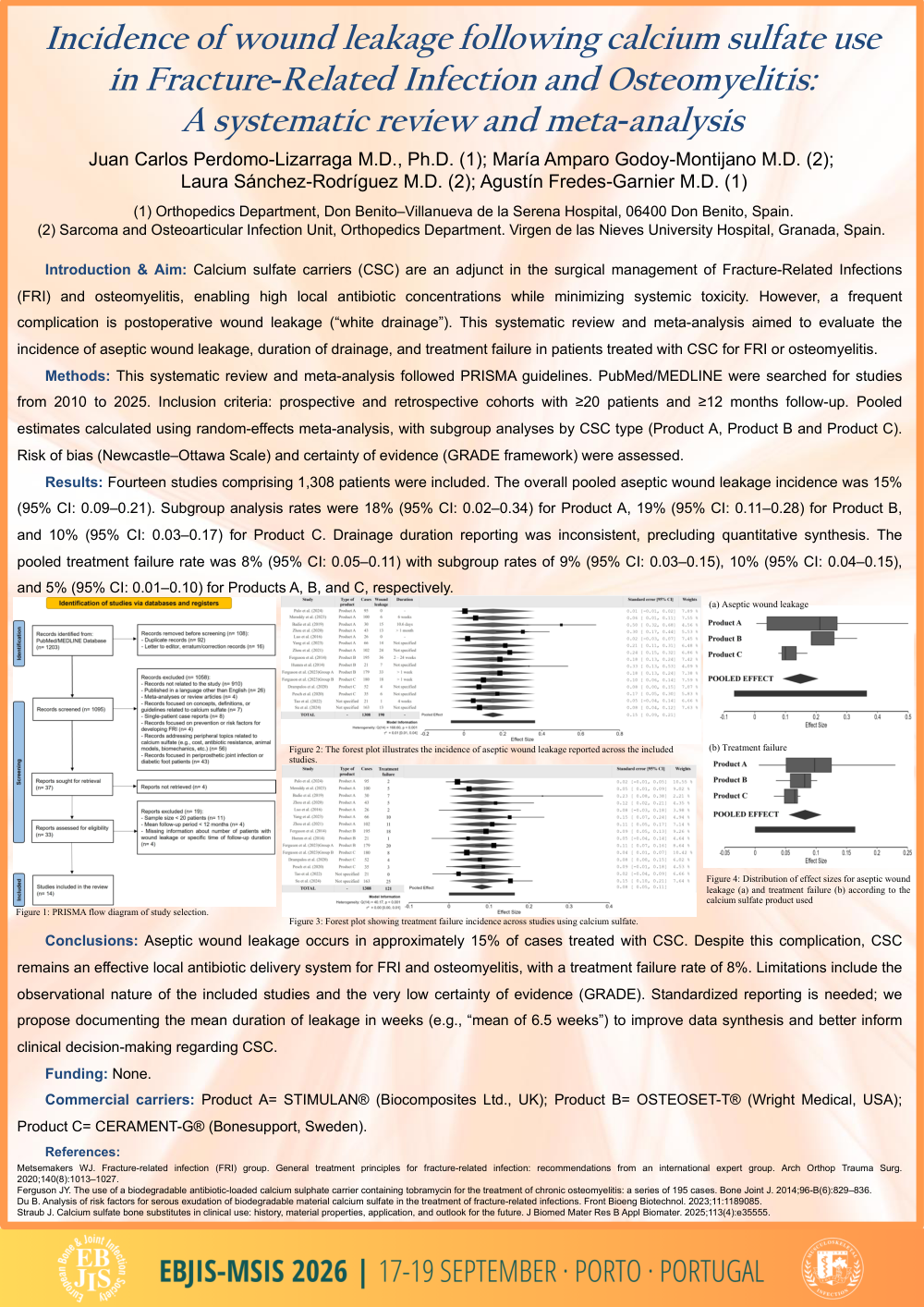
Results: Fourteen studies comprising 1,308 patients were included. The overall pooled aseptic wound leakage incidence was 15% (95% CI: 0.09–0.21). Subgroup analysis rates were 18% (95% CI: 0.02–0.34) for Product A, 19% (95% CI: 0.11–0.28) for Product B, and 10% (95% CI: 0.03–0.17) for Product C. Drainage duration reporting was inconsistent, precluding quantitative synthesis. The pooled treatment failure rate was 8% (95% CI: 0.05–0.11) with subgroup rates of 9% (95% CI: 0.03–0.15), 10% (95% CI: 0.04–0.15), and 5% (95% CI: 0.01–0.10) for Products A, B, and C, respectively.
Conclusions: Aseptic wound leakage occurs in approximately 15% of cases treated with CSC. Despite this complication, CSC remains an effective local antibiotic delivery system for FRI and osteomyelitis, with a treatment failure rate of 8%. Limitations include the observational nature of the included studies and the very low certainty of evidence (GRADE). Standardized reporting is needed; we propose documenting the mean duration of leakage in weeks (e.g., "mean of 6.5 weeks") to improve data synthesis and better inform clinical decision-making regarding CSC.
Funding: None.
Commercial carriers: Product A= STIMULAN® (Biocomposites Ltd., UK); Product B= OSTEOSET-T® (Wright Medical, USA); Product C= CERAMENT-G® (Bonesupport, Sweden).
References:
Metsemakers WJ. Fracture-related infection (FRI) group. General treatment principles for fracture-related infection: recommendations from an international expert group. Arch Orthop Trauma Surg. 2020;140(8):1013–1027.
Ferguson JY. The use of a biodegradable antibiotic-loaded calcium sulphate carrier containing tobramycin for the treatment of chronic osteomyelitis: a series of 195 cases. Bone Joint J. 2014;96-B(6):829–836.
Du B. Analysis of risk factors for serous exudation of biodegradable material calcium sulfate in the treatment of fracture-related infections. Front Bioeng Biotechnol. 2023;11:1189085.
Straub J. Calcium sulfate bone substitutes in clinical use: history, material properties, application, and outlook for the future. J Biomed Mater Res B Appl Biomater. 2025;113(4):e35555.