477 posters, 14 topics, 2,065 authors, 1,055 institutions
ePostersLive by SciGen Technologies S.A. All rights reserved.
The Joint EBJIS-MSIS 2026 Conference
17 - 19 September, 2026 | Porto, Portugal

EP122
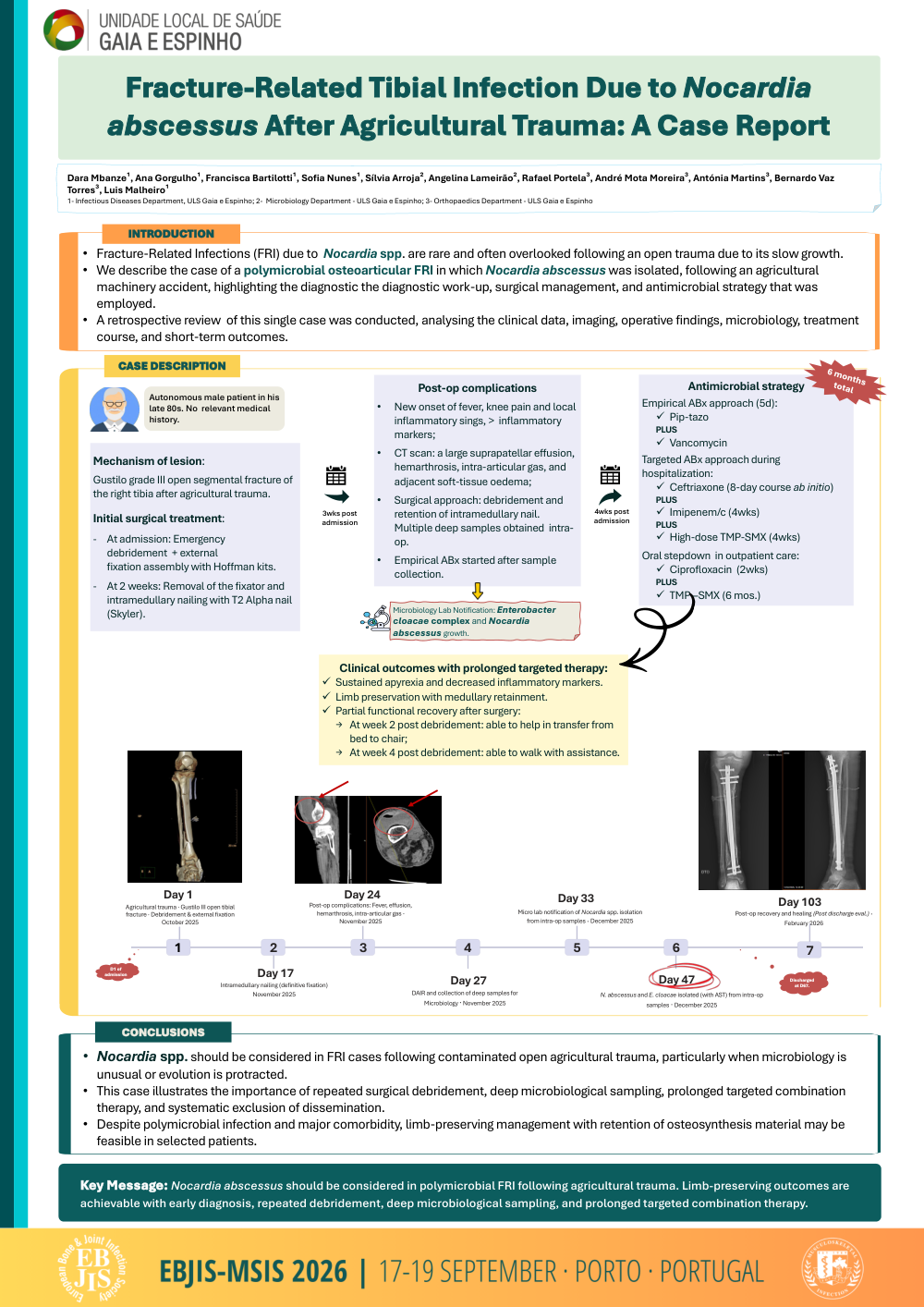
Fracture-Related Tibial Infection Due to Nocardia abscessus After Agricultural Trauma: A Case Report
Poster Presenter
Authors
Dara Mbanze, Ana Gorgulho, Francisca Bartilotti, Sofia Nunes, Silvia Arroja, Angelina Lameirao, Rafael Portela, Andre Mota Moreira, Antonia Martins, Bernardo Vaz Torres, Luis Malheiro
Affiliations
Infectious Diseases Department - ULS Gaia e Espinho, Vila Nova de Gaia, Portugal, Microbiology Department - ULS Gaia e Espinho, Vila Nova de Gaia, Portugal, Orthopaedics Department - ULS Gaia e Espinho, Vila Nova de Gaia, Portugal, ULS Gaia e Espinho
Part of Topic
Fracture-Related Infections
Fracture-Related Tibial Infection Due to Nocardia abscessus After Agricultural Trauma: A Case Report
INTRODUCTION
• Fracture-Related Infections (FRI) due to Nocardia spp. are rare and often overlooked following an open trauma due to its slow growth.
• We describe the case of a polymicrobial osteoarticular FRI in which Nocardia abscessus was isolated, following an agricultural machinery accident, highlighting the diagnostic the diagnostic work-up, surgical management, and antimicrobial strategy that was employed.
• A retrospective review of this single case was conducted, analysing the clinical data, imaging, operative findings, microbiology, treatment course, and short-term outcomes.
CASE DESCRIPTION
Autonomous male patient in his late 80s. No relevant medical history.
Mechanism of lesion: Gustilo grade III open segmental fracture of the right tibia after agricultural trauma.
Initial surgical treatment:
- At admission: Emergency
debridement + external fixation assembly with Hoffman kits.
- At 2 weeks: Removal of the fixator and intramedullary nailing with T2 Alpha nail (Skyler).
Post-op complications (3weeks later)
• New onset of fever, knee pain and local inflammatory sings, > inflammatory
markers;
• CT scan: a large suprapatellar effusion, hemarthrosis, intra-articular gas, and adjacent soft-tissue oedema;
• Surgical approach: debridement and retention of intramedullary nail. Multiple deep samples obtained intraop.
- Microbiology Lab Notification: Enterobacter cloacae complex and Nocardia abscessus growth.
• Empirical ABx started after sample collection.
Antimicrobial strategy (6 months total)
Empirical ABx approach (5d):
✓ Pip-tazo PLUS ✓ Vancomycin
Targeted ABx approach during hospitalization:
✓ Ceftriaxone (8-day course ab initio) PLUS ✓ Imipenem/c (4wks) PLUS ✓ High-dose TMP-SMX (4wks)
Oral stepdown in outpatient care:
✓ Ciprofloxacin (2wks) PLUS ✓ TMP –SMX (6 mos.)
Clinical outcomes with prolonged targeted therapy:
✓ Sustained apyrexia and decreased inflammatory markers.
✓ Limb preservation with medullary retainment.
✓ Partial functional recovery after surgery:
→ At week 2 post debridement: able to help in transfer from bed to chair;
→ At week 4 post debridement: able to walk with assistance.
CONCLUSIONS
• Nocardia spp. should be considered in FRI cases following contaminated open agricultural trauma, particularly when microbiology is
unusual or evolution is protracted.
• This case illustrates the importance of repeated surgical debridement, deep microbiological sampling, prolonged targeted combination therapy, and systematic exclusion of dissemination.
• Despite polymicrobial infection and major comorbidity, limb-preserving management with retention of osteosynthesis material may be feasible in selected patients.
Key Message: Nocardia abscessus should be considered in polymicrobial FRI following agricultural trauma. Limb-preserving outcomes are achievable with early diagnosis, repeated debridement, deep microbiological sampling, and prolonged targeted combination therapy.