477 posters, 14 topics, 2,065 authors, 1,055 institutions
ePostersLive by SciGen Technologies S.A. All rights reserved.
The Joint EBJIS-MSIS 2026 Conference
17 - 19 September, 2026 | Porto, Portugal

EP121
Multidisciplinary team management in fracture-related infection: a systematic review of clinical outcomes
Poster Presenter
Part of Topic
Fracture-Related Infections
Multidisciplinary team management in fracture-related infection: a systematic review of clinical outcomes
Introduction
•Management of FRI necessitates coordinated decision-making regarding debridement, implant retention or exchange, bone reconstruction, soft-tissue reconstruction, antimicrobial therapy, rehabilitation, and optimisation of patient comorbidities (1,2).
•Recognising this complexity, the international FRI consensus group recommended MDT management in 2018 (3).
•Although MDT management is widely advocated in FRI guidance, its implementation remains unknown, with different centres relying on informal or ad hoc collaboration rather than structured MDT pathways (1).
•Establishing structured MDT services requires organisational, workforce, and financial resources (4,5).
•It is therefore important to determine the strength of the evidence supporting MDT management and whether it is associated with improved clinical outcomes in FRI.
Aim
•MDT management is recommended in international guidance, but the evidence for its benefit on clinical outcomes has not been evaluated.
•This systematic review synthesised the available evidence on MDT management in adults with FRI.
Methods
•MEDLINE, Embase, Scopus, and the Cochrane Library were searched from database inception to 31 July 2025.
•Experimental and observational studies of adults with FRI managed through MDT care were eligible.
•Comparative studies formed the primary evidence, with single-arm MDT studies included for secondary descriptive analysis.
•Primary outcomes were infection recurrence, fracture union, reoperation, and amputation.
•Risk of bias was assessed using ROBINS-I for comparative studies and the JBI Critical Appraisal Checklist for single-arm studies.
•Results were synthesised narratively because of clinical and methodological heterogeneity.
•The review was registered with PROSPERO (CRD420251111990).
Results
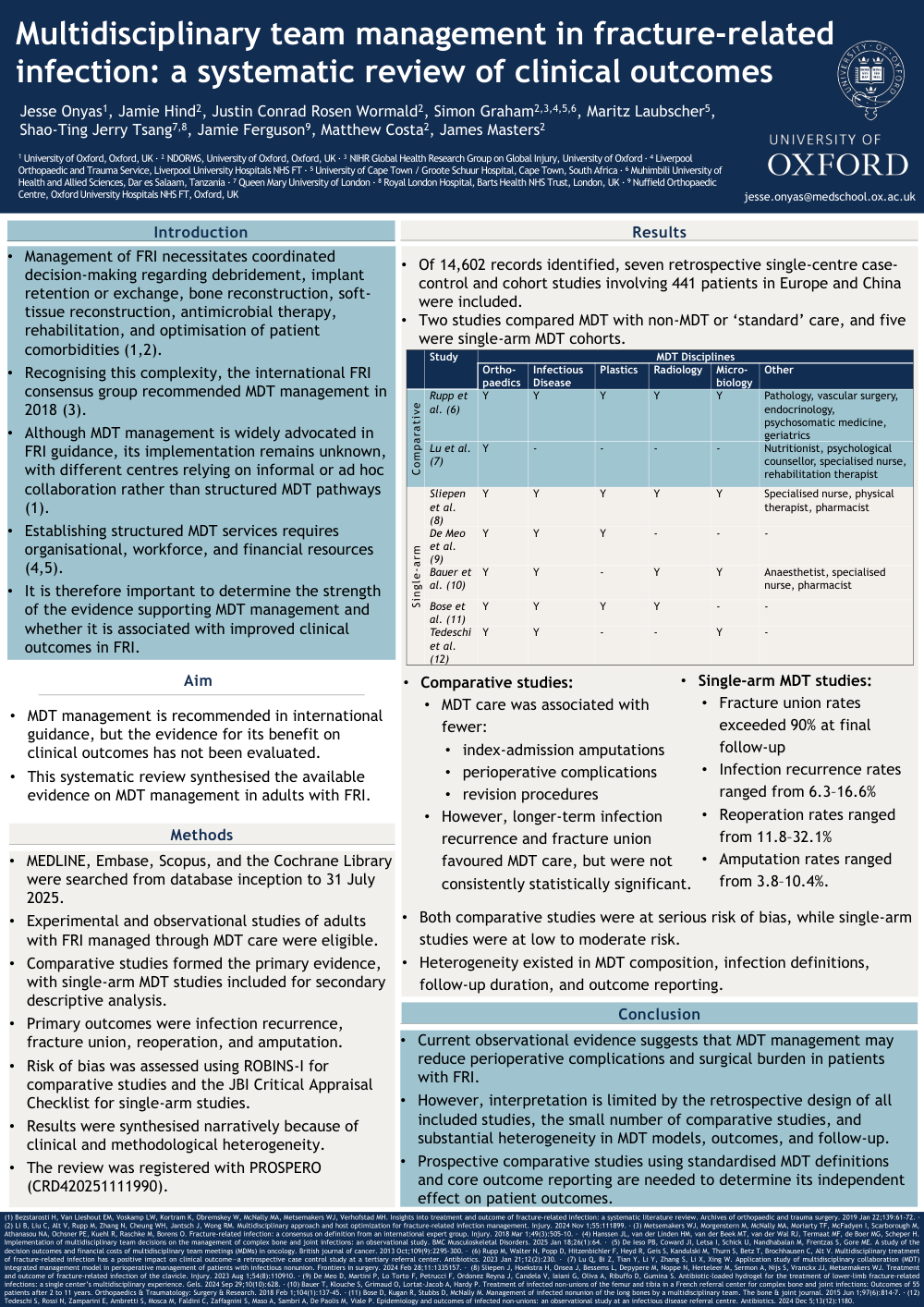
•Of 14,602 records identified, seven retrospective single-centre case-control and cohort studies involving 441 patients in Europe and China were included.
•Two studies compared MDT with non-MDT or ‘standard’ care, and five were single-arm MDT cohorts.
Comparative studies:
•MDT care was associated with fewer:
•index-admission amputations
•perioperative complications
•revision procedures
•However, longer-term infection recurrence and fracture union favoured MDT care, but were not consistently statistically significant.
Single-arm MDT studies:
•Fracture union rates exceeded 90% at final follow-up
•Infection recurrence rates ranged from 6.3–16.6%
•Reoperation rates ranged from 11.8–32.1%
•Amputation rates ranged from 3.8–10.4%.
•Both comparative studies were at serious risk of bias, while single-arm studies were at low to moderate risk.
•Heterogeneity existed in MDT composition, infection definitions, follow-up duration, and outcome reporting.
Conclusion
•Current observational evidence suggests that MDT management may reduce perioperative complications and surgical burden in patients with FRI.
•However, interpretation is limited by the retrospective design of all included studies, the small number of comparative studies, and substantial heterogeneity in MDT models, outcomes, and follow-up.
•Prospective comparative studies using standardised MDT definitions and core outcome reporting are needed to determine its independent effect on patient outcomes.