477 posters, 14 topics, 2,065 authors, 1,055 institutions
ePostersLive by SciGen Technologies S.A. All rights reserved.
The Joint EBJIS-MSIS 2026 Conference
17 - 19 September, 2026 | Porto, Portugal

EP114
Intra-articular calcaneal fractures supplemented with a gentamicin-loaded injectable synthetic bone void filler*: Our experience
Poster Presenter
Part of Topic
Fracture-Related Infections
INTRODUCTION
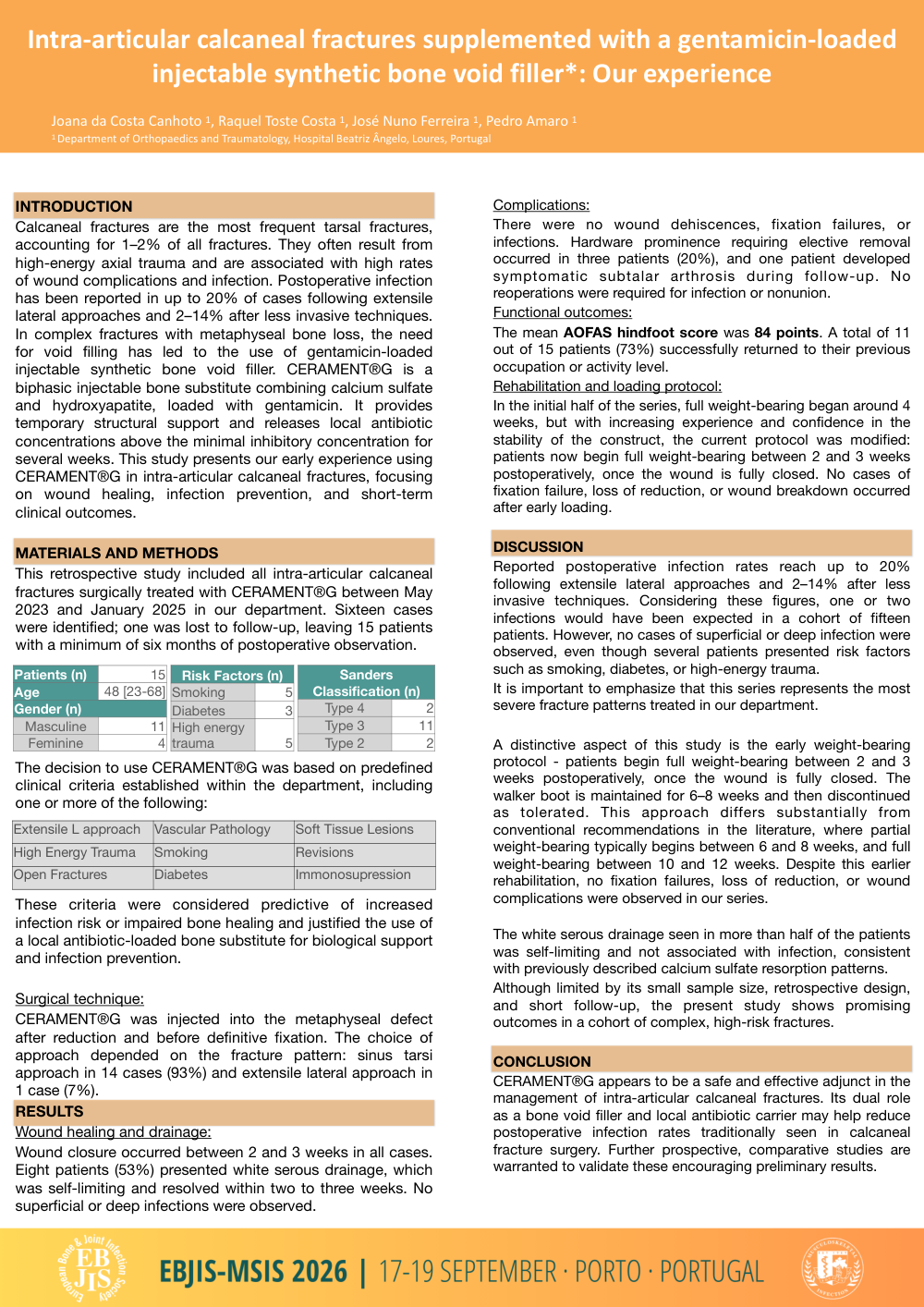
Calcaneal fractures are the most frequent tarsal fractures, accounting for 1–2% of all fractures. They often result from high-energy axial trauma and are associated with high rates of wound complications and infection. Postoperative infection has been reported in up to 20% of cases following extensile lateral approaches and 2–14% after less invasive techniques. In complex fractures with metaphyseal bone loss, the need for void filling has led to the use of gentamicin-loaded injectable synthetic bone void filler. CERAMENT®G is a biphasic injectable bone substitute combining calcium sulfate and hydroxyapatite, loaded with gentamicin. It provides temporary structural support and releases local antibiotic concentrations above the minimal inhibitory concentration for several weeks. This study presents our early experience using CERAMENT®G in intra-articular calcaneal fractures, focusing on wound healing, infection prevention, and short-term clinical outcomes.
MATERIALS AND METHODS
This retrospective study included all intra-articular calcaneal fractures surgically treated with CERAMENT®G between May 2023 and January 2025 in our department. Sixteen cases were identified; one was lost to follow-up, leaving 15 patients with a minimum of six months of postoperative observation.
The decision to use CERAMENT®G was based on predefined clinical criteria established within the department, including one or more of the following:
These criteria were considered predictive of increased infection risk or impaired bone healing and justified the use of a local antibiotic-loaded bone substitute for biological support and infection prevention.
Surgical technique:
CERAMENT®G was injected into the metaphyseal defect after reduction and before definitive fixation. The choice of approach depended on the fracture pattern: sinus tarsi approach in 14 cases (93%) and extensile lateral approach in 1 case (7%).
RESULTS
Wound healing and drainage:
Wound closure occurred between 2 and 3 weeks in all cases. Eight patients (53%) presented white serous drainage, which was self-limiting and resolved within two to three weeks. No superficial or deep infections were observed.
Complications:
There were no wound dehiscences, fixation failures, or infections. Hardware prominence requiring elective removal occurred in three patients (20%), and one patient developed symptomatic subtalar arthrosis during follow-up. No reoperations were required for infection or nonunion.
Functional outcomes:
The mean AOFAS hindfoot score was 84 points. A total of 11 out of 15 patients (73%) successfully returned to their previous occupation or activity level.
Rehabilitation and loading protocol:
In the initial half of the series, full weight-bearing began around 4 weeks, but with increasing experience and confidence in the stability of the construct, the current protocol was modified: patients now begin full weight-bearing between 2 and 3 weeks postoperatively, once the wound is fully closed. No cases of fixation failure, loss of reduction, or wound breakdown occurred after early loading.
DISCUSSION
Reported postoperative infection rates reach up to 20% following extensile lateral approaches and 2–14% after less invasive techniques. Considering these figures, one or two infections would have been expected in a cohort of fifteen patients. However, no cases of superficial or deep infection were observed, even though several patients presented risk factors such as smoking, diabetes, or high-energy trauma.
It is important to emphasize that this series represents the most severe fracture patterns treated in our department.
A distinctive aspect of this study is the early weight-bearing protocol - patients begin full weight-bearing between 2 and 3 weeks postoperatively, once the wound is fully closed. The walker boot is maintained for 6–8 weeks and then discontinued as tolerated. This approach differs substantially from conventional recommendations in the literature, where partial weight-bearing typically begins between 6 and 8 weeks, and full weight-bearing between 10 and 12 weeks. Despite this earlier rehabilitation, no fixation failures, loss of reduction, or wound complications were observed in our series.
The white serous drainage seen in more than half of the patients was self-limiting and not associated with infection, consistent with previously described calcium sulfate resorption patterns.
Although limited by its small sample size, retrospective design, and short follow-up, the present study shows promising outcomes in a cohort of complex, high-risk fractures.
CONCLUSION
CERAMENT®G appears to be a safe and effective adjunct in the management of intra-articular calcaneal fractures. Its dual role as a bone void filler and local antibiotic carrier may help reduce postoperative infection rates traditionally seen in calcaneal fracture surgery. Further prospective, comparative studies are warranted to validate these encouraging preliminary results.