477 posters, 14 topics, 2,065 authors, 1,055 institutions
ePostersLive by SciGen Technologies S.A. All rights reserved.
The Joint EBJIS-MSIS 2026 Conference
17 - 19 September, 2026 | Porto, Portugal

EP105
pH-Sensing Orthopaedic Implant for Hardware Infection Diagnosis
Poster Presenter
Authors
Raffaele Vitiello, Giulio Maccauro, Luca Fiore, Fabiana Arduini
Affiliations
Fondazione Policlinico Universitario A. Gemelli Irccs, Italy, Department of Chemical Science and Technologies, University of Rome �Tor Vergata�, via della Ricerca Scientifica, 00133 Rome, Italy, Fondazione Policlinico Universitario A. Gemelli Irccs
Part of Topic
Diagnosis
In the orthopaedic surgery eld, the use of medical implants to treat a patient’s bone fracture is nowadays a
common practice, nevertheless, it is associated with possible cases of infection. The consequent hardware
infection can lead to implant failure and systemic infections, with prolonged hospitalization, time-consum-
ing rehabilitation treatments, and extended antibiotic therapy. Hardware infections are strictly related to bac-
terial adhesion to the implant, leading to infection occurrence and consequent pH decreasing from physio-
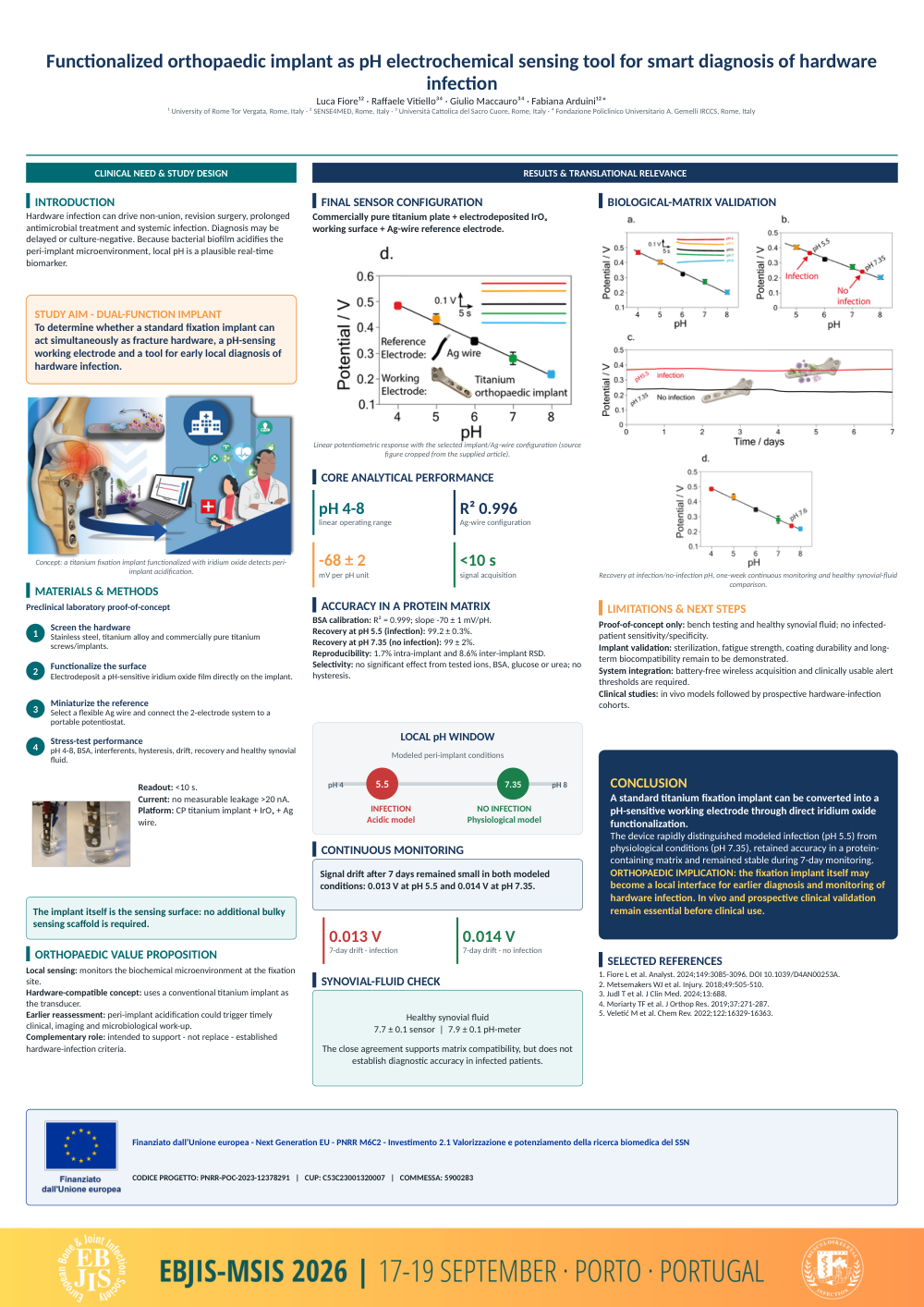
logical level to acid pH. Here, we demonstrate the new strategy to use an orthopaedic implant functiona-
lized with iridium oxide lm as the working electrode for the potentiometric monitoring of pH in hardware
infection diagnosis. A functional investigation was focused on selecting the implant material, namely tita-
nium, titanium alloy, and stainless steel, and the component, namely screws and implants. After selecting
the titanium-based implant as the working electrode and a silver wire as the reference electrode in the nal
con guration of the smart sensing orthopaedic implant, a calibration curve was performed in standard solu-
tions. An equation equal to y = (0.76 ± 0.02)− (0.068 ± 0.002) x, R2 = 0.996, was obtained in the pH range
of 4–8. Subsequently, hysteresis, interference, matrix e ect, recovery study, and storage stability were inves-
tigated to test the overall performance of the sensing device, demonstrating the tremendous potential of
electrochemical sensors to deliver the next generation of smart orthopaedic implants.