477 posters, 14 topics, 2,065 authors, 1,055 institutions
ePostersLive by SciGen Technologies S.A. All rights reserved.
The Joint EBJIS-MSIS 2026 Conference
17 - 19 September, 2026 | Porto, Portugal

EP104
Combination of next generation sequencing and culture improves microbiological diagnosis of prosthetic joint infections
Poster Presenter
Part of Topic
Diagnosis
BACKGROUND
METHODS
Samples from 25 patients with diagnosis of suspected PJI, aseptic implant failure or undergoing spacer removal in second stage revision were sent to Laboratory for culture (periprosthetic tissues, prosthetic implants or synovial fluid) and for NGS analysis (synovial fluid and tissues).
Culture: tissues and implants were treated with 0.1% dithiothreitol before inoculation onto agar plates and into enrichment broths for aerobes and anaerobes, which were incubated for 15 days (4). Synovial fluids were centrifuged and the resulting pellet was plated as described above. Enrichment broths were checked daily and, when turbidity was observed, an aliquot was plated onto blood agar or Schaedler agar. Grown colonies were identified by use of biochemical assays.
Samples for NGS analysis were stored at -80°C and sent to an External Service Laboratory (5). Sequencing targeted the V1 and V2 regions of bacterial 16S rRNA gene and the fungal transcribed spacer (ITS) regions. Microorganisms with a relative abundance above 2% were considered as clinically significant.
RESULTS
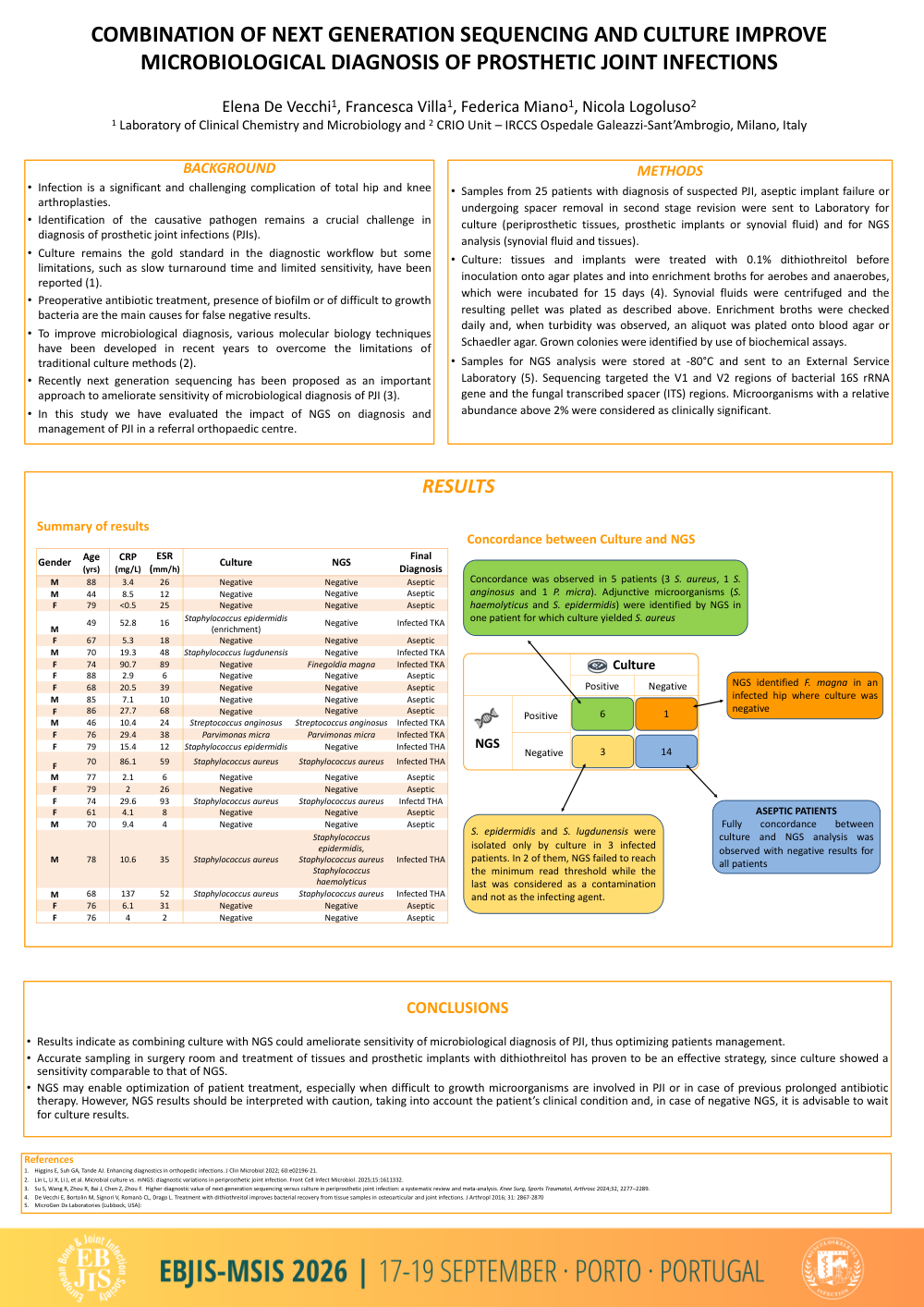
Concordance was observed in 5 patients (3 S. aureus, 1 S. anginosus and 1 P. micra). Adjunctive microorganisms (S. haemolyticus and S. epidermidis) were identified by NGS in one patient for which culture yielded S. aureus.
NGS identified F. magna in an infected hip where culture was negative
S. epidermidis and S. lugdunensis were isolated only by culture in 3 infected patients. In 2 of them, NGS failed to reach the minimum read threshold while the last was considered as a contamination and not as the infecting agent.
Fully concordance between culture and NGS analysis was observed with negative results for all aseptic patients
CONCLUSIONS
Results indicate as combining culture with NGS could ameliorate sensitivity of microbiological diagnosis of PJI, thus optimizing patients management.
Accurate sampling in surgery room and treatment of tissues and prosthetic implants with dithiothreitol has proven to be an effective strategy, since culture showed a sensitivity comparable to that of NGS.
NGS may enable optimization of patient treatment, especially when difficult to growth microorganisms are involved in PJI or in case of previous prolonged antibiotic therapy. However, NGS results should be interpreted with caution, taking into account the patient’s clinical condition and, in case of negative NGS, it is advisable to wait for culture results.