477 posters, 14 topics, 2,065 authors, 1,055 institutions
ePostersLive by SciGen Technologies S.A. All rights reserved.
The Joint EBJIS-MSIS 2026 Conference
17 - 19 September, 2026 | Porto, Portugal

EP102
Conventional synovial biomarkers correlate with matched next-generation sequencing for periprosthetic joint infection
Poster Presenter
Authors
Craig Tipton, Jacob Ancira, Saad Tarabichi, Alisina Shahi, Kayla Jarvis, Khalid Omeir, Nicholas Sanford, Jennifer White, Caleb Phillips, Javad Parvizi, Edward McPherson
Affiliations
Microgen Dx, Lubbock, United States, Microgen Dx, Lubbock, United States; Texas Tech University, Lubbock, United States, Mayo Clinic Arizona, Phoenix, United States, University of Texas Health Science Center at Houston, Houston, United States, Texas Tech University, Lubbock, United States, Acibadem University Hospital, Istanbul, University of California Los Angeles, Los Angeles, United States, Microgen Dx
Part of Topic
Diagnosis
Introduction [1]:
Primary Objectives:
Methods:
Results:
2,011 synovial fluid samples studied, the majority being knee samples (85.7%).
22.6% of samples were NGS-positive, predominantly for bacteria (448 vs. 26 fungal).
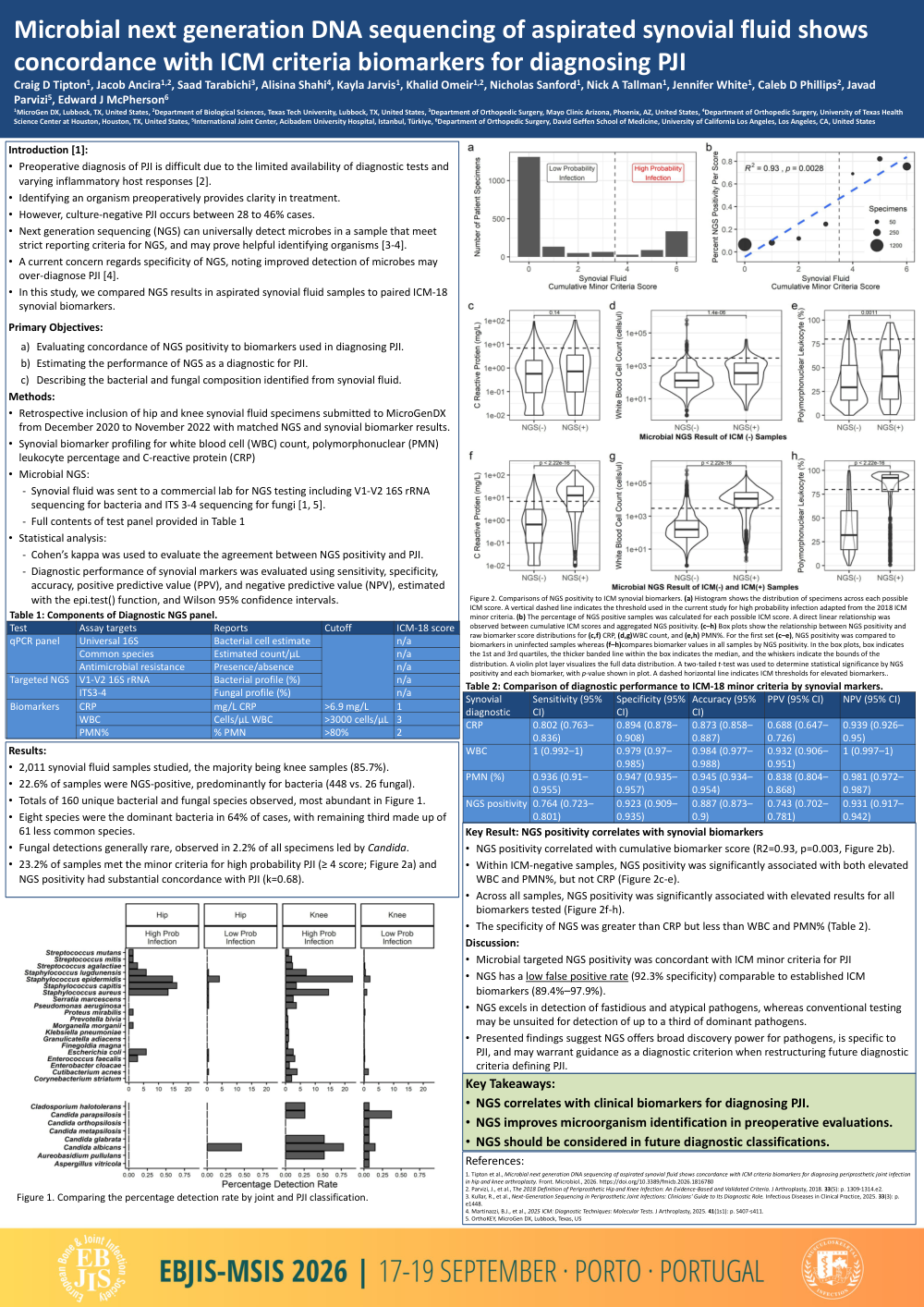
Totals of 160 unique bacterial and fungal species observed, most abundant in Figure 1.
Eight species were the dominant bacteria in 64% of cases, with remaining third made up of 61 less common species.
Fungal detections generally rare, observed in 2.2% of all specimens led by Candida.
23.2% of samples met the minor criteria for high probability PJI (≥ 4 score; Figure 2a) and NGS positivity had substantial concordance with PJI (k=0.68).
Key Result: NGS positivity correlates with synovial biomarkers
NGS positivity correlated with cumulative biomarker score (R2=0.93, p=0.003, Figure 2b).
Within ICM-negative samples, NGS positivity was significantly associated with both elevated WBC and PMN%, but not CRP (Figure 2c-e).
Across all samples, NGS positivity was significantly associated with elevated results for all biomarkers tested (Figure 2f-h).
The specificity of NGS was greater than CRP but less than WBC and PMN% (Table 2).
Discussion:
Microbial targeted NGS positivity was concordant with ICM minor criteria for PJI
NGS has a low false positive rate (92.3% specificity) comparable to established ICM biomarkers (89.4%–97.9%).
NGS excels in detection of fastidious and atypical pathogens, whereas conventional testing may be unsuited for detection of up to a third of dominant pathogens.
Presented findings suggest NGS offers broad discovery power for pathogens, is specific to PJI, and may warrant guidance as a diagnostic criterion when restructuring future diagnostic criteria defining PJI.
Key Takeaways:
- NGS correlates with clinical biomarkers for diagnosing PJI.
- NGS improves microorganism identification in preoperative evaluations.
- NGS should be considered in future diagnostic classifications.
References:
1. Tipton et al., Microbial next generation DNA sequencing of aspirated synovial fluid shows concordance with ICM criteria biomarkers for diagnosing periprosthetic joint infection in hip and knee arthroplasty. Front. Microbiol., 2026. https://doi.org/10.3389/fmicb.2026.1816780
2. Parvizi, J., et al., The 2018 Definition of Periprosthetic Hip and Knee Infection: An Evidence-Based and Validated Criteria. J Arthroplasty, 2018. 33(5): p. 1309-1314.e2.
3. Kullar, R., et al., Next-Generation Sequencing in Periprosthetic Joint Infections: Clinicians' Guide to Its Diagnostic Role. Infectious Diseases in Clinical Practice, 2025. 33(3): p. e1448.
4. Martinazzi, B.J., et al., 2025 ICM: Diagnostic Techniques: Molecular Tests. J Arthroplasty, 2025. 41(1s1): p. S407-s411.
5. OrthoKEY, MicroGen DX, Lubbock, Texas, US