Loading...

477 posters, 14 topics, 2,065 authors, 1,055 institutions

ePostersLive by SciGen Technologies S.A. All rights reserved.

The Joint EBJIS-MSIS 2026 Conference

17 - 19 September, 2026 | Porto, Portugal

The Joint EBJIS-MSIS 2026 Conference banner

EP099

Can the use of a Multiplex PCR Joint Infection Panel reduce length of stay and use of antibiotics?
Part of Topic

Diagnosis

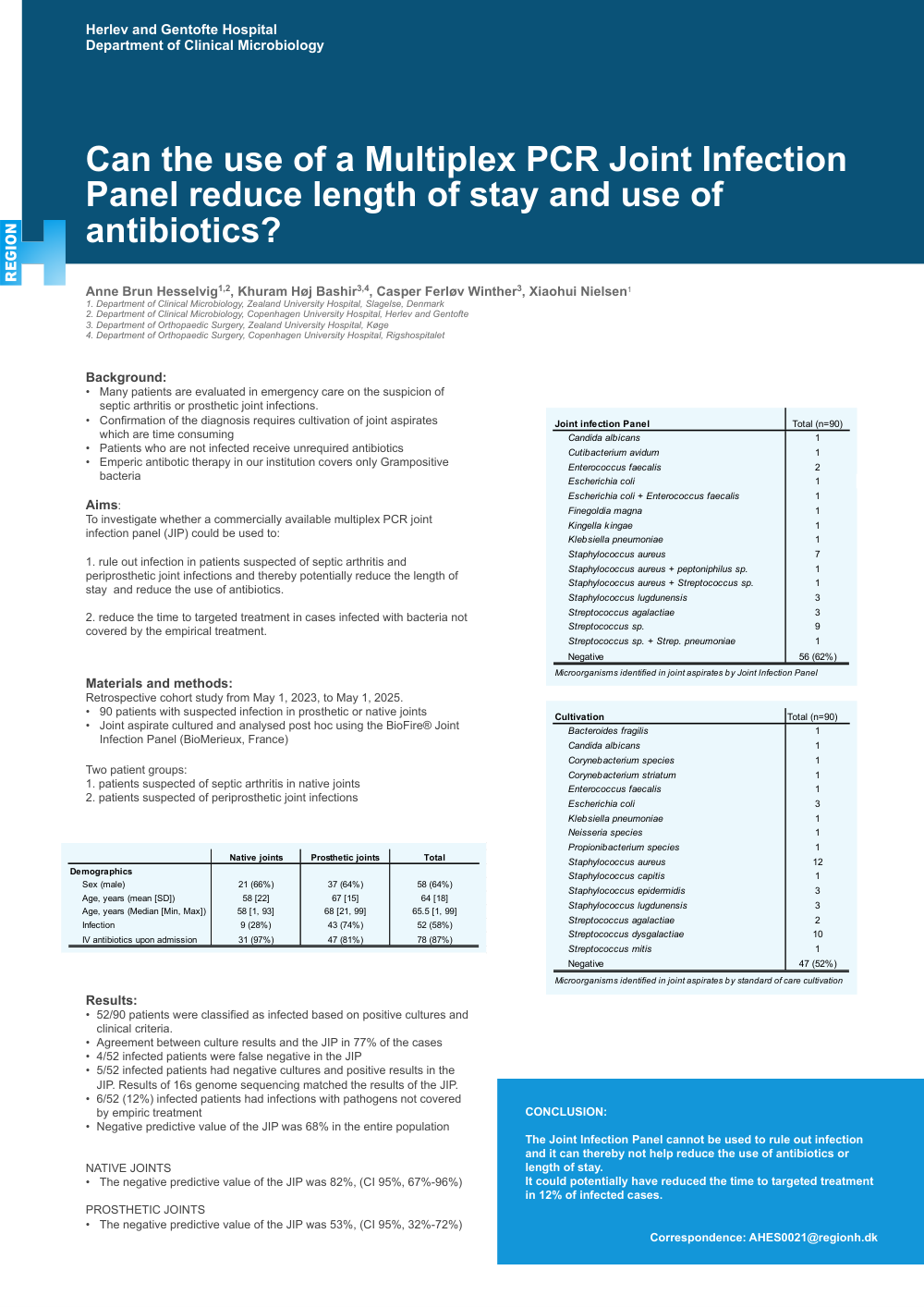
Can the use of a Multiplex PCR Joint Infection Panel reduce length of stay and use of antibiotics?
 
 
Background:
•Many patients are evaluated in emergency care on the suspicion of septic arthritis or prosthetic joint infections.
•Confirmation of the diagnosis requires cultivation of joint aspirates which are time consuming
•Patients who are not infected receive unrequired antibiotics
•Emperic antibotic therapy in our institution covers only Grampositive bacteria
 
Aims:
To investigate whether a commercially available multiplex PCR joint infection panel (JIP) could be used to:
 
1. rule out infection in patients suspected of septic arthritis and periprosthetic joint infections and thereby potentially reduce the length of stay  and reduce the use of antibiotics.
 
2. reduce the time to targeted treatment in cases infected with bacteria not covered by the empirical treatment.
 
Materials and methods:
Retrospective cohort study from May 1, 2023, to May 1, 2025.
•90 patients with suspected infection in prosthetic or native joints
•Joint aspirate cultured and analysed post hoc using the BioFire® Joint Infection Panel (BioMerieux, France)
 
Two patient groups:
1. patients suspected of septic arthritis in native joints
2. patients suspected of periprosthetic joint infections
 
Results:
•52/90 patients were classified as infected based on positive cultures and clinical criteria.
•Agreement between culture results and the JIP in 77% of the cases
•4/52 infected patients were false negative in the JIP
•5/52 infected patients had negative cultures and positive results in the JIP. Results of 16s genome sequencing matched the results of the JIP.
•6/52 (12%) infected patients had infections with pathogens not covered by empiric treatment
•Negative predictive value of the JIP was 68% in the entire population
 
 
NATIVE JOINTS
•The negative predictive value of the JIP was 82%, (CI 95%, 67%-96%)
•

PROSTHETIC JOINTS

•The negative predictive value of the JIP was 53%, (CI 95%, 32%-72%)
 

Conclusion:

The Joint Infection Panel cannot be used to rule out infection and it can thereby not help reduce the use of antibiotics or length of stay.

It could potentially have reduced the time to targeted treatment in 12% of infected cases.

Correspondence: AHES0021@regionh.dk


ebjis-msis2026 banner
Copyright © 2015-2026, ePostersLive® SciGen is a registered trademark of SciGen Technologies S.A. Patent pending.

This website and third-party tools we use rely on cookies for the best user experience. By selecting "I agree", you agree to cookie usage as described in our Privacy Policy.