477 posters, 14 topics, 2,065 authors, 1,055 institutions
ePostersLive by SciGen Technologies S.A. All rights reserved.
The Joint EBJIS-MSIS 2026 Conference
17 - 19 September, 2026 | Porto, Portugal

EP097
Diagnostic accuracy of various test methods for acute septic arthritis in adults
Poster Presenter
Authors
Lukas Rabitsch, Markus Luger, Verkonika Achatz, Tobias Winkler, Irene Sigmund
Affiliations
Medical University of Vienna, Department of Orthopaedics and Trauma Surgery, Department of Orthopaedics, Vienna, Austria, Medical University of Vienna, Department of Orthopaedics and Trauma Surgery, Department of Orthopaedics
Part of Topic
Diagnosis
Aim:
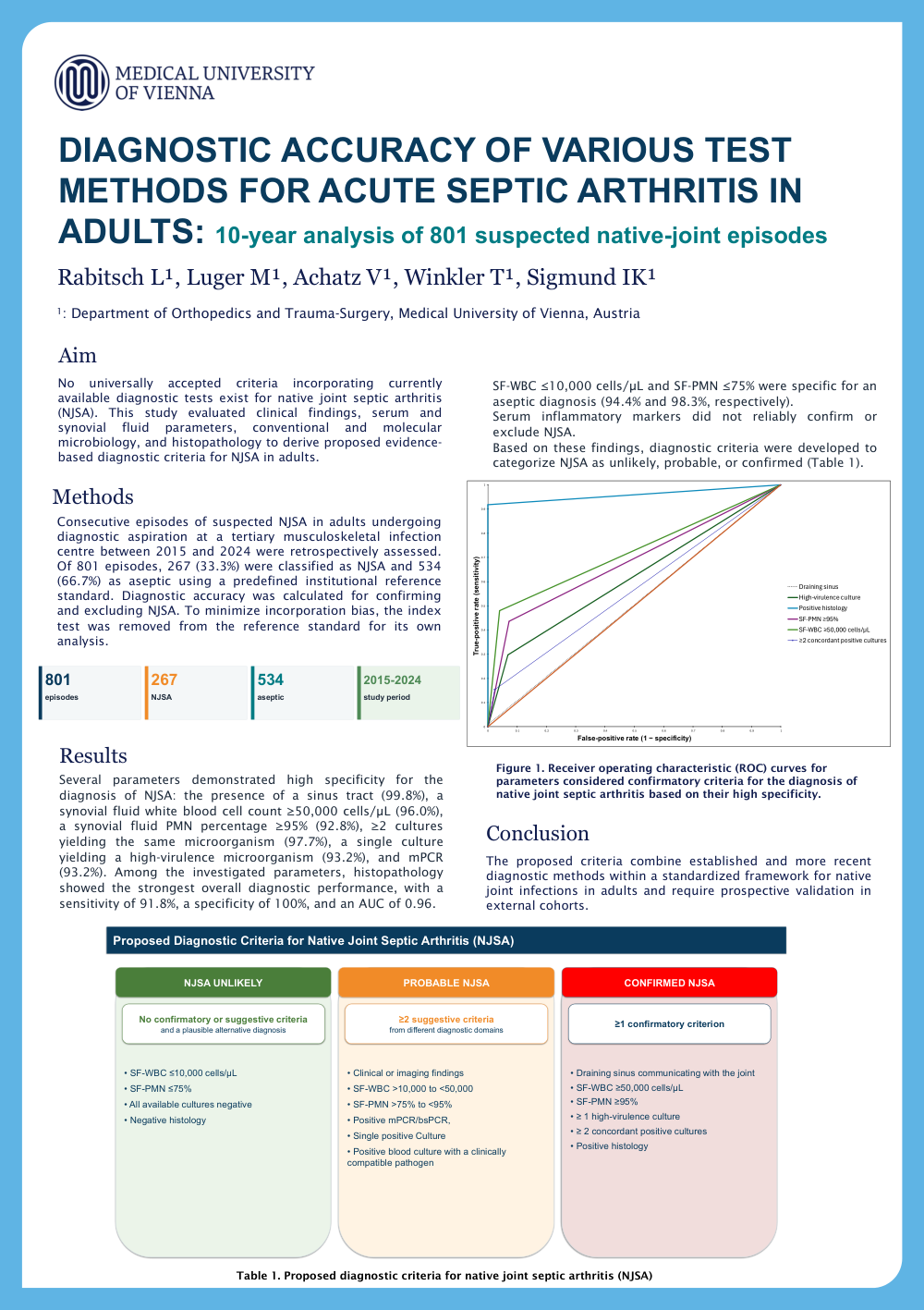
No universally accepted criteria incorporating currently available diagnostic tests exist for native joint septic arthritis (NJSA). This study evaluated clinical findings, serum and synovial fluid parameters, conventional and molecular microbiology, and histopathology to derive proposed evidence-based diagnostic criteria for NJSA in adults.
Methods:
Consecutive episodes of suspected NJSA in adults undergoing diagnostic aspiration at a tertiary musculoskeletal infection centre between 2015 and 2024 were retrospectively assessed. Of 801 episodes, 267 (33.3%) were classified as NJSA and 534 (66.7%) as aseptic using a predefined institutional reference standard. Diagnostic accuracy was calculated for confirming and excluding NJSA. To minimize incorporation bias, the index test was removed from the reference standard for its own analysis.
Results:
Several parameters demonstrated high specificity for the diagnosis of NJSA: the presence of a sinus tract (99.8%), a synovial fluid white blood cell count ≥50,000 cells/µL (96.0%), a synovial fluid PMN percentage ≥95% (92.8%), ≥2 cultures yielding the same microorganism (97.7%), a single culture yielding a high-virulence microorganism (93.2%), and mPCR (93.2%). Among the investigated parameters, histopathology showed the strongest overall diagnostic performance, with a sensitivity of 91.8%, a specificity of 100%, and an AUC of 0.96.
SF-WBC ≤10,000 cells/µL and SF-PMN ≤75% were specific for an aseptic diagnosis (94.4% and 98.3%, respectively). Serum inflammatory markers did not reliably confirm or exclude NJSA. Based on these findings, diagnostic criteria were developed to categorize NJSA as unlikely, probable, or confirmed (Table 1).
Conclusion:
The proposed criteria combine established and more recent diagnostic methods within a standardized framework for native joint infections in adults and require prospective validation in external cohorts.