477 posters, 14 topics, 2,065 authors, 1,055 institutions
ePostersLive by SciGen Technologies S.A. All rights reserved.
The Joint EBJIS-MSIS 2026 Conference
17 - 19 September, 2026 | Porto, Portugal

EP080
Sternoclavicular Septic Arthritis: Atypical Presentations and Microbiological Considerations
Poster Presenter
Authors
Jose Banza, Andre Grenho, Maria Parreira, Hugo Rafael, Jorge Rebola
Affiliations
Part of Topic
Case Report
Introduction
Sternoclavicular joint infection (SCJI) is rare, accounting for <1% of septic arthritis cases, but may be life-threatening because of its proximity to mediastinal structures. Its non-specific presentation and variable microbiology pose diagnostic and therapeutic challenges.
Methods
Two cases of SCJI managed at a tertiary centre were reviewed, covering clinical presentation, imaging findings, surgical management, microbiology, and outcomes.
Results
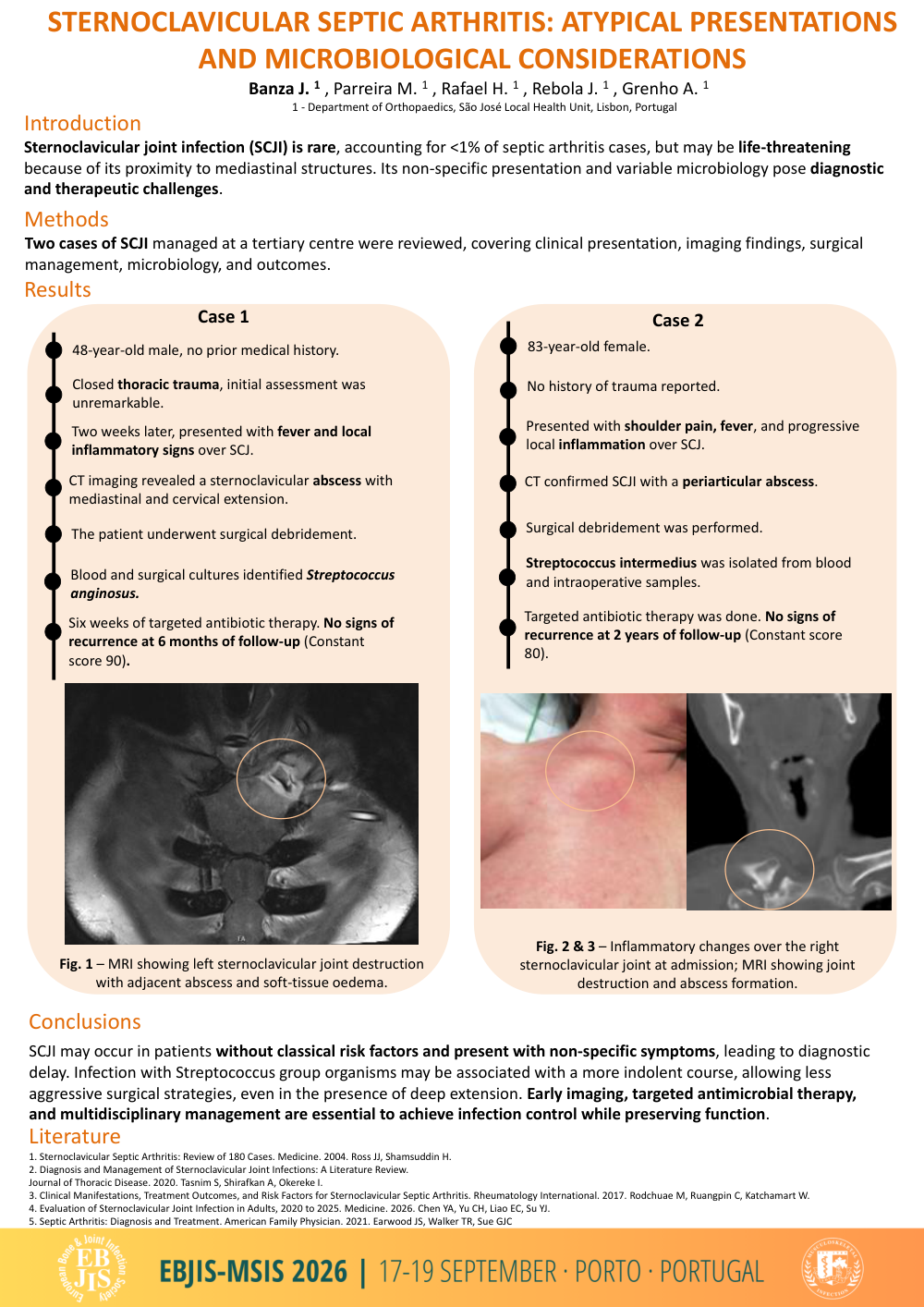
Case 1 48-year-old male, no prior medical history. Results Closed thoracic trauma, initial assessment was unremarkable. Two weeks later, presented with fever and local inflammatory signs over SCJ. CT imaging revealed a sternoclavicular abscess with mediastinal and cervical extension. Blood and surgical cultures identified Streptococcus anginosus. The patient underwent surgical debridement. Six weeks of targeted antibiotic therapy. No signs of recurrence at 6 months of follow-up (Constant score 90). Fig. 1 – MRI showing left sternoclavicular joint destruction with adjacent abscess and soft-tissue oedema.
Case 2 83-year-old female. No history of trauma reported. Presented with shoulder pain, fever, and progressive local inflammation over SCJ. CT confirmed SCJI with a periarticular abscess. Streptococcus intermedius was isolated from blood and intraoperative samples. Surgical debridement was performed. Targeted antibiotic therapy was done. No signs of recurrence at 2 years of follow-up (Constant score 80). Fig. 2 & 3 – Inflammatory changes over the right sternoclavicular joint at admission; MRI showing joint destruction and abscess formation.
Conclusions
SCJI may occur in patients without classical risk factors and present with non-specific symptoms, leading to diagnostic delay. Infection with Streptococcus group organisms may be associated with a more indolent course, allowing less aggressive surgical strategies, even in the presence of deep extension. Early imaging, targeted antimicrobial therapy, and multidisciplinary management are essential to achieve infection control while preserving function.