477 posters, 14 topics, 2,065 authors, 1,055 institutions
ePostersLive by SciGen Technologies S.A. All rights reserved.
The Joint EBJIS-MSIS 2026 Conference
17 - 19 September, 2026 | Porto, Portugal

EP077
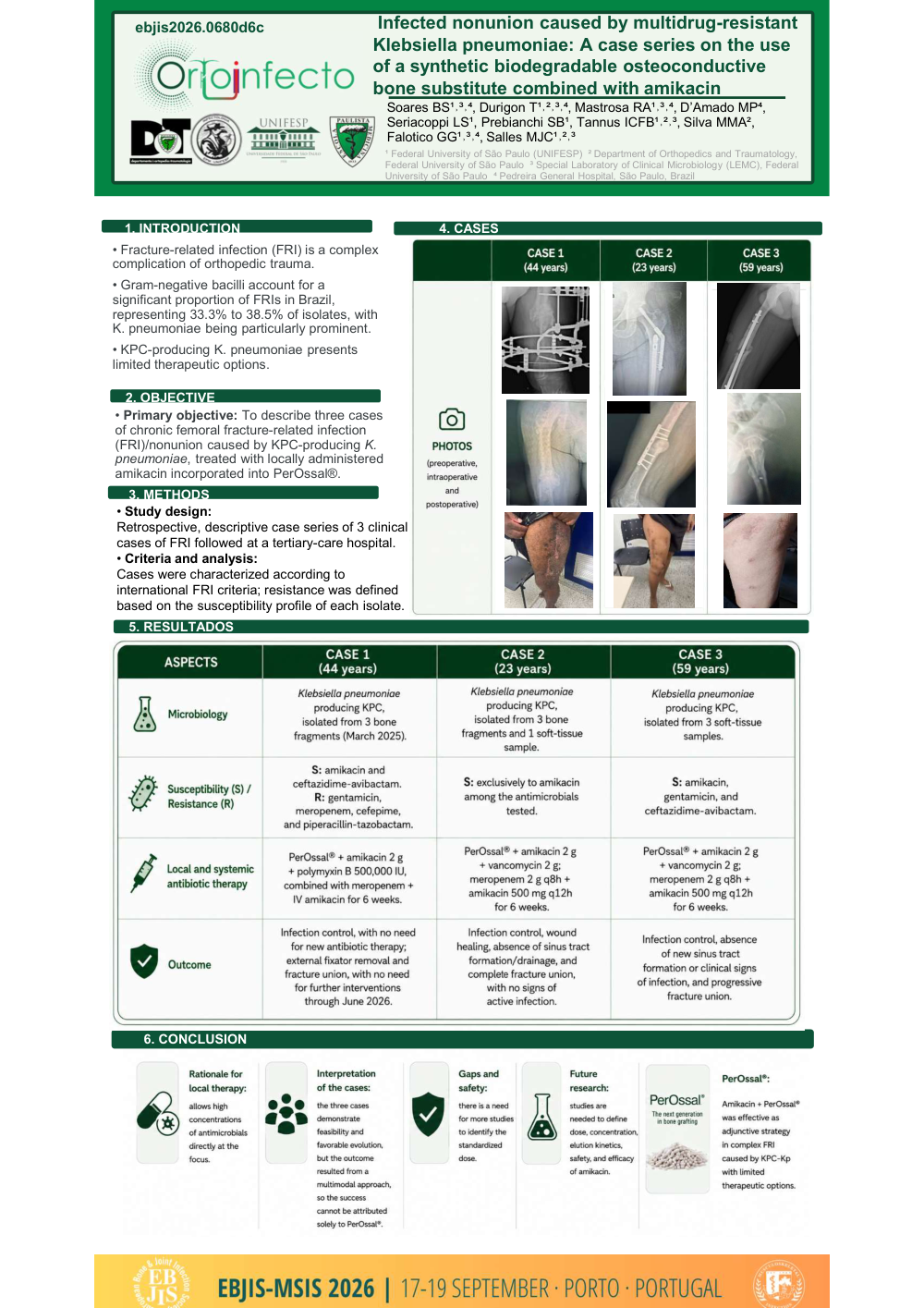
Infected nonunion caused by multidrug-resistant Klebsiella pneumoniae: A case series on the use of a synthetic biodegradable osteoconductive bone substitute* combined with amikacin
Poster Presenter
Authors
Beatriz De Santana Soares, Thomas Durigon, Rodrigo de Almeida Mastrosa, Marcelo Pigatto D'amado, Guilherme Guadagnini Falotico, Lais Sales Sericaoppi, Stef?nia Bazanelli Prebianchi, Isabelle C.F. Brasil Tannus, Mayara Muniz de Andrade Silva, Mauro J. Costa Salles
Affiliations
Universidade Federal De S?o Paulo (UNIFESP)), Universidade Federal De S?o Paulo (UNIFESP)), S?o Paulo, Brazil; Hospital Geral de Pedreira, S?o Paulo, Brazil; Departamento de Ortopedia e Traumatologia da UNIFESP (Universidade Federal de S?o Paulo), S?o Paulo, Brazil, Universidade Federal De S?o Paulo (UNIFESP)), S?o Paulo, Brazil; Hospital Geral de Pedreira, S?o Paulo, Brazil; Laborat?rio Especial de Microbiologia Cl?nica (LEMC), S?o Paulo, Braziλ, Hospital Geral de Pedreira, S?o Paulo, Brazil, Universidade Federal De S?o Paulo (UNIFESP)), S?o Paulo, Brazil, Universidade Federal De S?o Paulo (UNIFESP)), S?o Paulo, Brazil; Laborat?rio Especial de Microbiologia Cl?nica (LEMC), S?o Paulo, Brazil; Departamento de Ortopedia e Traumatologia da UNIFESP (Universidade Federal de S?o Paulo), Laborat?rio Especial de Microbiologia Cl?nica (LEMC), S?o Paulo, Brazil
Part of Topic
Case Report
Infected nonunion caused by multidrug-resistant Klebsiella pneumoniae: A case series on the use of a synthetic biodegradable osteoconductive bone substitute combined with amikacin
Abstract
Background: Fracture-related infection (FRI) is a challenging complication of orthopedic trauma. Multidrug-resistant Klebsiella pneumoniae producing KPC may severely limit systemic antimicrobial options.
Objective: To describe three cases of chronic FRI/femoral infected nonunion caused by KPC-producing K. pneumoniae treated with locally delivered amikacin incorporated into PerOssal®.
Methods: A retrospective descriptive case series of three patients with FRI treated at a tertiary hospital was performed. Clinical, surgical, microbiological, antimicrobial treatment, and clinical-radiographic outcomes were analyzed. Cases were characterized according to international FRI criteria.
Results: Three male patients (23, 44, and 59 years) with KPC-producing K. pneumoniae FRI were treated with PerOssal® containing amikacin, combined with systemic antimicrobial therapy. Microbiological profiles demonstrated limited therapeutic options, with amikacin remaining active in all three cases. All patients achieved infection control. Fracture consolidation was complete in two cases and progressive in one; no new signs of infection were reported during follow-up.
Conclusion: Local amikacin incorporated into PerOssal® was feasible as an adjunctive strategy in complex KPC-producing K. pneumoniae FRI with limited systemic therapeutic options. However, outcomes resulted from a multimodal and multidisciplinary approach, and the contribution of PerOssal® alone cannot be determined. Further studies are needed to establish standardized dosing, concentration, elution kinetics, safety, and efficacy.