99 posters, 2 videos, 5 audios, 13 topics, 7 sessions, 416 authors, 181 institutions
ePostersLive by SciGen Technologies S.A. All rights reserved.
The 21st Meeting of the Diabetic Foot Study Group 2026
24-26 September, 2026 | Florence, Italy

EP41
Adherence to therapeutic footwear and its impact on the recurrence of diabetic foot ulcers
Poster Presenter
Part of Topic
Basic and clinical science
"Good afternoon everyone.
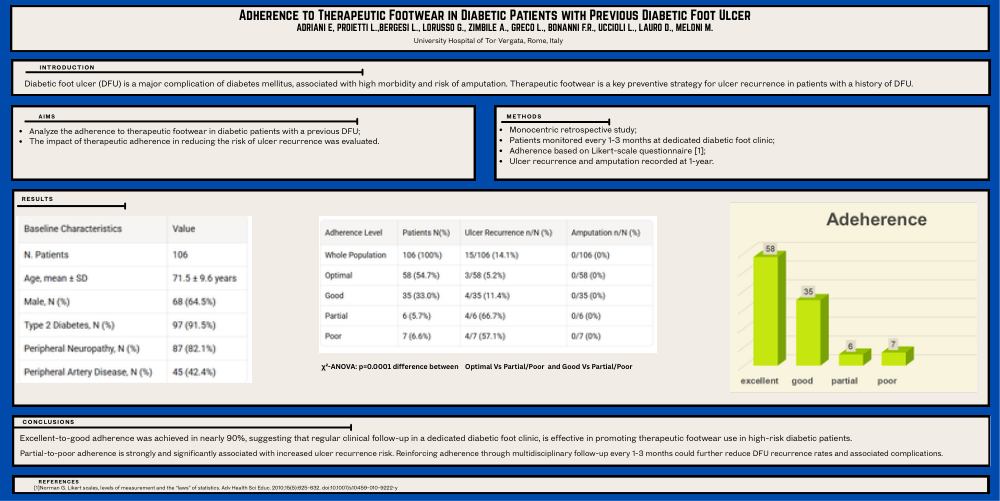
I am pleased to present our study titled: Adherence to Therapeutic Footwear in Diabetic Patients with Previous Diabetic Foot Ulcer.
As we all know, diabetic foot ulcer, or DFU, is one of the most serious complications of diabetes. It is associated with high morbidity and high risk of amputation. For patients with a history of DFU, therapeutic footwear is a key preventive strategy. However, its effectiveness depends entirely on one factor: adherence.
The aims of our study were twofold: First, to analyze the adherence to therapeutic footwear in patients with a previous ulcer. Second, to evaluate the impact of adherence on the risk of recurrence.
This was a monocentric, retrospective study. We included 106 patients, monitored every one to three months in our dedicated diabetic foot clinic. Adherence was evaluated using a validated Likert scale-based questionnaire. Ulcer recurrence and amputation were recorded at one-year follow-up.
Our population: 106 patients, mean age 71.5 years. 64.5 percent were male. 91.5 percent had type 2 diabetes. 82.1 percent had peripheral neuropathy and 42.4 percent had peripheral artery disease. So, a very high-risk population.
Looking at adherence: 58 patients, 54.7 percent, showed optimal adherence. 35 patients, 33 percent, showed good adherence. So, excellent-to-good adherence was achieved in nearly 90 percent of patients. Only 6 had partial and 7 had poor adherence.
Now, the most important data: outcomes at one year.
In patients with optimal adherence, recurrence was only 5.2 percent. In the good adherence group, 11.4 percent.
In contrast, recurrence increased dramatically: 66.7 percent in the partial group, and 57.1 percent in the poor group. Overall recurrence was 14.1 percent. Importantly, no amputations were recorded.
The statistical analysis confirmed this: Chi-square ANOVA, p equals 0.0001, with a significant difference between Optimal versus Partial and Poor, and Good versus Partial and Poor.
In conclusion: First, excellent-to-good adherence in nearly 90 percent suggests that regular follow-up in a dedicated clinic is effective. Second, partial-to-poor adherence is strongly associated with increased recurrence risk.
Therefore, reinforcing adherence through multidisciplinary follow-up could further reduce DFU recurrence and associated complications.
Thank you for your attention."