99 posters, 2 videos, 5 audios, 13 topics, 7 sessions, 418 authors, 180 institutions
ePostersLive by SciGen Technologies S.A. All rights reserved.
The 21st Meeting of the Diabetic Foot Study Group 2026
24-26 September, 2026 | Florence, Italy

EP109
Orthonyxia as a Preventive Strategy for Nail-Related Pressure Injury in Diabetic Patients: A Case Series
Poster Presenter
Authors
Areti Vasileiou, Elena Matopoulou, Dimitrios Skoutas, Nikolaos Papanas, Nikolaos Tentolouris, Christos Manes
Affiliations
Private Podology Center, Ioannina, Epirus, Greece, Private Podology Center, Thessaloniki, Central Macedonia, Greece, Private Diabetes Clinic, Thessaloniki, Central Macedonia, Greece, Second Department of Internal Medicine, Diabetes Centre, Democritus University of Thrace, Alexandroupolis, Eastern Macedonia and Thrace, Greece, Department of Diabetology, Laiko General Hospital, Athens, Attica, Greece, Papageorgiou General Hospital, Thessaloniki, Central Macedonia, Greece
Part of Topic
Wound healing and outcome
Title:
Orthonyxia as a Preventive Strategy for Nail-Related Pressure Injury in Diabetic Patients: A Case Series
Areti Vasileiou¹, Eleni Matopoulou², Dimitrios Skoutas³, Nikolaos Tentolouris⁴, Nikolaos Papanas⁵, Christos Manes⁶
Background:
Nail-related pressure and ingrown toenails are a frequent but often under-recognized source of local tissue stress in patients with diabetes mellitus, potentially contributing to soft tissue injury and increasing the risk of complications. Conservative, non-invasive strategies aimed at reducing mechanical load may play an important role in preventive care for high-risk patients.
Methods:
We present a case series of 32 patients managed in a private podiatry clinic. All patients underwent orthonyxia using a fiberglass brace system to address nail-induced periungual pressure. Patients were followed at regular intervals, with a median visit frequency of approximately 6 weeks. Long-term follow-up was available, with several cases monitored over extended periods.
Results:
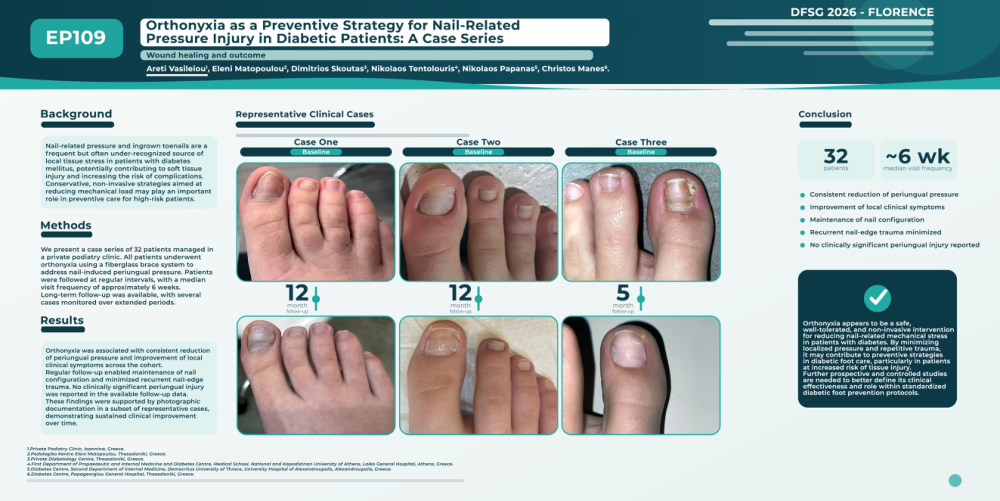
Orthonyxia was associated with consistent reduction of periungual pressure and improvement of local clinical symptoms across the cohort. Regular follow-up enabled maintenance of nail configuration and minimized recurrent nail-edge trauma. No clinically significant periungual injury was reported in the available follow-up data. These findings were supported by photographic documentation in a subset of representative cases, demonstrating sustained clinical improvement over time.
Conclusion:
Orthonyxia appears to be a safe, well-tolerated, and non-invasive intervention for reducing nail-related mechanical stress in patients with diabetes. By minimizing localized pressure and repetitive trauma, it may contribute to preventive strategies in diabetic foot care, particularly in patients at increased risk of tissue injury. Further prospective and controlled studies are needed to better define its clinical effectiveness and role within standardized diabetic foot prevention protocols.