180 posters, 53 videos, 29 audios, 5 topics, 304 authors, 182 institutions
ePostersLive by SciGen Technologies S.A. All rights reserved.
7th Commonwealth Chemistry Posters
24-25 June, 2026 | Online

P99
Removal of Heavy Metals via h-B₂S₃ with Kagome Architecture: A First-Principles Approach to Sustainable Water Treatment
Poster Presenter
Authors
Affiliations
Part of Topic
Clean Water and Sanitation (SDG 6)
Removal of Heavy Metals via h-B2S3 with Kagome Architecture: A First-Principles Approach to Sustainable Water Treatment
Muneeb Ali1, Muhammad Huzaifa1, Afsheen Razzaq1, Zaheer Ul-Haq1
1H.E.J. Research Institute of Chemistry, International Centre for Chemical and Biological Sciences, University of Karachi, Karachi, Pakistan
Abstract
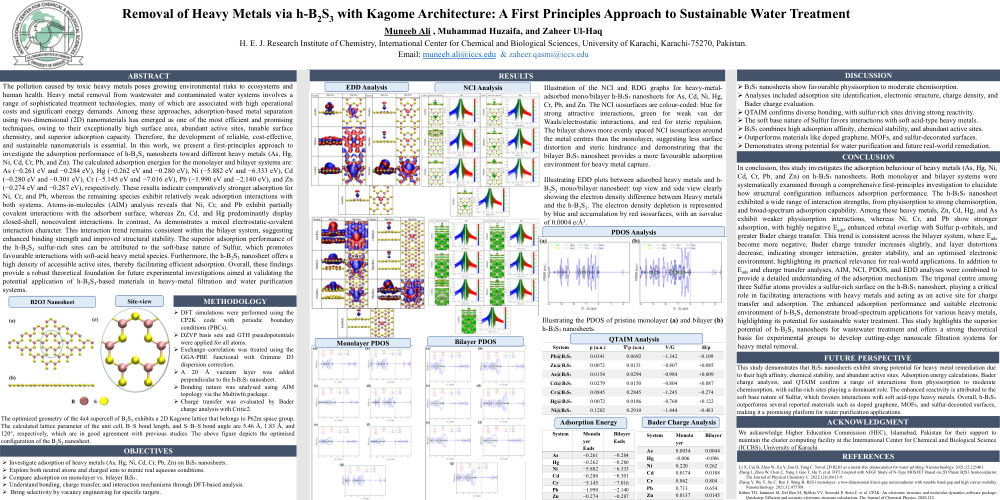
The pollution caused by toxic heavy metals poses growing environmental risks to ecosystems and human health. Heavy metal removal from wastewater and contaminated water systems involves a range of sophisticated treatment technologies, many of which are associated with high operational costs and significant energy demands. Among these approaches, adsorption-based metal separation using two-dimensional (2D) nanomaterials has emerged as one of the most efficient and promising techniques, owing to their exceptionally high surface area, abundant active sites, tunable surface chemistry, and superior adsorption capacity. Therefore, the development of reliable, cost-effective, and sustainable nanomaterials is essential. In this work, we present a first-principles approach to investigate the adsorption performance of h-B2S3 nanosheet toward different heavy metals (As, Hg, Ni, Cd, Cr, Pb, and Zn). The calculated adsorption energies for the monolayer and bilayer systems are: As (−0.261 eV and −0.284 eV), Hg (−0.262 eV and −0.280 eV), Ni (−5.882 eV and −6.333 eV), Cd (−0.280 eV and −0.301 eV), Cr (−5.145 eV and −7.016 eV), Pb (−1.990 eV and −2.140 eV), and Zn (−0.274 eV and −0.287 eV), respectively. These results indicate comparatively stronger adsorption for Ni, Cr, and Pb, whereas the remaining species exhibit relatively weak adsorption interactions with both systems. Atoms-in-molecules (AIM) analysis reveals that Ni, Cr, and Pb exhibit partially covalent interactions with the adsorbent surface, whereas Zn, Cd, and Hg predominantly display closed-shell, noncovalent interactions. In contrast, As demonstrates a mixed electrostatic-covalent interaction character. This interaction trend remains consistent within the bilayer system, suggesting enhanced binding strength and improved structural stability. The superior adsorption performance of the h-B2S3 sulfur-rich sites can be attributed to the soft-base nature of sulfur, which promotes favorable interactions with soft-acid heavy metal species. Furthermore, the h-B2S3 nanosheet offers a high density of accessible active sites, thereby facilitating efficient adsorption. Overall, these findings provide a robust theoretical foundation for future experimental investigations aimed at validating the potential application of h-B2S3-based materials in heavy-metal filtration and water purification systems.
Keywords: Water purification, nanomaterial, separation techniques, heavy metal removal, DFT