180 posters, 53 videos, 29 audios, 5 topics, 304 authors, 182 institutions
ePostersLive by SciGen Technologies S.A. All rights reserved.
7th Commonwealth Chemistry Posters
24-25 June, 2026 | Online

P41
Advancing Photodynamic Therapy: Ruthenium Polypyridyl/Schiff Base Complexes for Dual Biomedical Applications
Poster Presenter
Authors
Affiliations
Part of Topic
Good Health and Wellbeing (SDG 3)
Title
Advancing Photodynamic Therapy: Ruthenium Polypyridyl/Schiff Base Complexes for Dual Biomedical Applications
Introduction
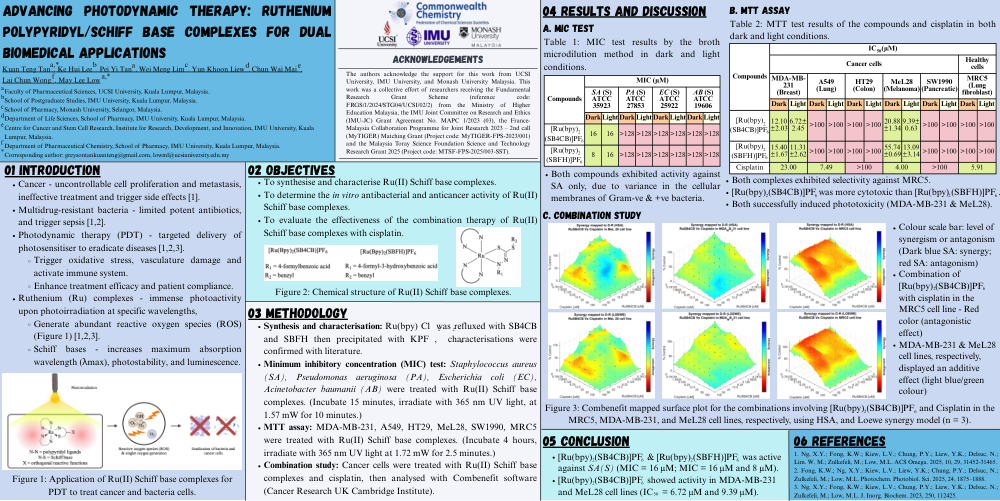
Cancer is characterised by uncontrollable cell proliferation and metastasis, while current treatment options often exhibit limited efficacy and cause adverse effects to healthy tissues. Multidrug-resistant bacteria present another major healthcare challenge due to the decreasing effectiveness of antibiotics and the risk of severe complications such as sepsis. Photodynamic therapy (PDT) has emerged as a promising therapeutic strategy that utilises photosensitisers activated by light to eradicate cancer cells and pathogenic microorganisms. Upon activation, PDT induces oxidative stress, damages vasculature, and stimulates immune responses, thereby enhancing treatment efficacy and patient compliance.
Ruthenium(II) complexes have attracted considerable interest as photosensitisers because of their strong photoactivity and ability to generate abundant reactive oxygen species (ROS) upon irradiation at specific wavelengths. Furthermore, incorporation of Schiff base ligands can improve the photophysical properties of ruthenium complexes by increasing the maximum absorption wavelength (λmax), photostability, and luminescence. These characteristics make ruthenium Schiff base complexes attractive candidates for dual antibacterial and anticancer PDT applications.
Objectives
The objectives of this study were to synthesise and characterise ruthenium(II) Schiff base complexes, determine their in vitro antibacterial and anticancer activities, and evaluate their effectiveness when combined with cisplatin as a potential combination therapy strategy.
Methodology
Ruthenium(II) Schiff base complexes were synthesised by refluxing Ru(bpy)₂Cl₂ with the Schiff base ligands SB4CB and SBFH, followed by precipitation with potassium hexafluorophosphate (KPF₆). Structural characterisation was performed and confirmed against literature data.
Antibacterial activity was evaluated using minimum inhibitory concentration (MIC) assays against Staphylococcus aureus, Pseudomonas aeruginosa, Escherichia coli, and Acinetobacter baumannii. For PDT studies, bacterial cultures were incubated with the complexes, irradiated with 365 nm UV light, and assessed using the broth microdilution method.
Anticancer activity was investigated using MTT assays against MDA-MB-231 breast cancer, A549 lung cancer, HT29 colon cancer, MeL28 melanoma, and SW1990 pancreatic cancer cell lines, with MRC5 lung fibroblasts serving as healthy controls. Cells were treated with the complexes, exposed to 365 nm UV irradiation, and subsequently analysed for cell viability. Combination studies involving ruthenium complexes and cisplatin were further analysed using Combenefit software to determine potential synergistic, additive, or antagonistic interactions.
Results and Discussion
The antibacterial studies demonstrated that both [Ru(bpy)₂(SB4CB)]PF₆ and [Ru(bpy)₂(SBFH)]PF₆ exhibited activity exclusively against Staphylococcus aureus. The MIC values for [Ru(bpy)₂(SB4CB)]PF₆ were 16 µM under both dark and light conditions, while [Ru(bpy)₂(SBFH)]PF₆ exhibited MIC values of 8 µM in the dark and 16 µM upon irradiation. Neither complex displayed activity against the Gram-negative bacterial strains tested. The observed selectivity was attributed to differences in the cellular membrane structures of Gram-positive and Gram-negative bacteria.
In the anticancer studies, both ruthenium complexes demonstrated selective toxicity towards cancer cells while showing negligible effects on healthy MRC5 fibroblasts. [Ru(bpy)₂(SB4CB)]PF₆ was the most potent compound, exhibiting IC₅₀ values of 6.72 µM and 9.39 µM against MDA-MB-231 and MeL28 cells under light irradiation, respectively. The compound showed enhanced activity under irradiated conditions compared to dark conditions, indicating successful induction of phototoxicity. Similarly, [Ru(bpy)₂(SBFH)]PF₆ also displayed improved cytotoxicity upon irradiation, although its activity was lower than that of [Ru(bpy)₂(SB4CB)]PF₆. Both complexes therefore demonstrated promising PDT-mediated anticancer effects.
Combination studies revealed that the combination of [Ru(bpy)₂(SB4CB)]PF₆ with cisplatin produced antagonistic effects in healthy MRC5 cells, while additive effects were observed in MDA-MB-231 and MeL28 cancer cells. These findings suggest that the combination may enhance therapeutic efficacy against cancer cells while reducing undesirable toxicity toward healthy tissues.
Conclusion
The ruthenium(II) Schiff base complexes [Ru(bpy)₂(SB4CB)]PF₆ and [Ru(bpy)₂(SBFH)]PF₆ exhibited promising antibacterial activity against Staphylococcus aureus. Furthermore, [Ru(bpy)₂(SB4CB)]PF₆ demonstrated significant anticancer activity against MDA-MB-231 breast cancer and MeL28 melanoma cells, particularly under light irradiation. The combination of [Ru(bpy)₂(SB4CB)]PF₆ with cisplatin resulted in additive anticancer effects while displaying antagonistic effects in healthy cells. Collectively, these findings highlight the potential of ruthenium Schiff base complexes as dual-function photosensitisers for antibacterial and anticancer photodynamic therapy.