180 posters, 53 videos, 29 audios, 5 topics, 304 authors, 182 institutions
ePostersLive by SciGen Technologies S.A. All rights reserved.
7th Commonwealth Chemistry Posters
24-25 June, 2026 | Online

P02
Study of the emulsifying capacity of mucilage from the pods of Abelmoschus esculentus
Poster Presenter
Authors
Affiliations
Part of Topic
Good Health and Wellbeing (SDG 3)
Good day, everyone. My name is Ndibi Brenton Hubert, representing the University of Yaoundé 1 and the Institute of Medical Research and Medicinal Plants Studies, IMPM, here in Cameroon.
I am pleased to share our study on the emulsifying capacity of mucilage extracted from the pods of Abelmoschus esculentus—commonly known as okra.
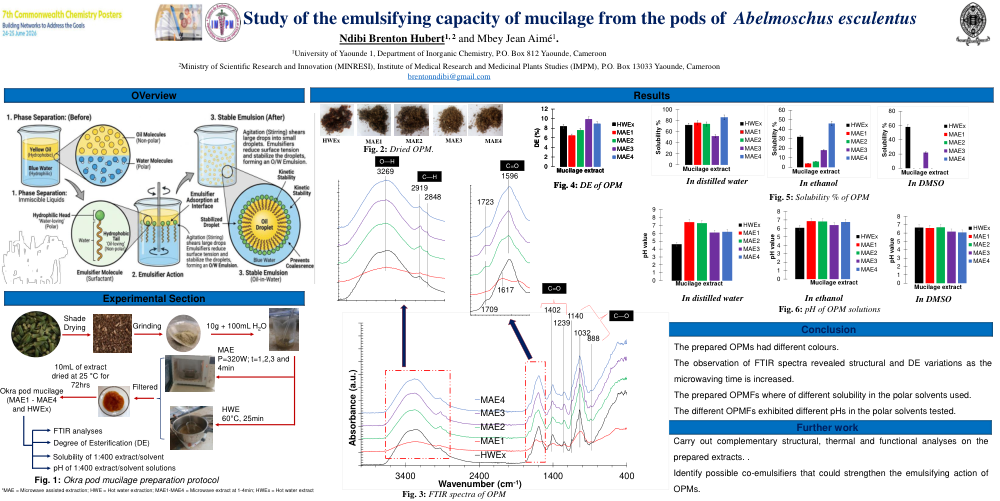
Emulsifiers are substances widely used in the food industry to retard the separation of two or more immiscible liquids. Synthetic polymers are traditionally used as emulsifiers, but the growing demand by consumers for eco-friendly and sustainably produced emulsifiers has shifted research towards substituting synthetic polymers for bio-based alternatives In the quest for sustainable, plant-derived emulsifiers for industrial and cosmetic applications, okra pod mucilage, or OPM, stands out as an excellent, non-toxic biopolymer candidate. The core objective of this research was to evaluate how different extraction methods—specifically comparing traditional hot water extraction with a modern green chemistry approach, microwave-assisted extraction—impact the structural and chemical properties of the resulting mucilage.
Figure 1 outlines the experimental protocol used. Fresh okra pods were collected, sliced, subjected to shade drying, and then ground into a fine powder. 10 grams of this powder was mixed with 100 milliliters of distilled water.
From there, the matrix was split into two parallel extraction pathways:
- The first was Hot Water Extraction (HWE), carried out at 60°C for 25 minutes.
- The second was Microwave-Assisted Extraction (MAE), operated at a constant power of 320 Watts. To study the kinetic effect of microwave irradiation, four distinct extracts were isolated at different time intervals: 1, 2, 3, and 4 minutes—referred to as MAE1 through MAE4.
All liquid extracts were filtered, and 10-milliliter aliquots were dried at 25°C for 72 hours to yield the solid, dried OPM flakes you see in Figure 2.
Upon structural and physicochemical characterisation, we observed distinct variations between the five prepared extracts:
First, macroscopically, the prepared OPMs exhibited entirely different colour profiles depending on the extraction time and method.
Second, turning to the FTIR spectra in Figure 3, the classic fingerprint of polysaccharide mucilage was verified. Characteristic bands were observed including the intense hydroxyl O-H stretching at 3269 cm-1, aliphatic C-H stretching around 2919 cm-1, and prominent carbonyl C=O stretching modes between 1596 and 1723 cm-1. Crucially, tracking these FTIR band intensities allowed us to monitor the Degree of Esterification (DE). The data revealed that as microwaving time increased from 1 to 4 minutes, significant structural variations and fluctuations in the Degree of Esterification occurred.
Third, the solubility and pH of a 1-to-400 extract-to-solvent solution across three polar solvents: distilled water, DMSO, and ethanol were analysed. The extracts behaved differently across the board; we observed distinct solubility percentages and shifting pH balances depending on whether the mucilage was extracted via hot water or via progressive microwave intervals.
In conclusion, our findings demonstrate that microwave-assisted extraction is not only a rapid, energy-efficient green method, but it actively allows us to tune the physicochemical properties—such as colour, solubility, pH, and degree of esterification—of Abelmoschus esculentus mucilage.
Moving forward, the immediate next steps involve carrying out complementary structural, thermal, and functional analyses to map out the explicit kinetic stability of these emulsions. Furthermore, we aim to identify optimal co-emulsifiers that can synergistically strengthen the emulsifying performance of these OPMs for targeting sensitive industrial formulations.
Thank you very much for your time and attention. I look forward to your questions at the poster session