180 posters, 53 videos, 29 audios, 5 topics, 304 authors, 182 institutions
ePostersLive by SciGen Technologies S.A. All rights reserved.
7th Commonwealth Chemistry Posters
24-25 June, 2026 | Online

P97
Seasonal and Source-Based Assessment of Physicochemical and Microbial Water Quality in Rocky-Hill Settlements of Southwestern Nigeria
Part of Topic
Clean Water and Sanitation (SDG 6)
Audio
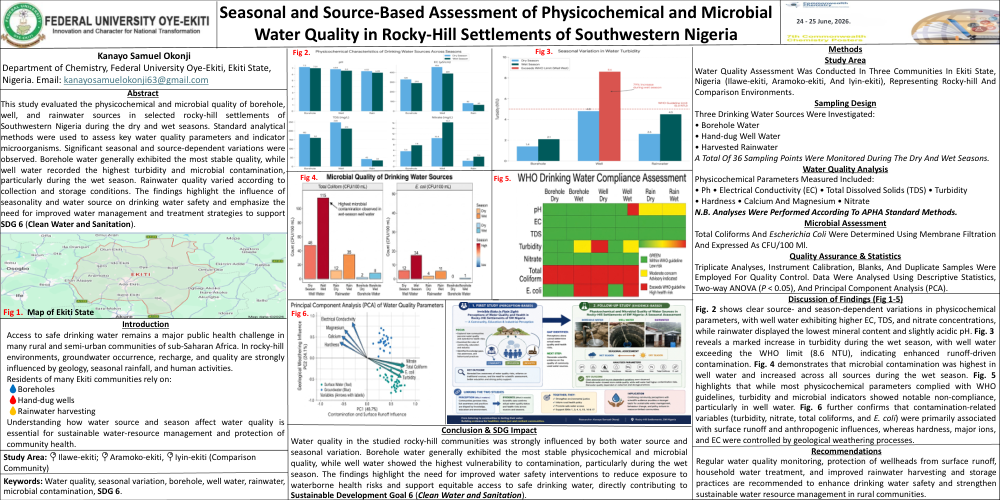
Seasonal and Source-Based Assessment of Physicochemical and Microbial Water Quality in Rocky-Hill Settlements of Southwestern Nigeria
Abstract
Access to safe drinking water remains a critical public health challenge in many rural and semi-urban communities in sub-Saharan Africa, particularly in geologically constrained “rocky-hill” settlements where groundwater availability and quality are highly variable. This study presents a comprehensive experimental assessment of water quality across different water sources and seasonal conditions in selected rocky-hill communities in Southwestern Nigeria.
Water samples were collected from borehole, well, and rainwater sources during both wet and dry seasons. Standard analytical procedures were used to evaluate key physicochemical parameters, including pH, electrical conductivity, total dissolved solids, turbidity, hardness, and major ion concentrations. Microbial quality was also assessed using indicator organisms to determine potential health risks associated with consumption.
Results reveal significant spatial and seasonal variability in water quality across the different sources. Borehole water generally exhibited more stable physicochemical characteristics compared to well and rainwater sources, although seasonal fluctuations were observed, particularly during the wet season. Well water showed elevated levels of contamination indicators, suggesting increased vulnerability to surface infiltration and anthropogenic influence. Rainwater quality varied depending on collection and storage conditions, highlighting potential post-collection contamination risks.
The findings demonstrate that water source type and seasonal variation critically influence water safety in rocky-hill environments. This study provides evidence-based insights for environmental monitoring, rural water management, and public health planning in resource-limited settings. It also underscores the need for improved water treatment strategies and community-level interventions to ensure safe drinking water access.
Keywords: Water quality assessment; seasonal variation; borehole water; well water; rainwater; physicochemical parameters; microbial contamination; rural water resources; rocky-hill settlements; environmental health.
Summary:
This study evaluates the physicochemical and microbial quality of water from borehole, well, and rainwater sources in rocky-hill settlements of Southwestern Nigeria across wet and dry seasons. Standard analytical methods were used to assess key water quality parameters. The results show clear seasonal and source-dependent variations, with borehole water generally exhibiting more stable quality, while well water showed higher contamination risks. Rainwater quality varied based on collection and storage conditions. The findings highlight significant environmental and public health implications, emphasizing the need for improved water management and treatment strategies in resource-limited communities.
References
APHA. (2017). Standard Methods for the Examination of Water and Wastewater (23rd ed.). American Public Health Association, American Water Works Association, Water Environment Federation.
World Health Organization (WHO). (2017). Guidelines for Drinking-water Quality (4th ed.). WHO Press, Geneva.
Kayode, M. O., Tomori, W. B., Okoronkwo, E. A., et al. (2024). Seasonal variation of groundwater quality in a basement complex geology of Ado Ekiti, Southwestern Nigeria using water quality index model. Journal of Umm Al-Qura University for Applied Sciences, 10(3), 1–15. https://doi.org/10.1007/s43994-024-00195-1
Ezurike, C. O., Ogbuagu, J. O., & Okakpu, O. J. (2026). Assessment of physical water quality parameters of borehole water in Enugu State: A comparative analysis of wet and dry seasons. International Research Journal of Pure and Applied Chemistry, 27(1), 33–50. https://doi.org/10.9734/irjpac/2026/v27i1971
Okonji, K. S. (2025). Community perception of waterborne health risks in rocky-hill settlements of Nigeria: Implications for environmental justice and rural health policy in Sub-Saharan Africa. Ethiopian Journal of Environmental Studies & Management, 18(4), 458–469. https://ejesm.org/doi/v18i4.3
Okonji, K. S. (2025, October). Invisible risks in plain sight: Perceptions of water quality and health in rocky-hill settlements of SW Nigeria — A community, education & industrial perception [Poster presentation]. 6th Commonwealth Chemistry Posters Conference. https://doi.org/10.6084/m9.figshare.30285346.v1
Bain, R. E. S., Cronk, R., Wright, J. A., et al. (2014). Fecal contamination of drinking-water in low- and middle-income countries: A systematic review and meta-analysis. PLoS Medicine, 11(5), e1001644. https://doi.org/10.1371/journal.pmed.1001644
Egbueri, J. C. (2019). Assessment of groundwater quality for drinking and irrigation purposes using hydrochemical indices in a semi-urban area, Nigeria. Applied Water Science, 9, 1–15. https://doi.org/10.1007/s13201-019-0965-3
Okoli, E., Nwaogazie, I. L., & Ugwoha, E. (2024). Seasonal variation of groundwater quality in Bonny Island, Rivers State, Nigeria. International Journal of Environment and Climate Change, 14(5), 105–114. https://doi.org/10.9734/ijecc/2024/v14i54174