180 posters, 53 videos, 29 audios, 5 topics, 304 authors, 182 institutions
ePostersLive by SciGen Technologies S.A. All rights reserved.
7th Commonwealth Chemistry Posters
24-25 June, 2026 | Online

P118
Bioinspired Symbiotic Architectures for Solar-Driven CO₂ Conversion, Sustainable Fuel Production and Renewable Energy Generation through Lichen Logic
Part of Topic
Responsible Energy (SDGs 7 and 12)
Audio
Bioinspired Symbiotic Architectures for Solar-Driven CO₂ Conversion, Sustainable Fuel Production and Renewable Energy Generation through Lichen Logic
Abstract
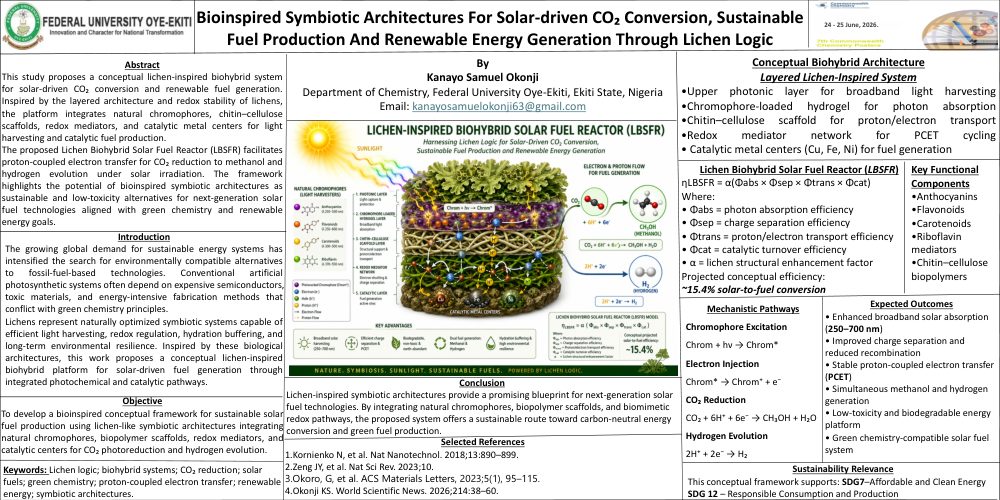
The pursuit of sustainable and environmentally responsible energy technologies has accelerated interest in bioinspired materials and artificial photosynthetic systems. This study presents a conceptual framework based on lichen-inspired symbiotic architectures designed to support solar-driven carbon dioxide (CO₂) conversion and renewable fuel generation. The approach draws from the structural and biochemical logic of natural lichen systems, where mutualistic interactions between fungal and photosynthetic partners enable efficient energy capture and long-term stability.
The proposed architecture integrates natural chromophores, biodegradable biopolymer scaffolds, and earth-abundant catalytic metals to create a multi-layered platform capable of efficient photonic harvesting and charge transport. Plant-derived pigments such as flavonoids, anthocyanins, and carotenoids were incorporated as broadband solar absorbers, while chitin–cellulose composite matrices were designed to provide hydration stability and facilitate proton transport. Bio-derived redox mediators, including riboflavin and quinone analogues, were introduced to support proton-coupled electron transfer pathways required for multi-electron reactions.
Mechanistic modeling demonstrated feasible pathways for solar-driven CO₂ reduction to methanol and concurrent hydrogen evolution processes. Predicted system behavior indicated enhanced photon utilization, improved charge separation efficiency, and stable catalytic performance within a symbiotic biomimetic framework. The integration of renewable materials and environmentally benign catalysts supports sustainable fuel production strategies and reduces reliance on toxic semiconductor systems.
Overall, this work establishes lichen logic as a promising blueprint for designing next-generation solar fuel technologies that align with sustainable energy development and responsible material utilization.
Keywords: Bioinspired systems; artificial photosynthesis; CO₂ conversion; solar fuels; lichen logic; biohybrid catalysis; renewable energy; green chemistry.
Summary
This study presents a lichen-inspired biohybrid framework for solar-driven CO₂ conversion and sustainable fuel production using renewable and biodegradable materials. By mimicking natural symbiotic architectures, the system integrates natural chromophores, biopolymer scaffolds, and earth-abundant catalysts to enhance light harvesting and catalytic efficiency. The proposed design highlights the potential of biomimetic strategies in advancing renewable energy technologies and supporting sustainable resource utilization aligned with global clean energy goals.
References
Okonji, K. S. (2026). Symbiotic photochemistry and lichen-inspired biohybrid architecture for next-generation solar fuel reactors: Photonic harvesting, PCET pathways, and CO₂-to-methanol conversion. World Scientific News, 214, 38–60. https://doi.org/10.65770/VSFV3422
Kornienko, N., Zhang, J. Z., Sakimoto, K. K., Yang, P., & Reisner, E. (2018). Interfacing nature’s catalytic machinery with synthetic materials for semi-artificial photosynthesis. Nature Nanotechnology, 13, 890–899. https://doi.org/10.1038/s41565-018-0252-9
Zeng, J.-Y., Wang, X.-S., Liu, X.-H., Li, Q.-R., Feng, J., & Zhang, X.-Z. (2023). Light-driven biohybrid system utilizes N₂ for photochemical CO₂ reduction. National Science Review, 10(7), nwad142. https://doi.org/10.1093/nsr/nwad142
Okoro, G., Husain, S., Saukani, M., Mutalik, C., Yougbaré, S., Hsiao, Y.-C., & Kuo, T.-R. (2023). Emerging trends in nanomaterials for photosynthetic biohybrid systems. ACS Materials Letters, 5(1), 95–115. https://doi.org/10.1021/acsmaterialslett.2c00752
Cai, B., Pavliuk, M. V., Berggren, G., et al. (2025). Bio-hybrid photoelectrochemical catalysis for solar fuels and chemical conversion. Nature Communications, 16, 9131. https://doi.org/10.1038/s41467-025-64931-