180 posters, 53 videos, 29 audios, 5 topics, 304 authors, 182 institutions
ePostersLive by SciGen Technologies S.A. All rights reserved.
7th Commonwealth Chemistry Posters
24-25 June, 2026 | Online

P114
Enhancement of a Urea-formaldehyde resin by Intercalated kaolinites
Poster Presenter
Part of Topic
Responsible Energy (SDGs 7 and 12)
Hello, distinguished colleagues and fellow researchers. My name is Hervé Barye Tatang, from the Laboratory of Applied Inorganic Chemistry at the University of Yaoundé I. It is my pleasure to present our work on the Enhancement of a Urea‑Formaldehyde Resin by Intercalated Kaolinites.
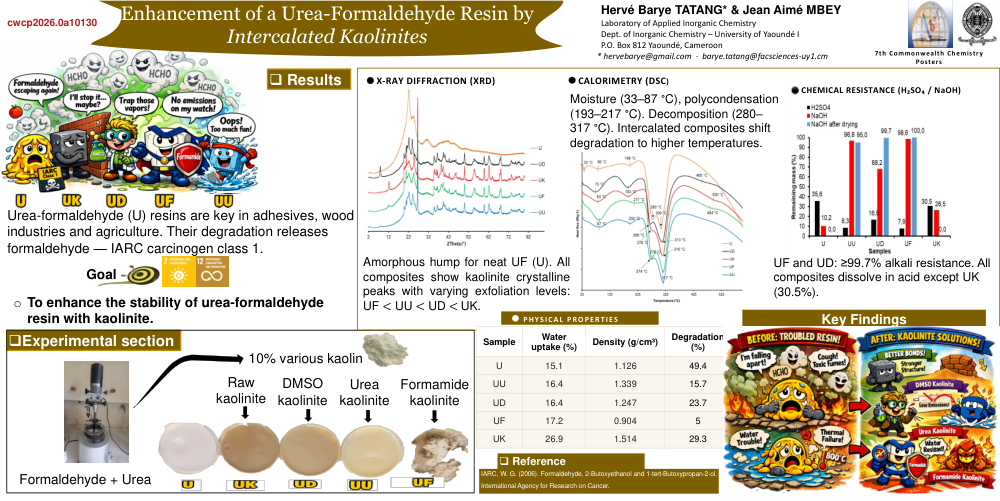
Urea‑formaldehyde (UF) resins are widely used in adhesives, wood composites, and agriculture. However, their degradation releases formaldehyde — classified by the IARC as a Group 1 carcinogen. This emission problem has long limited the safe and sustainable use of UF resins. Our research explores how kaolinite fillers, particularly when intercalated with molecules such as DMSO, urea, or formamide, can transform UF resins into more stable composites.
The resin was synthesized by mixing urea and formaldehyde at pH 9, followed by heating. Into this matrix, 10 % of various kaolinites (raw kaolinite, DMSO‑intercalated kaolinite, urea‑intercalated kaolinite, and formamide‑intercalated kaolinite) was incorporated . This yielded five composite series: U (neat resin), UU (resin filled with urea intercalated kaolinite), UD (resin fillled by DMSO intercalated kaolinite), UF (resin fillled by formamide intercalated kaolinite), and UK (resin fillled by raw kaolinite).
X‑ray diffraction confirmed intercalation, with crystalline peaks and low‑angle reflections indicating exfoliation. DSC analysis showed that intercalated composites shifted degradation to higher temperatures. Physically, the UF composite with formamide intercalation demonstrated the lowest degradation, only 5 % compared to nearly 50 % for the neat resin. Chemically, UF and UD resisted alkali attack with over 99 % mass retention, while most composites dissolved in acid.
Our study demonstrates that kaolinite intercalation significantly enhances resin stability. Among all composites, the formamide‑intercalated resin (UF) showed the best performance in terms of water resistance, thermal stability, and alkali resistance. This approach not only mitigates formaldehyde release but also aligns with sustainability goals, particularly responsible production and clean energy.
In conclusion, intercalated kaolinites offer a promising pathway to safer, stronger, and more sustainable urea‑formaldehyde resins. We believe this work contributes to advancing composite materials for industrial and environmental applications. Thank you for your attention, and I welcome your questions.