180 posters, 53 videos, 29 audios, 5 topics, 304 authors, 182 institutions
ePostersLive by SciGen Technologies S.A. All rights reserved.
7th Commonwealth Chemistry Posters
24-25 June, 2026 | Online

P122
Tunable properties (structural, Dielectric, Optical, I-V) of the High-Entropy Oxides (HEO) materials and their composite with biopolymer for green energy
Poster Presenter
Authors
Affiliations
Part of Topic
Responsible Energy (SDGs 7 and 12)
Video
Tunable Properties (structural, Dielectric, Optical, I-V) of the High-Entropy Oxides (HEOs) Materials and their Composite with Biopolymer for Green Energy
Jahangir Malik a, Uzma Hira a
a; School of Chemistry, University of the Punjab, New Campus, Lahore, 54590, Pakistan
(Email: jgr.m14144@gmail.com)
Introduction
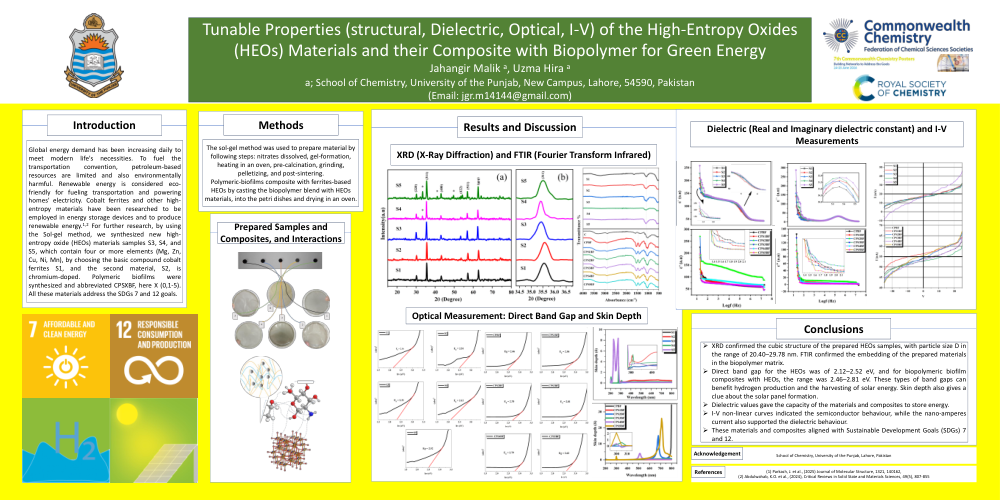
Global energy demand has been increasing daily to meet modern life's necessities. To fuel the transportation convention, petroleum-based resources are limited and also environmentally harmful. Renewable energy is considered eco-friendly for fueling transportation and powering homes' electricity. Cobalt ferrites and other high-entropy materials have been researched to be employed in energy storage devices and to produce renewable energy.1,2 For further research, by using the Sol-gel method, we synthesized new high-entropy oxide (HEOs) materials samples S3, S4, and S5, which contain four or more elements (Mg, Zn, Cu, Ni, Mn), by choosing the basic compound cobalt ferrites S1, and the second material, S2, is chromium-doped. Polymeric biofilms were synthesized and abbreviated CPSXBF, here X (0,1-5). All these materials address the SDGs 7 and 12 goals.
Method
The sol-gel method was used to prepare material by following steps: nitrates dissolved, gel-formation, heating in an oven, pre-calcination, grinding, pelletizing, and post-sintering.
Polymeric-biofilms composite with ferrites-based HEOs by casting the biopolymer blend with HEOs materials, into the petri dishes and drying in an oven
- XRD confirmed the cubic structure of the prepared HEOs samples, with particle size D in the range of 20.40–29.78 nm. FTIR confirmed the embedding of the prepared materials in the biopolymer matrix.
- Direct band gap for the HEOs was of 2.12–2.52 eV, and for biopolymeric biofilm composites with HEOs, the range was 2.46–2.81 eV. These types of band gaps can benefit hydrogen production and the harvesting of solar energy. Skin depth also gives a clue about the solar panel formation.
- Dielectric values gave the capacity of the materials and composites to store energy.
- I-V non-linear curves indicated the semiconductor behaviour, while the nano-amperes current also supported the dielectric behaviour.
- These materials and composites aligned with Sustainable Development Goals (SDGs) 7 and 12.