180 posters, 53 videos, 29 audios, 5 topics, 304 authors, 182 institutions
ePostersLive by SciGen Technologies S.A. All rights reserved.
7th Commonwealth Chemistry Posters
24-25 June, 2026 | Online

P87
Amalgamated Experimental, DFT, Monte Carlo, and Molecular Dynamics Investigation of Low-Cost Biosorbents for Dichlorodiphenylethane Sequestration from Water
Poster Presenter
Part of Topic
Clean Water and Sanitation (SDG 6)
Video
Amalgamated Experimental, DFT, Monte Carlo, and Molecular Dynamics Investigation of Low‑Cost Biosorbents for Dichlorodiphenylethane Sequestration from Water
Ikechukwu P. Ejidike1, Temitope O. Fakoya2, Olajumoke Oluade3
1Biological and Analytical Application of Synthetic and Nanomaterials Research (BAASNMR) Group, Department of Chemical Sciences, Faculty of Science, Anchor University, Lagos 100278, Nigeria.
2Department of Industrial Chemistry, Faculty of Science, University of Ilesa, Ilesa 233252, Nigeria
3Department of Chemistry, Faculty of Science, Gombe State University, Gombe 760253, Nigeria.
Corresponding E-mail address: pejidike30@gmail.com; destinedchild12@gmail.com
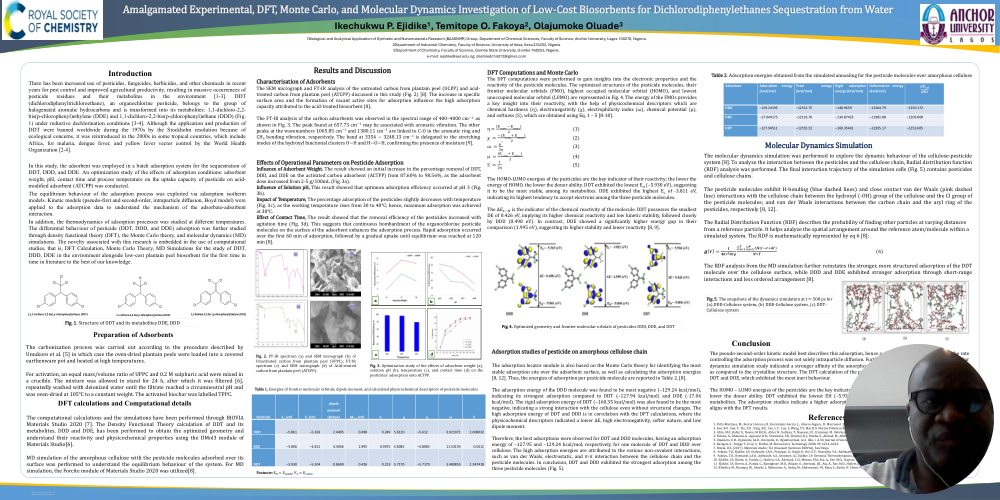
Persistent organochlorine pesticides such as dichlorodiphenyltrichloroethane (DDT) and its metabolites (DDD and DDE) continue to pose serious risks to water quality due to their high stability, bioaccumulation, and toxicity. This study presents an integrated experimental and computational investigation into the sequestration of dichlorodiphenylethanes from aqueous systems using a low-cost biosorbent derived from acid-treated unripe plantain peel. The adsorbent was characterized using FT-IR and SEM, revealing enhanced porosity and active surface functional groups. Batch adsorption experiments demonstrated removal efficiencies exceeding 95% under optimized conditions, with equilibrium data best described by the Langmuir isotherm and pseudo-second order kinetics, indicating a chemisorption mechanism. Thermodynamic analysis confirmed the adsorption process to be spontaneous and exothermic. To complement the experimental findings, Density Functional Theory (DFT) calculations were employed to elucidate the electronic properties and reactivity of DDT, DDD, and DDE, revealing higher reactivity for DDT and DDD. Monte Carlo simulations and molecular dynamics (MD) studies further demonstrated strong non-covalent interactions, dominated by van der Waals forces, between the pesticide molecules and amorphous cellulose components of the biosorbent. The strong agreement between experimental and computational results highlights the effectiveness of combining low-cost biosorbents with multiscale modelling tools for the remediation of pesticide-contaminated water, offering a sustainable strategy for environmental cleanup.
Keywords: Dichlorodiphenylethanes, Agro‑waste valorization, DFT, Monte Carlo simulations, MD simulations, Water remediation