180 posters, 53 videos, 29 audios, 5 topics, 304 authors, 182 institutions
ePostersLive by SciGen Technologies S.A. All rights reserved.
7th Commonwealth Chemistry Posters
24-25 June, 2026 | Online

P112
Evaluation of Phenobarbital Adsorption Efficiency on Biosorbents or Activated Carbon Obtained from Adansonia Digitata Shells
Poster Presenter
Authors
Affiliations
Part of Topic
Clean Water and Sanitation (SDG 6)
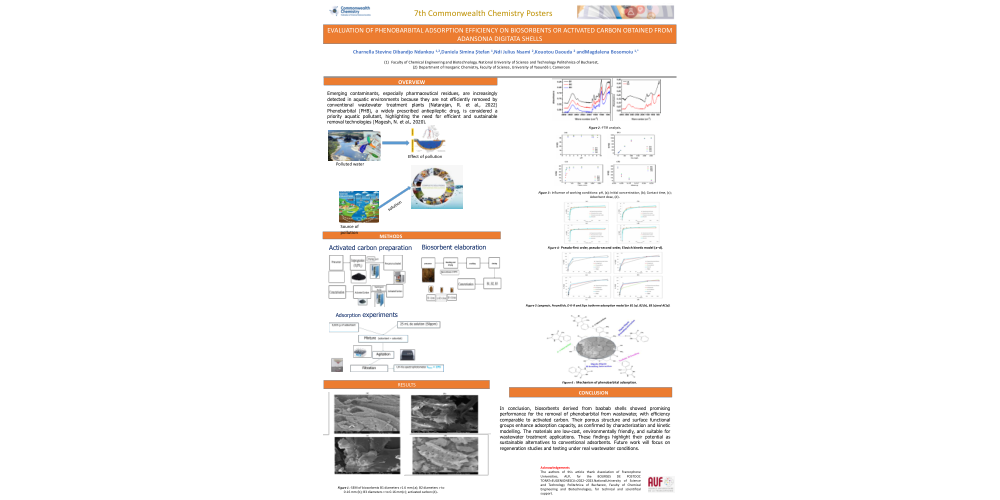
The increasing presence of pharmaceutical residues in aquatic environments has highlighted the need for sustainable water treatment technologies. This study evaluated the adsorption efficiency of biosorbents and activated carbon derived from Adansonia digitata (baobab) shells for the removal of phenobarbital from wastewater. biosorbent and Activated carbon were prepared and characterized using SEM and FTIR analyses, which revealed a porous structure and oxygen-containing functional groups favorable for adsorption. Batch experiments were conducted to assess the effects of pH, contact time, initial concentration, and adsorbent dose on phenobarbital removal. The biosorbent with the smallest particle size showed the highest adsorption capacity, comparable to that of activated carbon. Kinetic and equilibrium studies indicated that the adsorption process was best described by the pseudo-second-order, Elovich, Langmuir, and Sips models. The proposed adsorption mechanism involves pore filling, hydrogen bonding, π–π interactions, and electrostatic interactions between phenobarbital molecules and the surface functional groups of the adsorbents. These findings demonstrate the potential of baobab-shell-derived biosorbents as low-cost, environmentally friendly, and sustainable materials for wastewater treatment.