180 posters, 53 videos, 29 audios, 5 topics, 304 authors, 182 institutions
ePostersLive by SciGen Technologies S.A. All rights reserved.
7th Commonwealth Chemistry Posters
24-25 June, 2026 | Online

P147
Sustainable Drug Delivery Using Biodegradable Polymers: An Eco-Friendly Approach to Pharmaceutical Innovation
Poster Presenter
Part of Topic
Sustainable Planet (SDGs 2, 11, 13, 14 and 15)
Video
Audio
Title:“Sustainable Drug Delivery Using Biodegradable Polymers: An Eco-Friendly Approach to Pharmaceutical Innovation.”
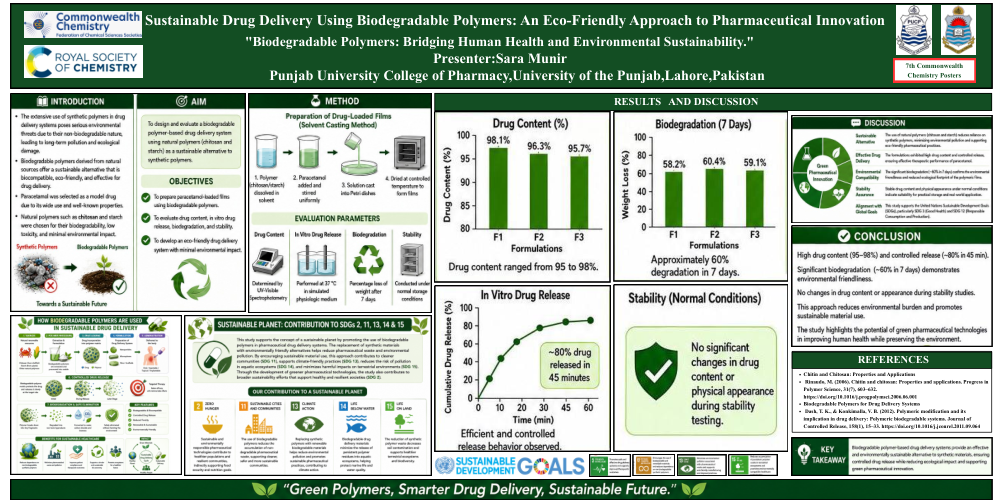
The extensive use of synthetic polymers in pharmaceutical drug delivery systems poses serious environmental concerns because these materials persist in the environment for long periods. Biodegradable polymers derived from natural sources provide a sustainable alternative as they are biocompatible, environmentally friendly, and capable of delivering drugs effectively. In this study, paracetamol was selected as a model drug because of its widespread use and well-established safety profile. Natural polymers such as chitosan and starch were chosen due to their biodegradability, low toxicity, and minimal environmental impact.The aim of this study was to design and evaluate a biodegradable polymer-based drug delivery system using natural polymers as a sustainable alternative to conventional synthetic polymers. The main objectives were to prepare paracetamol-loaded films using biodegradable polymers, evaluate drug content and in vitro drug release, assess biodegradation behavior, study formulation stability, and develop an environmentally friendly drug delivery system with reduced ecological impact.The drug-loaded films were prepared using the solvent casting method. Chitosan and starch were dissolved in a suitable solvent, paracetamol was added and mixed uniformly, and the solution was poured into Petri dishes. After drying under controlled conditions, drug-loaded biodegradable films were obtained. The prepared formulations were evaluated for drug content, in vitro drug release, biodegradation, and stability.The mechanism of drug delivery using biodegradable polymers involves encapsulating the drug within a biodegradable polymer matrix. After administration, the polymer absorbs water and gradually swells, allowing controlled diffusion of the drug. Simultaneously, the polymer undergoes biodegradation through hydrolysis or enzymatic action, resulting in sustained drug release over time. Eventually, the polymer breaks down into non-toxic by-products that are safely eliminated from the body. This controlled release mechanism improves therapeutic efficacy, reduces dosing frequency, enhances patient compliance, minimizes side effects, and provides an environmentally sustainable alternative to conventional drug delivery systems.The formulations showed excellent drug loading efficiency. F1 contained 98.1% drug content, F2 contained 96.3%, and F3 contained 95.7%, indicating uniform drug distribution. In the biodegradation study conducted over seven days, F1 showed 58.2% degradation, F2 showed 60.4%, and F3 showed 59.1% degradation, demonstrating the environmentally friendly nature of the formulations. The in vitro drug release study revealed controlled release behavior, with approximately 80% of the drug released within 45 minutes. Stability studies showed no significant changes in drug content or physical appearance during storage, confirming formulation stability.Biodegradable polymer-based drug delivery systems contribute directly to sustainable development by reducing pharmaceutical waste and environmental pollution. Such systems support Sustainable Development Goals including SDG 2 (Zero Hunger), SDG 11 (Sustainable Cities and Communities), SDG 13 (Climate Action), SDG 14 (Life Below Water), and SDG 15 (Life on Land).In conclusion, the prepared biodegradable films exhibited high drug content, controlled drug release, significant biodegradation, and good stability. These findings indicate that biodegradable polymers represent a promising green alternative for sustainable pharmaceutical innovation and future drug delivery applications.